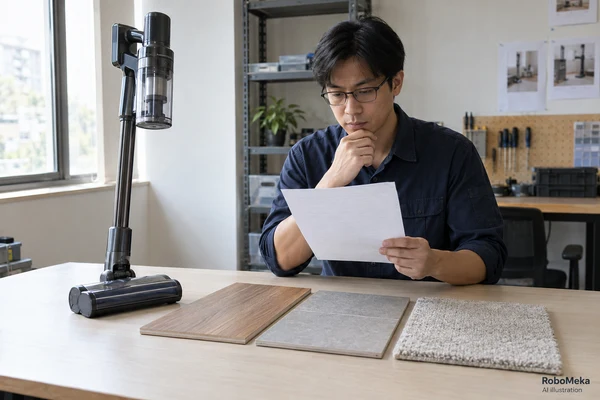
The short answer
Choose a wet-dry floor washer for its documented hard-floor washing tasks and a stick vacuum for its supported dry-cleaning tasks and attachments. Compare preparation, cleaning, disposal, maintenance and storage as one routine. The categories can complement each other; neither automatically replaces the other across every household surface.
Introduction
A customer who wants to remove crumbs from a rug and a customer who wants to wash sticky kitchen marks are buying different outcomes. A wet-dry floor washer and a cordless stick vacuum can sit next to each other in a catalogue, yet neither should automatically be described as a substitute for the other. Start with the supported surfaces and tasks, then compare the complete cleaning routine.
For an importer, the question is not simply which category has more features. It is which product customers will understand, use correctly and maintain after the first demonstration. A machine can produce an attractive sample-room result but still be the wrong assortment choice when its water handling, storage needs or cleaning restrictions do not match the intended household.
This guide develops a proposed category-selection worksheet. The examples are purchasing scenarios, not documented RoboMeka customer projects or completed factory testing. No competitor specification below establishes the performance or availability of a RoboMeka configuration.
What is the practical difference between these categories?
A conventional dry stick vacuum collects supported dry debris through a suction path and usually offers a floor head plus selected attachments. A dedicated floor washer applies liquid to an approved hard surface, agitates or wipes soil, and recovers wastewater through its particular mechanism. Some combined appliances perform both roles, but their individual modes and accessories still need separate verification.
Do not classify solely from the phrase “wet and dry.” It may describe simultaneous pickup of permitted wet and dry household mess on a hard floor, a detachable wet-cleaning accessory, or another architecture. It does not automatically mean carpet extraction, unrestricted liquid pickup or suitability for building dust. Ask the supplier to identify the intended function in ordinary language.
Dyson's WashG1 introduction describes a dedicated hard-floor cleaner with separate handling of liquid and solid debris. Tineco's iFloor product explanation describes a dual-tank floor-washing arrangement. These are examples of different implementation choices, not a universal specification or an endorsement of either product.
Which tasks must remain outside the promise?
Put exclusions beside the included tasks. A dry-only vacuum must not be presented as a spill cleaner. A hard-floor washer should not be sold as a rug cleaner unless the exact configuration supports that use. Neither a water tank nor a high power rating establishes suitability for hazardous materials, commercial sanitation or industrial cleanup.
This scope statement helps the purchasing team as much as the customer. It prevents a salesperson from demonstrating one mode while a packaging designer illustrates a different application. The approved sample, carton, instruction leaflet and online listing should all describe the same product.
Start with a household task map
List rooms, surfaces and recurring messes rather than asking customers only for total home area. A tiled kitchen, carpeted bedroom and upholstered staircase produce three different access and cleaning problems. The number of tasks a device cannot perform may explain a return more clearly than its advertised capacity.
For each task, record whether water is permitted, whether the surface has vulnerable joints, whether an attachment is needed and whether the user must carry the device. Floor manufacturer care instructions remain important even when a cleaner's listing uses broad terms such as wood or laminate. A material name alone is not approval for a particular liquid routine.
| Customer task | Question for a dry stick vacuum | Question for a floor washer |
|---|---|---|
| Loose crumbs on a kitchen floor | Does the selected head collect the permitted debris? | Is mixed debris permitted without a separate preparation step? |
| Dried marks on sealed flooring | Is another cleaning method required afterward? | What liquid, passes and final drying checks are specified? |
| A small area rug | Which head and setting are approved? | Is this surface explicitly supported or excluded? |
| Upholstery and stairs | Are suitable attachments included and manageable? | Can the appliance serve this task at all? |
| Daily quick pickup | How fast can the user start and empty it? | Does setup and post-use care fit a short task? |
Use the table to define the shortlist, not to assign predetermined winners. A household dominated by hard flooring may still need an attachment-based vacuum for furniture. A household with extensive carpeting may still value a separate washer for a permitted kitchen surface.
Compare the full session, not one cleaning pass
Time the sequence from storage through setup, cleaning, emptying and return to storage. Keep active user time separate from unattended machine time. A self-clean cycle may run without hands-on attention while still delaying when the roller can be stored or when the machine is ready for another user.
Use the same task boundary for each sample. If one evaluation includes filling, tank rinsing and roller care while another records only motor-on time, the comparison is not meaningful. Conversely, do not charge the stick vacuum with time spent mopping unless the purchasing question actually concerns completion of a combined vacuum-and-wash routine.
Record interruptions individually: changing an attachment, moving a chair, refilling water, emptying wastewater, clearing an allowed obstruction and recharging. These observations reveal what the customer must do. A single total duration hides the difference between a convenient short pause and a difficult maintenance operation.
A hypothetical assortment decision
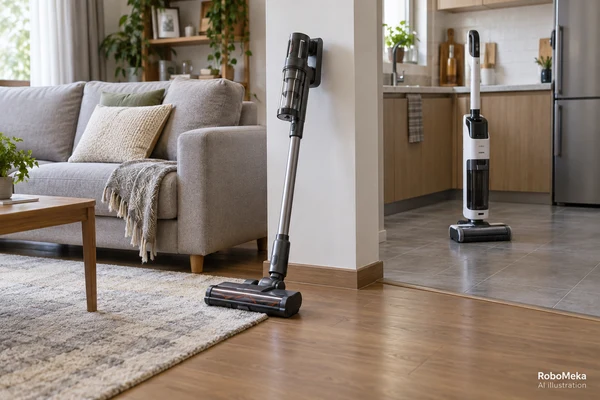
Consider a retailer serving apartments with tiled kitchens and rugs in the living area. A floor washer might handle the kitchen task while leaving the rug and sofa to another device. A stick vacuum may handle the dry tasks while leaving sticky marks to an approved separate washing method.
The retailer could stock both categories, choose one as its entry range, or investigate a supported combination system. None is automatically correct. The decision depends on the buyer's intended price position, customer expectations and service capability. This scenario illustrates a worksheet; it is not sales data or evidence that one bundle will outperform another commercially.
What should sample evaluation measure?
Begin with safe, permitted household soils on representative test surfaces. Agree the amount, distribution and preparation method before comparing samples. Do not introduce flour clouds, hazardous dust, sharp fragments or large liquid spills merely to create a dramatic demonstration. A controlled modest task is more useful than a visually impressive misuse test.
For dry pickup, record remaining visible debris, scattering, repeated passes and access around furniture. For wet washing, record visible soil removal, streaking after drying, liquid left near edges and the effort needed to service the recovery system. Keep the conditions and observation method consistent between configurations.
A finished floor should be assessed after the specified drying period as well as immediately after the pass. Lighting can conceal or exaggerate residue. Use a repeatable viewing direction and retain images of the test area before and after, with the sample identity and settings recorded separately.
The existing vacuum floor and use-case guide can help define the surface brief. For the new category comparison, add water preparation and wastewater disposal rather than repeating a suction-only test.
Decide acceptance criteria before the demonstration
Write observable requirements such as reaching the permitted kitchen edge without an extra hand tool, completing the agreed dry route with the included head, or allowing the intended user to remove the wastewater tank without spilling. Numerical thresholds should come from the actual project brief or a suitable method, not from an invented industry benchmark.
Keep “not tested” distinct from “passed.” If a sample arrives without its approved washing liquid or missing an attachment, record the evaluation gap and request the correct configuration. Substituting an improvised component may answer a different question and can introduce safety or compatibility problems.
Send Your Requirements with the floor mix, priority messes, included tasks and expected maintenance routine. These details make a category discussion more useful than asking for the strongest or most advanced cleaner.
Maintenance changes the ownership proposition
A bagless dry vacuum needs an appropriate emptying and filter-care routine. A washer adds clean-water preparation, wastewater handling and care of wet components. The exact sequence differs by model, and an automated cycle should not be assumed to replace every manual step.
Observe whether components are easy to identify and return correctly. Similar-looking clean and dirty tanks, hidden latches or unclear fill marks can make an otherwise capable product frustrating. Ask a new evaluator to follow the supplied instructions without coaching; record where the instructions, labels or component design cause hesitation.
Check the location where care will happen. A large tank may not fit easily under a household tap. A roller may require a ventilated drying space that the customer does not have. A dock may fit on the floor but leave insufficient room to lift a tank or open a cover.
Consumables should be priced as a system
Ask for replacement roller, filter, seal, dust bag and approved cleaning-liquid identities where applicable. Clarify which items are routine consumables and which are service parts. Avoid implying that a washable part lasts indefinitely or that every third-party liquid is acceptable.
Build a simple ownership worksheet using the supplier's documented service guidance and your expected local selling arrangements. Mark replacement frequencies as assumptions until supported. The point is to reveal dependency on a particular consumable, not to manufacture a precise lifetime cost from uncertain inputs.
How should importers structure the product range?
Separate the customer-facing category promise from the factory's internal platform names. A shared motor supplier or similar casing does not make two devices interchangeable. Catalogue filters should let customers identify dry cleaning, supported wet washing, attachments and maintenance requirements without decoding ambiguous product labels.
Start with a limited set of clearly differentiated configurations. One dry stick bundle and one dedicated hard-floor washer may be easier to support than several almost identical packages with unclear exclusions. Add variants only when they solve a distinct customer task or channel requirement.
Review the cordless stick vacuum family and wet and dry floor cleaner family as discussion starting points. These family pages do not replace a model-specific offer. Confirm the actual configuration, evidence and availability before preparing purchase orders or retailer commitments.
What belongs in the quotation comparison?
Require exact appliance, head, tank, battery, charger, dock and accessory identities. List included consumables, regional documents, packaging languages and spare-part support separately. A cheaper headline price may simply omit the part needed for the buyer's intended demonstration or customer routine.
State which changes are cosmetic and which alter performance or care. A new roller material, tank seal or control mode can affect the accepted cleaning result. Such changes need review even if the outside of the product and retail model name remain unchanged.
Factory testing and shipment inspection serve different purposes
Application evaluation establishes whether a selected configuration fits the intended customer task. Factory testing checks agreed functions during production. Shipment inspection verifies the released lot against its documented requirements. These activities should support one another, but a successful demonstration does not replace production controls.
For a washer, the control plan might cover tank seating, accessible seals, liquid-path checks and correct accessory inclusion using a supplier-approved procedure. For a dry vacuum, the relevant checks may include head operation, dustbin closure and the offered attachment bundle. Request actual test records rather than assuming a particular factory performs all of these checks.
At shipment inspection, verify that cartons and manuals do not broaden the approved application. Photographs showing a hard-floor-only washer on a rug can create a misleading promise even when the text is technically correct. Keep artwork approval connected to engineering and service review.
What information should a sales page make easy to find?
Answer the customer's first practical questions near the product description: which surfaces, which messes, which attachments, what remains manual and where the machine can be stored. A comparison page should admit when the categories are complementary rather than forcing an artificial winner.
Include a visible maintenance summary and a link to the correct instructions. Explain whether the supplied package includes the consumables shown in imagery. Label illustrative scenes so they are not mistaken for evidence of a verified model or cleaning result.
Avoid promises such as “replaces every cleaner” or “no maintenance.” They remove useful distinctions and create expectations that a normal sample trial cannot substantiate. A precise description of supported everyday tasks is a stronger purchasing foundation.
Prepare the retailer handover
Give the retailer a short task-based demonstration script with the approved surfaces, modes and exclusions. Include the post-use routine rather than ending the presentation at the clean floor. A salesperson who can show where the wastewater goes or how the dustbin closes is better equipped to explain ownership than one repeating a power specification.
Retain the configuration used in training and update the script when the bundle changes. If a later shipment omits a tool used in the demonstration, the customer promise has changed even if the main appliance is identical. The handover record should identify the version supplied to each channel.
Frequently asked questions
Can a wet-dry floor washer replace a stick vacuum?
Only when all intended tasks fall within the washer's documented scope. Dedicated hard-floor machines may not address rugs, upholstery, elevated surfaces or crevices. Map those tasks before deciding. A combined appliance also needs verification of each mode and included accessory; the category name alone is not enough.
Is a stick vacuum suitable for spilled water?
Do not use a dry-only vacuum for liquid pickup. Confirm explicit permission in the exact model's instructions before any wet task. A detachable washing head or another supported arrangement does not automatically make the appliance's ordinary suction path suitable for liquids.
Does a self-cleaning washer require no care afterward?
Usually there are remaining responsibilities such as handling wastewater and caring for accessible wet components according to the manual. Verify the exact sequence on the sample. Describe which steps are automated and which remain with the user instead of reducing the whole routine to a self-cleaning label.
Which category should a new distributor launch first?
Choose the category with the clearest customer task and a support routine your team can explain and supply. Review local floor mix, accessories, consumables and returns handling. There is no universal first choice; a small, well-defined range is easier to validate than an assortment built around overlapping claims.
Conclusion
Stock wet-dry floor washers and stick vacuums according to the jobs customers need to complete, not according to an assumed hierarchy of features. Compare preparation, supported cleaning, disposal, maintenance and storage as one routine. Record exclusions as carefully as benefits, then release only the configuration that was actually evaluated.
Ask for Product Catalog with your destination market, preferred category mix and sample-evaluation brief. Email the prepared requirements to info@RoboMeka.com to discuss available scope, documentation and next steps without assuming unconfirmed specifications.