
The short answer
Choose a replacement vacuum battery through a controlled appliance-pack-charger compatibility record. Match part identifiers, revisions, approved replacement procedures and supporting evidence. Voltage, connector appearance and a brief power-on demonstration are not enough to establish compatibility or authorize an improvised substitution.
Introduction
Two vacuum batteries can have the same advertised voltage and a similar connector while belonging to different approved systems. A replacement decision must identify the appliance, battery, charger and relevant revisions together. Physical fit is only one part of compatibility, and an improvised adapter is not an acceptable substitute for documented approval.
For a private-label importer, battery support is also an identity-management problem. The retail model name may remain unchanged while an internal pack, charging arrangement or service procedure changes. Without a controlled compatibility record, a warehouse can ship a plausible-looking part that does not match the customer's actual machine.
This guide explains a proposed purchasing and service-control process. It does not certify a battery, establish compatibility between brands or provide instructions for opening packs. Electrical validation, damaged-battery handling and transport decisions belong with qualified parties using the applicable product documentation and requirements.
Define compatibility at the system level
An approved replacement must match the requirements of the complete appliance system. Relevant considerations can include electrical characteristics, mechanical retention, connector arrangement, temperature sensing, protective functions, communication and charging behaviour. Which of these applies depends on the actual design; buyers should request the supplier's controlled assessment rather than assuming a universal architecture.
Do not treat a matching nominal voltage as a complete answer. The label is not a full description of the charge profile or protective arrangement. Likewise, a pack that powers a motor briefly has not thereby demonstrated acceptable charging, sustained use or fault behaviour.
Dyson's V11 replacement selection page distinguishes battery attachment variants within a familiar product family. It is a useful example of why a family name alone is insufficient. It does not imply that the same variants or parts exist in a RoboMeka product.
What does “approved” need to mean?
Ask who approved the combination, which technical documents identify it and which regional configuration those documents cover. A supplier's informal statement that a pack is “the same” leaves too much unspecified. The record should allow a service employee to select a part without making an engineering judgment.
Keep the approved combination separate from commercially available alternatives. A battery listed by an online seller may physically resemble the original, but the buyer still needs relevant validation and authorization for the intended appliance. Do not encourage end users to experiment with unverified combinations.
Build a compatibility matrix before launch
Create one row for each supported appliance revision and replacement pathway. Include the retail SKU, manufacturer model identity, serial or production range, battery part number and revision, charger identity, permitted replacement role and supporting document reference.
Use explicit statuses: approved, superseded with an approved replacement, awaiting review, or not compatible. An empty cell must not be interpreted as permission. The matrix should be maintained by an accountable owner and available to the people who quote, pick and dispatch service parts.
| Record field | Why it belongs in the matrix | Example of an unresolved question |
|---|---|---|
| Appliance identity | Distinguishes similar retail variants | Does the serial range cross a design change? |
| Pack identity | Connects the physical part to approval | Is the new label a cosmetic or technical revision? |
| Charger identity | Defines the approved charging combination | Does a changed adapter require a new review? |
| Replacement method | Separates user and service-centre work | Is opening the appliance required? |
| Evidence reference | Makes approval traceable | Which document covers this exact combination? |
| Effective date | Controls old and new inventory | When may the substitute part begin shipping? |
Avoid relying on colour as the main identifier. A casing colour may change for branding without changing the technical part, while a technical revision may retain the same appearance. Use readable part identifiers and controlled records, with photographs as supporting information.
Mechanical fit is necessary but not sufficient
Inspect the approved sample for secure seating, understandable release and clear orientation. The intended user should not need force or an improvised tool to install a user-replaceable pack. Follow the manual and stop if a part does not engage as expected.
Record the pack and appliance identities before the inspection. Otherwise a successful fit demonstration can become detached from the exact components that were examined. Do not use the appearance of the latch to generalize compatibility across other models in the range.
Dyson's click-in battery page explicitly explains how its listed attachment type differs from another V11 arrangement. The purchasing lesson is to make identification understandable to the customer while preserving model-specific limits. It is not a cross-brand substitution guide.
Keep tools and adapters outside ordinary customer support
A customer-facing service process should not suggest cutting housings, changing connectors or using adapters to make an unapproved pack fit. If the design requires authorized service, say so clearly and arrange the appropriate route. Convenience does not justify bypassing the appliance's intended arrangement.
Similarly, do not ask an untrained person to probe live terminals or open a battery casing to identify a fault. Useful first-line support can collect labels, symptoms and permitted external observations without exposing the user to internal components.
Treat the charger as part of the replacement decision
Record the actual charger model and regional supply arrangement, not merely the plug shape. A product can have different market versions or a changed charging interface. Ask whether the replacement pack uses the existing approved charger or requires a documented kit.
Dyson's charger selection resource directs owners to model-specific choices. For your own range, provide an equally clear identification route, based on the released configuration rather than copied competitor part names.
A warehouse should not solve a charging complaint by sending whichever adapter fits the socket. Route uncertain cases to technical review. If an approved combined replacement kit is required, its contents and customer instructions should travel together.
What evidence should procurement request?
Request configuration identification, relevant evaluation records, instructions, quality controls and change-notification arrangements from the supplier. Have qualified reviewers determine which safety, transport and market documents are needed for the actual battery and finished appliance. A generic certificate or report for a different pack should remain an unresolved gap.
Check that document identifiers match the offered production part. Differences in manufacturer name, model suffix, rated information or revision deserve explanation. The buyer does not need to perform every engineering assessment internally, but must know who is responsible and what has actually been reviewed.
Separate application evidence from safety evidence. A runtime trial may help assess the intended cleaning task, yet it cannot replace appropriate electrical or battery-safety evaluation. Likewise, a documentation package does not show whether the delivered retail accessory bundle is correct.
The existing cordless battery and runtime procurement guide addresses the broader energy-system decision. Use this article to add the replacement identity and service controls needed after the initial order.
Send Your Requirements with the planned appliance variants, destination markets and replacement-service expectations. These details help define a supportable battery programme before a quotation becomes a purchase commitment.
Validate the service journey without unsafe testing
Use approved, intact components and the normal procedures in the manual. Ask the evaluator to identify the appliance, locate the relevant pack label, choose the correct service entry and follow the permitted replacement pathway. Record ambiguities before the product reaches a customer.
Do not deliberately short, overcharge, heat, damage or dismantle packs as a buyer demonstration. Such activities are outside an ordinary procurement trial and require specialized facilities and qualified personnel where appropriate. A purchasing checklist should define evidence needs, not encourage improvised abuse testing.
Verify the customer communication as well as the physical process. Can the owner distinguish a charging issue from a request for a replacement part? Does support explain when operation should stop? Can the service team identify whether the issue requires the whole appliance, a charger or another component?
A hypothetical revision problem
Imagine that an importer stocks Appliance A with Pack P1 and later receives an approved production revision using Pack P2. The external retail name is unchanged. A customer sends only the retail name, and a service agent selects P2 because it is the newest item in the warehouse.
The correct response is not to assume backward compatibility. The agent checks the appliance identifier against the controlled matrix and follows the approved pathway. If the records do not resolve the case, shipment waits for technical confirmation. This is a hypothetical process example, not a report of a RoboMeka incident.
Plan replacement inventory around actual demand evidence
Initial service stock should be agreed with the supplier using the product plan, expected installed base and replenishment constraints. Do not invent a universal failure rate or a fixed spare percentage. Record assumptions so the plan can be revised when actual service information becomes available.
Separate new service stock from returns, uncertain items and parts awaiting assessment. Maintain traceability through receiving, storage and dispatch. Storage and charging practices must follow the product documentation and applicable handling procedures rather than a generic internet rule.
Clarify who monitors stock condition, age and suitability for dispatch. A part remaining in a warehouse for a long time should not automatically be shipped just because its packaging is unopened. Establish the relevant review process with qualified personnel and the supplier.
Avoid orphaned installed products
Ask what happens when a pack is discontinued. Will there be an approved successor, a complete conversion kit handled by authorized service, a final-buy opportunity or another documented support path? Record the limits of any commitment rather than advertising indefinite availability.
The spare-parts planning guide can help connect component support to the wider product range. Battery replacements deserve explicit ownership because their identity, shipping and handling requirements may differ from a simple brush or plastic cover.
Control engineering changes and substitutions
Agree which changes require notification and reapproval. Potentially relevant changes can include cells, protection electronics, mechanical housing, connector components, charger design and identification labels. The supplier should explain the significance of a proposed change instead of describing every revision as an equivalent replacement.
Maintain a revision log that connects the date, affected production range, supporting assessment and updated instructions. Retain the previous record for products already sold. Replacing a document with the latest version without preserving earlier applicability can make future service decisions harder.
Do not permit purchasing urgency to become technical approval. A substitute offered to avoid a shipment delay still needs the relevant assessment. If it is not ready, distinguish the commercial scheduling decision from the unresolved compatibility question.
Include identity checks in shipment inspection
For the agreed inspection scope, verify that appliance, pack, charger, carton and manual identities correspond to the approved bundle. Sample the relevant variants rather than checking only the most common colour. A technically correct part in a mislabeled package can still lead to an incorrect customer replacement.
Check service cartons separately from complete appliances when they are part of the order. Confirm part numbers, revision labels, quantities and intended destination. Require appropriate transport review from the responsible specialists; this guide does not classify individual shipments or replace current carrier requirements.
The pre-shipment inspection guide explains how to connect a release decision to evidence. For batteries, make sure any discrepancy is escalated to someone qualified to decide whether it affects compatibility, documentation or handling.
Write replacement promises carefully
“Removable battery” is not the same as “interchangeable with every product in the range.” “Replacement available” also needs a defined model scope and service route. Describe the approved system and how customers can identify the correct part.
Do not promise improved suction or longer life simply because an alternative pack has a higher advertised capacity. Performance and compatibility must be assessed for the exact system. A parts page should help prevent an incorrect purchase, not encourage speculative upgrades.
For discussion of an offered platform, begin with the cordless stick vacuum family and request model-specific confirmation. The family description is not a compatibility matrix and should not be treated as approval for unlisted packs or chargers.
Rehearse a warehouse pick before launch
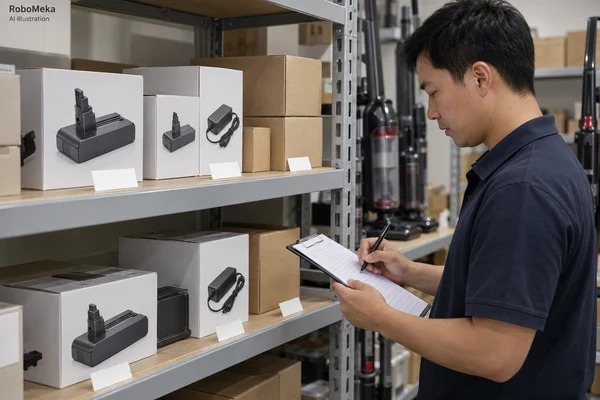
Give a service employee a sample customer identification record and ask them to select the corresponding packaged replacement using the approved matrix. Do not tell them which shelf contains the right item. The exercise tests whether the identification system works outside the engineering team.
Record where the employee needs clarification, especially when two cartons share a retail family name or when a revised part supersedes an older code. Improve labels and lookup instructions before dispatch begins. The correct technical decision is not enough if the warehouse cannot execute it reliably.
Include a stop condition for missing or contradictory information. A short escalation delay is preferable to sending a part on an unsupported assumption. Preserve the resolved case as a training example without retaining unnecessary customer information.
Frequently asked questions
Is matching voltage enough to choose a vacuum battery?
No. Compatibility depends on the complete approved appliance, pack and charger arrangement, including relevant mechanical and electrical requirements. A label value alone does not establish that arrangement. Use the exact part identifiers and documented approval, and escalate uncertain combinations rather than trying them.
Can a battery that clicks into place be treated as compatible?
Physical retention is only one check. It does not validate charging, protection or other system requirements. Do not infer approval from a brief power-on demonstration. The replacement should be listed for the appliance revision and supplied through the appropriate documented service process.
Should a buyer offer a universal replacement charger?
Only if the responsible technical assessment explicitly supports the defined models and configurations. A shared plug shape or connector is insufficient. Clear model-specific selection is preferable to a broad universal claim that the service team cannot substantiate.
What should happen when the customer cannot identify the model?
Ask for safe external identification such as the model label, serial information and permitted photographs, while avoiding unnecessary personal data. If those records do not resolve the configuration, refer the case to authorized support. Do not send an uncertain replacement simply to complete the ticket quickly.
Conclusion
Replacement-battery support works when product identity, technical approval and warehouse execution remain connected. Build the compatibility matrix before launch, maintain it through revisions and give service staff a clear escalation route. A controlled replacement process is more valuable than an unsupported promise of universal interchangeability.
Contact Us with your product variants and service-market requirements. Email the brief to info@RoboMeka.com to discuss approved configuration records, parts identification and the support scope for a proposed project.