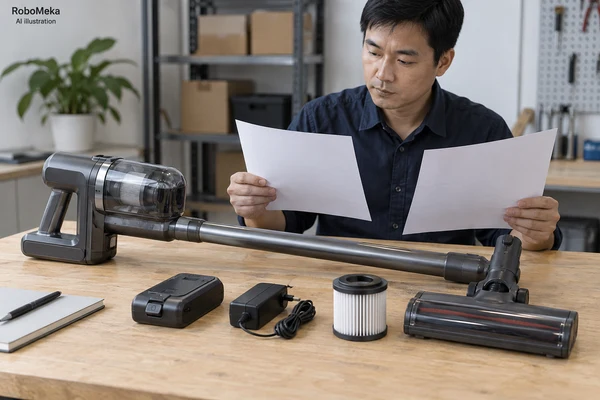
The short answer
Compare vacuum prices only after aligning the complete configuration and quotation conditions. Identify assembly, battery, accessory, packaging and evidence differences; separate recurring unit charges from development and tooling; and check the assumptions behind quantity breaks. Negotiate approved changes against customer requirements while preserving configuration identity and substitution control.
Introduction
A vacuum cleaner unit price is meaningful only when the buyer can identify what that price includes. Two quotations may show similar product photographs while using different motors, batteries, filters, floor heads, accessory bundles, packaging, or production assumptions. Comparing the headline numbers before reconciling those differences can reward an incomplete proposal instead of a more suitable product.
For importers and private-label brands, the useful starting point is the quoted configuration. Define the required customer outcome, identify the assemblies that support it, and ask suppliers to price the same scope. Then review which changes actually reduce recurring cost, which move cost into development or tooling, and which remove something important from the product.
This guide focuses on the factors behind vacuum unit quotations and the decisions that make them comparable. It does not provide market price benchmarks, assumed component percentages, or a landed-cost calculator. The examples are hypothetical procurement exercises. Any price, order quantity, development charge, or available specification must be confirmed for the actual supplier proposal.
Establish a common specification before comparing prices
Create a reference configuration that names the appliance category, main assemblies, approved attachments, operating modes, and retail contents. For a cordless model, identify the battery and charger as well as the vacuum body. For a corded appliance, identify the electrical configuration proposed for the destination. Include the relevant test evidence and package requirements in the commercial scope.
Ask each supplier to mark differences from that reference. A quotation should distinguish an exact match, an alternative needing approval, and an excluded item. This is more useful than asking every bidder to confirm a vague phrase such as high performance. It also gives a supplier room to propose a sensible alternative without disguising it as the original specification.
The cordless stick vacuum range can help define the category under discussion, while the wet and dry vacuum range represents a different product application. Do not force unlike appliance types into a single price ranking. Their component systems, intended use, maintenance requirements, and acceptance work can differ substantially.
Keep quotation conditions visible beside the specification. Record the currency, validity, order quantity, quantity per variant, packaging basis, and named delivery basis. This article concentrates on product pricing, but even that comparison becomes unclear if one figure describes a bulk configuration and another includes a finished retail package or a different commercial handoff.
Understand the main assembly cost drivers
Ask how the proposed motor, airflow system, and floor head support the intended performance. A motor label alone does not describe the complete cleaning result. Changes in the fan, controller, airflow path, seals, or head can alter both cost and behavior. Request the actual assembly identity and evidence behind the product claim rather than assuming a larger power number deserves a higher price.
Motor control is also a system choice. Texas Instruments describes brushless motor drivers as components with different control and sensing capabilities across applications. That primary source helps explain why a controller is more than an interchangeable label; it does not reveal the bill of materials or cost of any proposed vacuum. See TI's brushless DC motor driver overview.
For cordless products, compare the complete battery pack and charging arrangement. Cell selection, pack construction, protection, connector design, and replacement architecture can affect the proposal. Ask suppliers to identify their offered configuration and any alternatives. A battery described only by a headline capacity makes it difficult to determine whether the quotations refer to the same electrical and mechanical product.
Filters and sealing components deserve their own scope. Clarify the filter assembly, replacement elements, fit, and evidence required for any filtration claim. A less expensive media component does not automatically provide the same whole-product behavior. The sealed-system vacuum filtration guide explains why procurement should distinguish the material claim from the performance of the assembled appliance.
Price the floor head and accessories explicitly
The floor head can change the value proposition more than a visible change to the vacuum body. Identify whether the quoted head is powered, its intended surfaces, the brush arrangement, and the user-maintenance method. Ask what happens to the quote if the head changes and which performance statements would need renewed review. Treat the complete combination as the item being purchased.
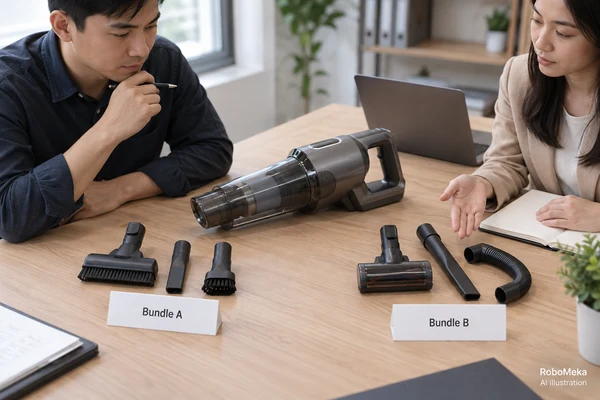
Compare tool bundles by exact contents. A supplier may quote a basic nozzle while another includes a powered handheld attachment, a storage support, and replacement consumables. Count is not enough: tools need identifiable roles and compatibility. A package with more pieces can still be a poor match if customers cannot use or store them conveniently.
Request separate pricing for genuinely optional accessories where the supplier can provide it. This helps a buyer construct a base model and a premium bundle without asking the factory to redesign the entire appliance. Confirm whether separate accessory pricing assumes inclusion in the same production order, individual retail packaging, or supply as spare parts; these are different commercial scopes.
Avoid removing a component solely because it lacks an obvious marketing benefit. Seals, retention features, or protective parts may support the intended function. Ask the technical team to assess a proposed deletion and identify the evidence needed to accept it. Cost reduction should be a reviewed configuration change with a clear consequence, not a hidden substitution discovered after delivery.
Separate recurring price from engineering and tooling
Recurring unit price covers what is charged for each production unit under the agreed conditions. Development, tooling, artwork setup, samples, and special evaluation may be charged separately or recovered through the unit price. Ask the supplier which approach the quotation uses. Without that distinction, a low first-order unit figure can conceal a substantial one-time commitment.
If a supplier includes tooling recovery in unit price, ask what quantity basis was used and whether the price changes after that recovery. If the buyer pays tooling separately, define the deliverables, ownership or use rights, maintenance responsibility, and change conditions. These matters require project-specific terms; a buyer should not infer ownership merely because a line on the quotation says mold fee.
Customization also creates smaller setup costs that deserve visibility. Special colors, printed packaging, labels, and manual layouts may have different minimum batches or preparation requirements. Request the cost effect of each approved change and identify whether unused custom materials remain with the supplier, transfer to the buyer, or need a separate agreement if plans change.
The OEM and ODM customization overview provides context for discussing these options. Keep the price review tied to the precise change requested. A new brand mark on an established surface and a modified housing with new tooling are not the same development scope, even if both are described as private-label customization in a sales conversation.
Examine the assumptions behind volume discounts
A quantity break should state what quantity it measures. It may refer to the full order, units of one model, units of one color, or a shared component commitment. Ask whether quantities can be combined across variants and why. A headline volume discount is not useful if the buyer's realistic mix does not satisfy its underlying production or purchasing conditions.
Understand the difference between an order commitment and a forecast. A supplier may base component pricing on a firm purchase while the buyer assumes the same terms apply to an estimated annual demand. Put that distinction into the quotation record. Neither party should discover later that the offered price depends on a commitment the other party never intended to make.
Request quantity alternatives that reflect plausible demand. A first-order configuration with fewer variants may create a different commercial result from a larger assortment with small runs of each color. The purpose is to identify a viable launch structure, not to chase the lowest theoretical unit price by committing to inventory that the business has no plan to sell.
When a volume proposal looks attractive, send a comparable vacuum quotation brief with the intended specification, realistic order mix, optional accessories, and development scope. A clear baseline allows RoboMeka to discuss relevant configurations and quotation conditions. It also makes supplier alternatives easier to assess because their technical and commercial differences can be stated explicitly.
Use a configuration comparison table
The following table is a recommended structure for comparing proposals. Replace the sample categories with the actual assemblies and commercial conditions in your project. Every unresolved difference should remain visible until the buyer either accepts it as an alternative or asks the supplier to quote the original requirement again.
| Comparison area | Information to align | Typical reason a lower figure needs clarification |
|---|---|---|
| Main appliance | Model, motor system, modes, complete assembly | Different underlying platform or omitted function |
| Battery and charger | Identified pack and charging configuration | Different pack, charger, or included quantity |
| Floor head and tools | Exact parts and bundle contents | Basic attachment compared with a richer bundle |
| Filtration | Assembly identity and evidence scope | Media description substituted for whole-product evidence |
| Branding and packaging | Materials, artwork, inserts, retail contents | Bulk pack compared with finished retail configuration |
| Engineering charges | Included and separate one-time work | Recovery shifted between setup fees and unit price |
| Quantity basis | Model and variant commitments | Discount assumes a different mix or larger commitment |
| Quality scope | Approved checks, records, and release requirements | Inspection or evidence work outside quoted scope |
Use the comparison to ask focused questions. If one bidder offers a different battery, ask for the technical distinction and the price of the reference battery if available. If another excludes the retail insert, request the completed package price. Avoid adding guessed allowances merely to force every proposal into a ranking before the supplier has clarified the scope.
Once aligned, preserve the quotation revision. A spreadsheet that changes quantities or accessories without updating the supplier's price reference can quickly become misleading. Record which configuration each accepted figure buys, when the quote expires, and what would require repricing. That makes the negotiated result traceable when the purchase order is prepared.
Keep performance evidence in the price discussion
A price comparison should retain the evidence required for the intended claims. IEC 62885-2:2026 covers mains and cordless household dry-vacuum performance, with limited handheld coverage and separate treatment of robots. Confirm the relevant method with the test provider. Its existence does not establish that a quoted product was tested. Ask which report, configuration, and method support the claim being compared and who supplies any missing evaluation.
If a supplier proposes a lower-cost alternative, identify which accepted characteristics may change. A different head or filter might require renewed application review; a new control mode may affect how runtime is described. The technical team should set proportionate checks. A lower quote is useful when the revised configuration still meets the buyer's essential requirements with adequate evidence.
Separate engineering validation from routine factory testing and shipment inspection. Validation examines whether the design meets agreed requirements. Production checks and inspection help verify the order against its approved definition. The quotation should make responsibilities and included work clear without assuming that every unit receives every engineering test or that final inspection replaces design approval.
The manufacturing overview can support a discussion of how these activities fit the project. Request the actual controls and records proposed for the configuration. General factory descriptions do not establish that a specific evidence package, inspection arrangement, or optional test cost is already included in the unit quotation.
Negotiate changes through their effect on the product
Begin negotiation with a ranked set of requirements. Preserve the features necessary for the customer task, then identify options whose cost is disproportionate to their value in the planned channel. Potential changes might include consolidating colors, simplifying a tool bundle, or using an established package format. Each option should be reviewed for its effect on the complete product and approved claims.
A hypothetical buyer could compare an established stick-vacuum configuration with a proposal that adds a special finish, a display, and several accessories. Instead of asking for an unexplained percentage reduction, the buyer requests separate alternatives for the finish, display, and bundle. This reveals which choices drive the quotation without pretending to know the supplier's confidential component costs.
Review the resulting sample when a price change alters physical content or behavior. An alternative is not equivalent simply because its specification summary uses familiar words. Record accepted differences, update retail claims and packaging where necessary, and obtain a revised quotation referring to the new configuration. This prevents the final order from mixing an old sample approval with a new price scope.
Finally, define substitution control. If the supplier later seeks to change a part for availability or cost reasons, request the proposed identity, technical impact, evaluation needs, and commercial effect before release. The agreed price should buy a controlled configuration. It should not become permission to replace components silently whenever a cheaper alternative appears.
Frequently asked questions
Why do similar-looking vacuum cleaners have different prices?
Similar housings can contain different motors, control systems, batteries, filters, and accessories. Packaging, order mix, engineering recovery, and included quality work can also differ. Compare identified configurations and quotation conditions before interpreting the price gap. A photograph and a headline suction value are not enough to establish equivalent products.
Should buyers demand a full confidential bill of materials?
Buyers need enough detail to understand the configuration, evidence, and quoted alternatives, but a supplier may protect detailed component costing. Request assembly identities, included scope, change costs, and clear explanations of differences. A useful quotation comparison does not require inventing component percentages or treating confidential supplier margins as known facts.
Does a larger order always produce the best unit price?
Quantity can affect pricing, but the relevant basis may be model, color, component commitment, or production batch. Ask which condition creates the quoted break and whether it fits realistic demand. A discount tied to an unsuitable variant mix or an unwanted inventory commitment may not support the buyer's launch plan.
How should a cheaper component substitution be evaluated?
Treat it as a proposed configuration change. Identify the exact replacement, the reason, affected performance and documentation, required checks, and any price adjustment. Approve the revised product before production release where necessary. A lower component price does not by itself establish that the complete vacuum still meets the accepted requirements.
Conclusion
The strongest vacuum price negotiation begins with a comparable product definition. Align assemblies, accessories, packaging, evidence, order mix, and one-time charges before ranking quotations. Then negotiate the changes that fit the customer task and preserve the agreed configuration through sample approval and production. This produces a price that purchasing, engineering, and sales can interpret consistently.
For a focused quotation discussion, prepare your vacuum sourcing price brief with the target product role, required configuration, realistic quantities, branding scope, and optional features. Mark which requirements are essential and which can change. RoboMeka can use that information to discuss available alternatives and the commercial assumptions behind a project-specific quotation.