The short answer
Choose an OEM robot vacuum manufacturer by matching your customer application to a documented configuration, evaluating samples under repeatable conditions, and agreeing production controls and service responsibilities. Do not use factory size or suction pressure as a substitute for model-specific evidence.
Introduction
Choosing an OEM robot vacuum manufacturer is not simply a search for the lowest quotation or the largest suction number. For an importer, distributor, or private-label brand, the product must also match the customer's home, survive everyday maintenance, and remain supportable after delivery. A promising demonstration becomes a viable product only when the configuration, software, documentation, and service responsibilities are clear.
The most useful starting point is a purchasing brief that connects customer requirements with evidence. Instead of asking whether a factory can supply a robot vacuum, ask which configuration it proposes, what that configuration has demonstrated, and how the approved version will be controlled during production. This guide provides a practical evaluation framework, not a report of tests performed by our factory or an endorsement of a particular platform.
Use it when preparing a new product range, replacing a supplier, or deciding whether an existing model can support your brand. Begin with the four product families, then narrow the project to a specific indoor cleaning application.
What should you check before shortlisting an OEM manufacturer?
Define the buyer and the cleaning job
A robot intended for compact apartments should not automatically share the same specification as one positioned for larger homes with pets and mixed flooring. Describe the expected hard floors, rugs, thresholds, furniture clearances, and debris. Explain whether the customer expects daily maintenance cleaning, occasional targeted cleaning, or combined vacuuming and mopping.
Write down who installs the app, maintains the brushes, buys replacement filters, and deals with problems. A retail product needs instructions that work without a trained installer. A distributor-supported product may allow more onboarding, but that support has a cost. These differences should influence the platform selection before packaging artwork is discussed.
Separate mandatory requirements from preferences
Divide the brief into essential, preferred, and unconfirmed items. Essential requirements might include a particular floor application or language. Preferred items could include a color or accessory bundle. Unconfirmed items should become questions for engineering review, not assumptions hidden in a quotation.
Include the target sales market, channel, indicative order quantity, sample deadline, and planned launch window. Treat quantities and timing as planning inputs until the supplier confirms feasibility. There is no universal MOQ or reliable lead time that applies to every OEM robot vacuum project.
How can you verify the manufacturer's role and capability?
Connect the company introduction to the proposed product
Ask which activities the supplier performs directly and which depend on outside partners. Product design, electronics assembly, software development, final assembly, testing, and packaging may involve different organizations. Outsourcing is not automatically a problem; unclear responsibility is.
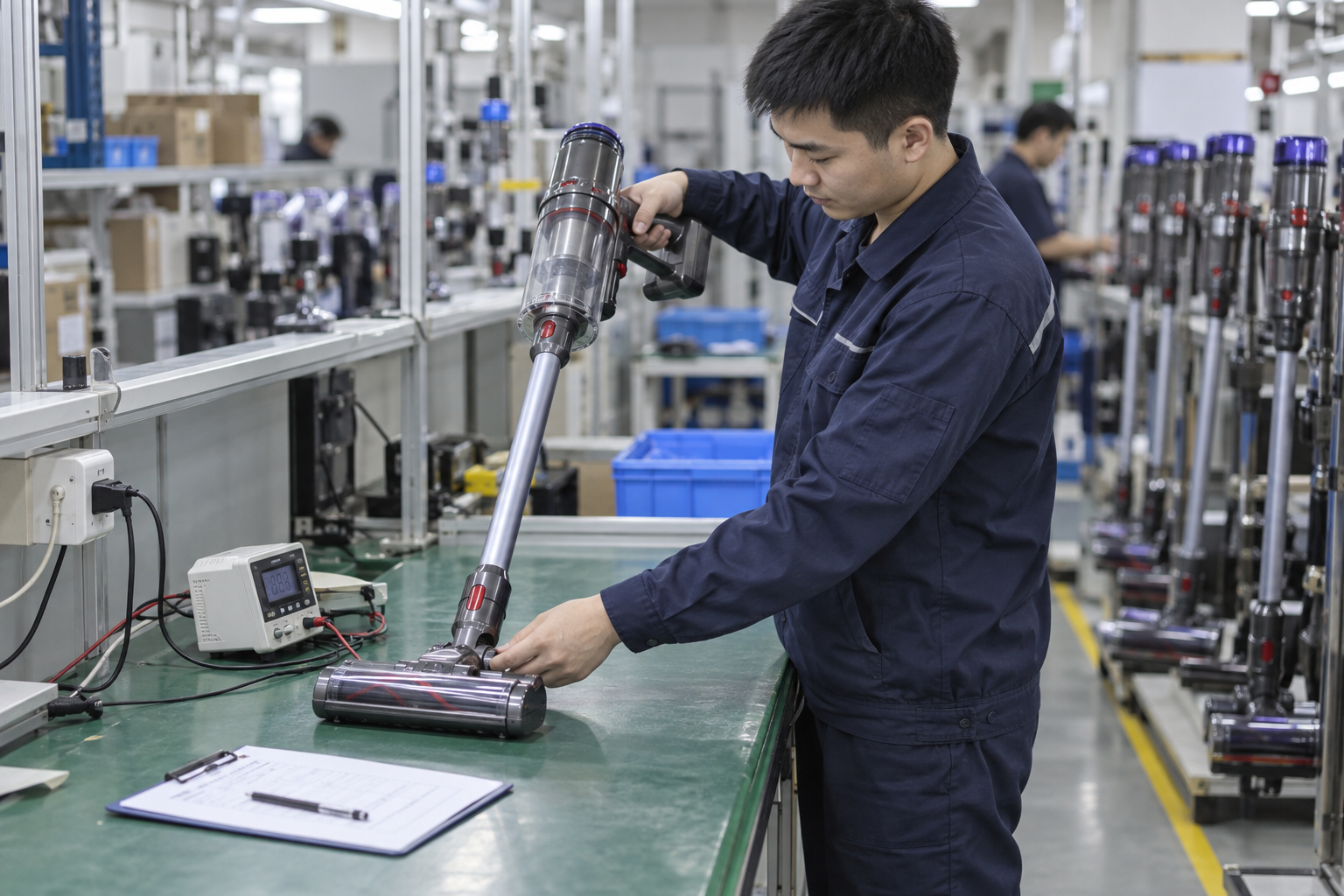
Request an explanation of how the proposed model moves through production and who handles engineering questions. During a factory review, follow the product rather than accepting a general workshop tour as proof of capability. Ask to see relevant work instructions and records where available, with commercially sensitive information appropriately protected.
Our company identifies its location as Shenzhen and its factory area as 8,000 square meters. Those facts provide context, not evidence of a particular production capacity, test result, or certification. Use the manufacturing overview to prepare specific questions about your proposed order.
Ask for a model-specific evidence pack
Build a folder for the exact robot, dock, charger, battery configuration, and firmware proposed. Request specifications, operating instructions, maintenance instructions, and available test documentation. Record which items are supplied, pending, or not applicable, and identify the person responsible for resolving each gap.
A report for a visually similar product should not silently become evidence for a different configuration. If components change, ask what review or further evaluation is necessary. This is a purchasing control process; market-specific compliance decisions require suitably qualified review rather than assumptions based on a logo in a brochure.
Which robot vacuum specifications actually matter?
Suction pressure is not a complete cleaning score
Pressure expressed in pascals describes one aspect of an airflow system, not the complete cleaning result. Brush contact, airflow path, filter condition, debris, floor surface, and movement all affect what reaches the bin. Comparing headline pressure figures without their measurement conditions can therefore produce a misleading shortlist.
Ask where pressure was measured, which mode was used, and whether the test configuration matches the quotation. Then request relevant pickup evaluation. The IEC/ASTM 62885-7 publication page identifies a performance-measurement standard for household dry-cleaning robots. Ask the supplier or laboratory to identify the applicable edition and method; citing the standard does not mean a product was tested to it.
Navigation, obstacle handling, and docking are separate questions
A robot can create a useful room map while still struggling with particular small objects. Ask separately about coverage, localization, obstacle response, room selection, no-go zones, and return-to-dock behavior. Treat broad labels such as smart navigation as invitations to ask for a demonstration, not as acceptance criteria.
Manufacturer documentation illustrates why model identification matters: iRobot's coverage support guidance discusses different navigation systems and configuration-dependent behavior. Do not transfer another manufacturer's capabilities to an OEM platform. Evaluate the proposed robot with its own software and operating instructions.
A dock changes the ownership experience
For an auto-empty or mop-care dock, inspect the complete system. Consider the space needed for placement, access to tanks or bags, cleaning around the tray, replacement consumables, and recovery from a failed docking attempt. A feature-rich dock is useful only if its routine tasks make sense to the intended customer.
Request a maintenance demonstration by someone following the supplied instructions. Record awkward steps, unclear indicators, and parts that are easily installed incorrectly. These observations can reveal support needs that a short cleaning demonstration misses.
How should you compare supplier quotations?
Create a comparison sheet in which every price refers to a named configuration. Keep the assumptions visible rather than placing unresolved items in email threads. The following worksheet is a starting point, not a claim that every supplier offers every option.
| Comparison area | Question for the supplier | Evidence to retain |
|---|---|---|
| Product configuration | Which robot, dock, accessories, and software are included? | Versioned specification and packing list |
| Cleaning application | Which surfaces and debris were evaluated? | Method, observations, and configuration |
| Customization | Which changes are existing options or development work? | Approved scope and responsibility list |
| Commercial scope | Which costs and delivery assumptions are included? | Itemized quotation and exclusions |
| Service | Which parts, instructions, and support are available? | Parts list and agreed service process |
Separate tooling, artwork, software work, samples, packaging changes, and recurring costs where applicable. If two offers differ substantially, ask whether the lower offer excludes something necessary rather than immediately assuming either supplier is wrong.
Build a simple total-cost scenario
Use your own assumptions to compare landed product cost, support time, replacement parts, and expected return handling. Label the calculation as a scenario, not a forecast. A small difference in unit price can be less important than an unclear repair process, but the impact depends on your channel and actual experience.
Revisit the scenario after sample evaluation. Replace assumptions with observed maintenance steps and confirmed commercial terms. This makes the business case more useful than a spreadsheet based entirely on catalogue claims.
Send your requirements before choosing a configuration
Bring your target market, floor application, essential features, indicative quantity, and branding requests into one document. We can use that brief to discuss the proposed scope without assuming that every feature or customization is available.
Send Your Requirements or review the OEM and ODM project workflow. The current website inquiry tool prepares a downloadable brief; it does not yet transmit a message.
How do you run a useful sample evaluation?
Write the protocol before the sample arrives
Define the questions the sample must answer, the conditions of evaluation, and how observations will be recorded. Use repeatable layouts and documented floor preparation. Identify the robot, battery, dock, accessories, app version, firmware, cleaning mode, and starting condition for every run.
For debris evaluation, specify the material and quantity, the test area, and the collection or scoring method. Avoid mixing a controlled comparison with a casual home trial and presenting both as equivalent evidence. A practical field evaluation is useful, but its conditions should be stated plainly.
Include inconvenient situations
Test agreed thresholds, chair legs, room transitions, and dock placement conditions that represent the intended application. Record interventions as well as completed cycles. Follow the manual and do not create unsafe challenges involving people, animals, liquids, or live electrical hazards.
Keep cleaning quality, navigation coverage, docking, noise observations, and maintenance as separate records. A single overall score can hide a critical weakness. For example, acceptable pickup does not resolve a recurring inability to return to the selected dock location.
Use failures to improve the specification
When a sample behaves unexpectedly, record the sequence and ask for a diagnosis. If the proposed remedy changes software, hardware, or instructions, decide which checks need repeating. Do not approve the original sample while assuming that an untested change will resolve the concern.
Retain the approved reference and its documentation. A signed photograph alone cannot capture the internal configuration or software version. The reference should be detailed enough for purchasing, engineering, and shipment inspection teams to recognize the same product.
What needs to be agreed for private-label customization?
Clarify the boundary between branding and development
Logo application, color selection, packaging language, and accessory bundling may differ greatly from changes to the dock, electronics, app, or cleaning mechanism. Ask the supplier to classify each request and explain the sample and approval steps it creates.
Agree ownership and permitted use of artwork, tooling, and software deliverables where relevant. Commercial arrangements vary; do not assume that paying for a sample gives unrestricted rights to every associated asset. Record responsibilities in the project agreement with appropriate professional support where needed.
Treat the app as part of the product
Ask who publishes the app, which languages and regions are supported, and how accounts, updates, and customer support are handled. Request the applicable privacy information and clarify what functionality remains when connectivity is unavailable. Test onboarding with the actual devices and network conditions relevant to your market.
Plan how a software issue will be identified and communicated after shipment. A physical spare part cannot fix every digital problem. The buyer needs a clear escalation route, version identification, and agreed responsibility for diagnosing issues.
How do you prepare factory testing and shipment inspection?
Convert the approved sample into production controls
Before production, agree the specification, approved changes, packaging contents, labeling artwork, and review points. Ask which factory testing applies to the order and how its results are recorded. Do not assume that the existence of a testing station defines the checks performed on every unit.
For shipment inspection, agree the sampling approach, defect definitions, functional checks, reporting format, and response to findings. A sample inspection describes the inspected lot within its agreed limits; it is not a guarantee that every uninspected unit is flawless.
Check the customer-facing details
Confirm the supplied accessories, manual language, model identification, carton markings, and serial-number process where applicable. Verify that the instructions describe the shipped configuration, especially when the same enclosure is used for several variants. Small mismatches can generate avoidable onboarding questions.
Create a release checklist that identifies who approves shipment and which unresolved items prevent release. Keep corrective actions connected to the finding that caused them. This reduces the risk of a verbal promise being treated as completed work.
What after-sales questions should you ask before placing an order?
Request a serviceable-parts list, replacement procedures, diagnostic information, and proposed availability arrangements. Discuss brushes, filters, wheels, batteries, charging parts, and dock consumables according to the selected model. Confirm which work can be done by the customer and which requires trained service personnel.
Define how warranty claims will be documented and assessed rather than relying on a duration alone. Ask what evidence is needed, where returns go, and who handles customer communication. Include discontinued components and software support in the discussion because a product range may remain in use beyond its active sales period.
Plan a small, deliberate launch when commercial conditions allow. Use early customer feedback to refine instructions, stock planning, and escalation procedures. This is a recommended rollout method, not a claim about completed customer projects or a promise of lower returns.
Frequently asked questions
What is the difference between OEM and ODM robot vacuum sourcing?
The terms are used differently by suppliers. In practice, ask whether the project uses an existing platform, modifies that platform, or requires new design work. Define engineering scope, ownership, approvals, and responsibility explicitly instead of relying on the acronym alone.
Is higher suction pressure always better?
No. A pressure figure does not describe every part of cleaning performance. Compare measurement conditions and evaluate pickup, coverage, maintenance, and operating behavior on representative surfaces using the configuration you intend to buy.
How many samples should an importer request?
There is no universally correct number. Plan samples around the decisions to be made, the variants involved, repeatability needs, and the teams performing evaluation. One demonstration unit should not automatically be treated as sufficient evidence for all configurations or production consistency.
Can a robot vacuum replace a cordless stick vacuum?
Not for every task. Define the surfaces and jobs involved before positioning them as substitutes. Stairs, upholstery, concentrated spot cleaning, and autonomous floor maintenance create different requirements. A complementary floor-care range may suit your channel better than a single-product promise.
What should a first factory inquiry include?
Include your market, channel, cleaning application, desired configuration, indicative volume, sample needs, and requested launch timing. Add essential languages, branding requirements, and questions about service. Clearly label requirements that still need feasibility confirmation.
Conclusion
The strongest OEM sourcing decision connects application fit, model-specific evidence, repeatable sample evaluation, controlled customization, and service planning. Factory size and catalogue features are starting information, not substitutes for that process. Compare suppliers using the same documented brief and carry the approved decisions into production and inspection.
Ask for a product discussion based on your brief
Explore our cleaning product range, then Ask for Product Catalog with your application and target market. State your essential features and planned evaluation so the next discussion can focus on suitability, available configurations, and evidence still required. Until online sending is connected, retain the downloaded inquiry brief for your purchasing records.