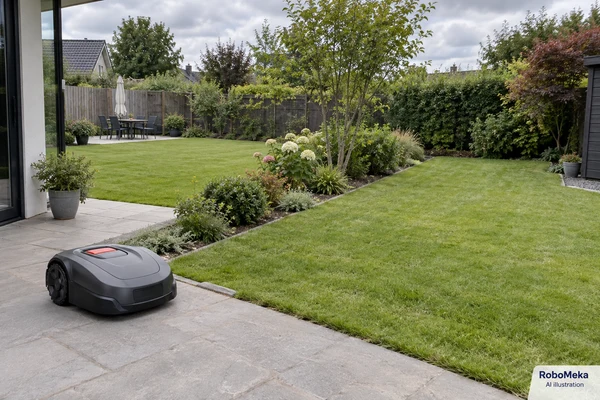
The short answer
Separate a mower’s permitted weather exposure from the condition of the lawn. Review traction, grass finish, standing water exclusions, pause triggers and restart decisions. A forecast-based routine is not the same as an on-device rain sensor, and weather tolerance does not establish submersion resistance.
Introduction
A robotic mower can be approved for certain outdoor weather conditions while producing an unsatisfactory result on a saturated lawn. Those are different questions. Equipment exposure, grass condition, ground firmness, traction, visibility, and the customer's acceptable finish should not be compressed into a single claim that the machine works in rain.
For a distributor, the practical task is to specify an operating policy customers can understand. Which weather conditions are permitted by the manual? What makes the lawn unsuitable today? What information triggers a pause, and what authorizes a restart? The answers influence product selection, scheduling, installation, and after-sales workload.
This guide presents an original buyer framework for robotic mowers in rain and wet grass. It is not an exposure test report or evidence of completed RoboMeka field trials. Product limits, cleaning methods, power arrangements, and storm procedures must come from the exact model's instructions and appropriately qualified support.
Separate equipment tolerance from lawn suitability
Begin with the manufacturer's stated operating environment and restrictions. Ask for the relevant manual sections for the mower, charging station, power supply, reference equipment, and accessories. A weather-related statement about one component does not establish the conditions permitted for every part of the installation.
Then assess the lawn as a separate surface. Record drainage, low spots, shaded sections, slopes, and heavily traveled approaches. A site can contain dry open grass and a persistently wet corridor at the same time. The limiting section may be the route to the charging station rather than the largest mowing area.
Weather resistance does not imply permission for submersion, standing-water operation, or unrestricted washing. Avoid replacing precise instructions with waterproof in a sales description. Buyers should obtain the documented exposure and care limits and preserve their meaning in retail content and translated manuals.
Ask what the customer means by mowing in rain
Some customers mean light precipitation while the ground remains firm. Others mean operation immediately after prolonged rain, when the surface is wet and soft. These conditions can lead to different product application decisions. Ask about the local use case instead of answering an undefined question with a general yes.
Include irrigation in that discussion. A garden watering schedule may create a wet operating surface even when the weather forecast is clear. Ask who controls irrigation, whether its timing changes seasonally, and how the approved mowing routine accommodates it. Do not assume that a weather-service feature knows the site's watering activity or that the mower integrates with the irrigation controller. If coordination is manual, describe it as a customer task; if integration is proposed, obtain the supported configuration and verify its documented behavior separately.
The same distinction applies to commercial promises. Reliable weekly maintenance under a local climate is a scheduling outcome. A machine surviving a particular documented exposure is an equipment result. Evidence for one should not be presented as proof of the other.
Distinguish rain sensors from forecast automation
An on-device rain sensor, where fitted and documented, observes a local condition through its designed sensing method. A weather-service routine uses external information and a configured location or region. A manual pause is a user decision. These controls differ in prerequisites, timing, and the information they can actually know.
Husqvarna's Rain Guard guidance describes a forecast-dependent routine for supported connected models and notes that forecast conditions may differ from actual weather. It also explains that synchronization can delay parking. This illustrates why buyers should ask how a weather feature receives information before treating it as immediate local rain detection.
None of these descriptions proves that the system measures ground saturation. If the product does not have a documented way to assess the relevant ground condition, do not imply that a rain-related feature automatically selects the best time for every lawn to resume mowing.
Request a clear control-priority explanation
Ask how scheduled mowing, rain settings, user pauses, other automated routines, and fault states interact. The answer should identify which condition takes priority and how the customer sees the reason for a pause. A mower remaining docked may be responding correctly to a configured routine rather than malfunctioning.
Document what happens when the connected service is unavailable. Does the feature retain a previous decision, revert to a local schedule, or behave in another documented way? Do not assume an offline mode includes weather automation. Confirm the exact behavior for the supplied model, market, and software version.
Review traction without turning slope ratings into wet-weather promises
A published slope capability must be interpreted with the manufacturer's conditions and measurement method. It should not be treated as permission to operate on every slope in every weather state. Assess slope location, approach, turning space, ground condition, and proximity to hazards together with the approved installation instructions.
The purpose of a buyer assessment is to identify whether the proposed application remains within its accepted limits. Do not conduct deliberate slip tests near water, roads, drop-offs, or people. Where wet-condition evaluation is appropriate, use a manufacturer-approved method and a controlled, suitable site with competent personnel.
Our mower slope and site-assessment guide provides the broader terrain framework. Add weather observations to that record rather than creating a separate assumption that an accepted dry route is automatically accepted after heavy rain.
Look at repeated turning and station approaches
Straight travel across firm grass can hide problems at turns, constricted entrances, or the charging approach. Ask evaluators to record the entire permitted operating cycle, including return and docking. The customer needs a complete routine, not simply evidence that the mower moved forward on a wet patch.
Observe the surface before and after the evaluation. Record visible marks, accumulated clippings, and any intervention without inventing a standardized turf-damage score. Agree with the buyer how appearance will be assessed, using consistent photographs and conditions rather than promotional terms such as perfect lawn protection.
Define cutting quality separately from navigation success
A completed route does not establish an acceptable grass finish. Record the starting grass condition, approved cutting-height setting, maintenance state, and weather context. Observe areas left uneven, clippings remaining on the surface, and any additional work the customer would need to perform.
Comparisons should use similarly maintained equipment and comparable starting conditions. A candidate tested on a recently maintained dry lawn should not be ranked directly against another tested on long, wet growth. Where conditions differ, retain the observations as separate cases and explain the limits of the comparison.
Assess the cleaning burden after the permitted session using the manual's procedure. Time required for approved routine care is part of ownership. Avoid claiming that a product is maintenance-free because it returned to the station without an alert; a session may still leave routine cleaning or inspection work.
Keep cause and observation distinct
Write what happened before assigning a cause. For example, the record may state that a particular return attempt required assistance and that the approach was visibly damp. It should not automatically conclude that rain caused a drive-system defect. The supplier may need additional model-specific information to distinguish terrain, setup, maintenance, and equipment factors.
This discipline also protects the buyer from dismissing real problems as weather. If the installation and conditions satisfy the documented requirements but the agreed behavior is not achieved, escalate the evidence. A weather explanation should be supported rather than used as a general excuse.
Compare operating-control options in a procurement worksheet
The following table organizes questions without assuming a specific feature is included. Use it with the selected model's documentation and your target customer's property conditions.
| Control or condition | What it can establish | What still needs review |
|---|---|---|
| Documented outdoor operating limits | Permitted exposure for identified components | Actual lawn and route suitability |
| On-device rain sensing, if offered | The sensor's stated local input and response | Sensitivity, restart logic, and ground condition |
| Forecast-based parking | Response to supported weather-service information | Location accuracy, connectivity, and timing |
| User pause | A deliberate instruction through approved controls | Who monitors conditions and authorizes restart |
| Fixed schedule | Planned availability for mowing | Weather interruptions and remaining capacity |
| Site inspection after severe weather | Observable debris, water, or installation changes | Qualified review where damage is suspected |
Send your climate and operating requirements with representative lawn photographs, drainage concerns, target market, and preferred dealer installation model. Download the inquiry brief or open it in your email application, then send it to info@RoboMeka.com for a configuration discussion.
Set restart criteria before the first wet week
A fixed delay after rain may be easy to explain, but it should not be presented as proof that every lawn has recovered. Soil, shade, drainage, rainfall duration, and site geometry can differ. Follow the equipment instructions and agree who assesses observable conditions relevant to the approved installation.
The restart plan should address standing water, debris, changed access, and any visible equipment or installation problem. Do not send a customer into unsafe weather to rescue a mowing schedule. If an area is unsuitable or damage is suspected, keep the product out of service and seek the appropriate support.
Distinguish a normal weather pause from a return after an incident. Routine scheduling may resume according to documented controls; suspected water ingress, damaged electrical components, or a displaced installation needs a different assessment. The dealer handover should explain that difference without asking the owner to dismantle equipment.
Reassess the site after drainage or landscaping changes
New paving, altered drainage, or a changed garden level can affect where water collects. Retain a dated installation plan so the customer and dealer can identify changes. A station position accepted at commissioning should not remain unquestioned after its surrounding surface or runoff pattern changes.
Our robotic mower installation checklist connects station placement with access and power preparation. Weather planning adds a reason to document site changes and to seek qualified review when the original assumptions no longer apply.
Keep thunderstorms and severe weather outside routine rain messaging
Rain tolerance is not a blanket severe-weather guarantee. Husqvarna's thunderstorm guidance warns that lightning and heavy rain can damage its mower and charging equipment and gives model-specific preparation procedures. The useful purchasing lesson is to request a separate severe-weather procedure for the entire supplied system.
Preparation should follow the manual and take place when safe, using qualified help where needed. Do not provide a generic connector sequence across different brands or encourage handling electrical equipment in hazardous conditions. The customer needs the correct instructions for the delivered components, not a copied procedure from a competitor.
After a severe event, the return-to-service process should address the actual installation and any visible damage or change. A weather app showing clear skies does not inspect a power component, check a displaced station, or remove storm debris from the lawn.
Explain cleaning limits with equal precision
Ask whether the identified mower may be cleaned with a specified water method, and under which conditions. Follow the exact instructions for shutdown, access, tools, water use, and drying. Do not infer pressure-washer permission from a weather rating or from a photograph of another model being rinsed.
Ensure private-label instructions keep component distinctions clear. A cleaning method approved for an external part may not apply to the station, power supply, or another accessory. Customer care content should use the supplied model's documentation rather than combining attractive tips from unrelated products.
Account for weather downtime in product selection
Build the capacity discussion around the customer's accepted operating window and plausible interruptions. Ask for the supplier's sizing basis and how the proposed configuration handles missed work according to its documented operation. Avoid claiming a universal percentage of reserve capacity without application evidence.
For a hypothetical garden with a shaded access corridor, the open lawn may become suitable earlier than the route needed to reach it. The owner could therefore lose more usable mowing time than a forecast-only schedule suggests. The proposal should recognize the limiting route rather than calculating capacity from total lawn area alone.
The robotic mower area-capacity guide provides a framework for this calculation. Use local observations and customer requirements for planning assumptions, and label them as assumptions. Longer daily operation should not override periods reserved for people, pets, or other site constraints.
Define an alternative maintenance arrangement
Agree what happens if unsuitable conditions prevent normal operation for an extended period. The answer may involve postponement or another approved maintenance method when conditions permit. It should not involve overriding protections or forcing the robot onto a site outside its accepted limits simply to preserve a service promise.
Distributors can help dealers by providing a clear explanation of these limits in sales materials. Customers are more likely to understand a planned exception than an unexpected restriction introduced after delivery. A realistic weather policy is part of a supportable product offer.
Frequently asked questions
Can robotic mowers operate in rain?
Some models are designed for specified rainy conditions, but the answer must come from the selected model's manual and component requirements. Equipment tolerance does not establish that a particular wet lawn is suitable for mowing. Review the surface, route, weather severity, and customer operating policy together before making a recommendation.
Does a rain sensor tell the mower when the ground is dry?
Do not assume that it does. Ask what the sensor actually measures and how restart behavior is determined. A rain-related input or a preset delay is not automatically a measurement of ground firmness or saturation. Communicate the documented function accurately and retain any required site assessment in the customer routine.
Is forecast-based rain parking the same as local sensing?
No. Forecast automation uses external weather information and may have connection, location, or synchronization dependencies. Local sensing uses the particular device's stated input. Compare the exact response and limitations of each offered feature, and avoid implying that either one guarantees immediate detection of every unsuitable lawn condition.
Can a weather-resistant mower enter standing water?
Do not infer that permission from weather-resistance language. Standing water and submersion are different exposure conditions, and the equipment instructions govern use. Keep the mower away from unsuitable areas and seek qualified support if water exposure or damage is suspected. Do not create a flooded-area demonstration as a buyer test.
What should a wet-weather sample evaluation record?
Record the approved procedure, product configuration, starting lawn condition, weather context, complete operating cycle, interventions, final grass appearance, and required care. Separate observations from suspected causes. Keep the result limited to the conditions evaluated and do not present a short site trial as a general weather certification.
Conclusion
A useful rain policy distinguishes permitted equipment exposure, suitable ground conditions, available controls, and a clear restart decision. Evaluate the full mowing and return cycle, include routine care and weather downtime in purchasing discussions, and provide separate instructions for severe weather and suspected damage.
Prepare a robotic mower product inquiry with your region, expected quantities, representative terrain, weather-related customer requirements, and service plans. Use the downloadable brief or email-client option to send it to info@RoboMeka.com. RoboMeka can use those details to discuss evaluation scope and model-specific documentation before claims are approved.