The short answer
Qualify a sloping lawn by measuring relevant gradients, separating working-area and boundary limits, and documenting surface conditions, transitions, hazards and navigation requirements. Compare the complete site with the exact model instructions. A maximum gradient or drive-system label cannot establish safe suitability for every property.
Introduction
A robotic lawn mower's slope rating is a starting point for property qualification, not permission to send it onto every hillside below that number. Buyers need to distinguish gradient inside the mowing area from gradient at its edge, then consider ground condition, transitions, obstacles, and the consequences of losing traction. A modest incline ending beside a road can deserve more attention than a steeper, open section safely contained within a garden.
For dealers and importers, the practical decision is whether a particular mower, installation, and support arrangement fit the customer's property. Selecting the largest advertised percentage without a site survey can produce an unsuitable recommendation even when the specification itself is accurate.
This guide provides an original purchasing worksheet and a proposed qualification process. It does not report completed RoboMeka factory testing or establish the slope capability of any product shown on this website. Obtain the exact model manual and written supplier confirmation before making a customer commitment.
How do slope percentages differ from degrees?
Slope percentage is vertical rise divided by horizontal distance, multiplied by one hundred. The horizontal distance matters: measuring along the grass surface and using that length as the denominator gives a different result. Degrees describe the angle relative to horizontal. The two units are related, but they are not interchangeable.
For example, a hypothetical rise of 0.4 meters over a horizontal distance of two meters is a twenty percent grade. Its angle is approximately 11.3 degrees. A fifty percent grade corresponds to approximately 26.6 degrees, while a forty-five degree hillside has a one hundred percent grade. Confusing the units can radically change a purchasing decision.
Use one primary unit in the survey and record the original measurement method. If a supplier states degrees and the dealer measures percentages, convert deliberately and retain both values. A photograph with a phone tilted toward the hill is not a dependable substitute for a documented measurement.
Where should the installer measure?
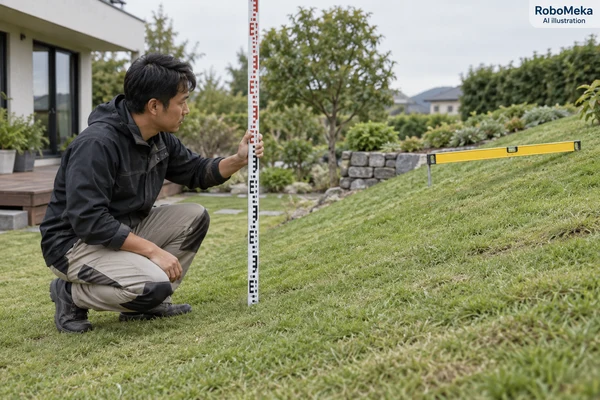
Record the steepest relevant sections rather than a property-wide average. Include the working area, turning locations, docking approach, passages, and boundaries. Local ridges or depressions may matter even when the broader slope appears gentle. Measurements should be taken safely by a competent person without operating the mower on an unqualified area.
Photographs should identify the measurement location and show its surroundings. Pair each image with a location code on a sketch. This lets a supplier distinguish a long uniform incline from a short bank ending abruptly at paving. Record uncertain measurements as uncertain instead of rounding them down to make the property fit a preferred model.
Why are working-area and boundary limits different?
The mower may face different demands while moving through an open slope and while reaching an edge, slowing, turning, or following an installed boundary. A single headline figure can conceal that distinction. Ask the supplier for both the permissible working gradient and the relevant edge conditions, including any special installation requirements.
Husqvarna's slope installation guidance publishes separate working-area and boundary limits for its listed models. It also discusses obstacles and wet conditions. These are useful examples of why a survey needs more than one gradient field; its numbers and installation prescriptions cannot be transferred to an unrelated mower.
An edge should also be classified by consequence. A flowerbed, retaining wall, public footpath, pond, and road are not equivalent surroundings. Follow the selected manufacturer's required exclusions, clearances, and physical protections. An obstacle sensor or virtual boundary should never be assumed to replace required protection beside a hazard.
Can extra space solve an unsuitable edge?
Sometimes a supported redesign may move the mowing boundary onto suitable ground and leave the difficult bank for another maintenance method. That is a change to the service scope, not proof that the mower can maintain the original whole lawn. Obtain approval for the revised layout before pricing full coverage.
Do not invent a universal setback distance. Required dimensions depend on the model, boundary method, and hazard. If the available documentation does not address the layout clearly, request manufacturer or qualified installer review. The commercial answer may be partial coverage or a different product configuration.
Which ground conditions belong in the survey?
Describe the surface as well as the angle. Established turf, exposed soil, loose material, roots, wheel ruts, and abrupt transitions create different operating conditions. Note drainage and recurring damp areas from observation or owner information, while distinguishing those reports from conditions actually seen during the visit.
Grip is not just a wheel specification. The mower must also maintain supported movement through turns and transitions without an unacceptable pattern of intervention or lawn damage. Claims about all-wheel drive, traction control, or special tires require evaluation in the complete product configuration. A feature name does not establish suitability for a particular bank.
Seasonality deserves a field in the survey. A garden photographed during dry weather may behave differently after irrigation or in another season. This does not justify deliberately creating a hazardous test. Instead, ask which conditions are permitted and whether the property can be maintained within those limits throughout its intended operating season.
What should a buyer ask about transitions?
A short change from level ground to a slope may be more restrictive than a smooth incline. Record the crest, bottom transition, edging, and any nearby obstacle. Ask whether the mower has documented clearance requirements and whether the chosen mowing direction or route is supported.
Avoid treating a wheel climbing over one small obstacle in a demonstration as proof of general terrain capability. A transition can affect chassis clearance, blade-area clearance, traction, and localization differently. The appropriate evidence is a model-specific instruction and a controlled evaluation of a representative, permitted layout.
What should a slope qualification worksheet contain?
Use a compact table to make the buying decision traceable. The following is an original template, not a manufacturer test standard. Add rows where the property changes character rather than trying to summarize an entire garden in one description.
| Survey field | Information to record | Purchasing decision supported |
|---|---|---|
| Location | Sketch reference and contextual photographs | Identify the exact problem section |
| Gradient | Percentage, method, measurement uncertainty | Compare with documented model limits |
| Edge relationship | Interior, boundary, passage, docking approach | Apply the correct type of limit |
| Surface | Turf condition, roots, ruts, drainage observations | Determine whether further review is needed |
| Surroundings | Water, road, drop, people access, obstacles | Establish exclusions and required protection |
| Proposed treatment | Maintain, exclude, redesign, or decline | Define what the quotation actually covers |
| Approval owner | Installer or supplier reviewer and date | Retain accountability for the recommendation |
A useful worksheet keeps observations separate from conclusions. “Visible rut at location C” is an observation. “Requires ground preparation before installation” is a proposed action. “Acceptable for model X under these conditions” is a decision that needs an identified reviewer and supporting documentation.
Send the worksheet with photographs when discussing our terrain mower product family. Product images establish neither gradient capability nor approval for the surveyed site. The requested outcome should be a documented configuration recommendation, including exclusions and unresolved questions.
How could a dealer assess a mixed-slope property?
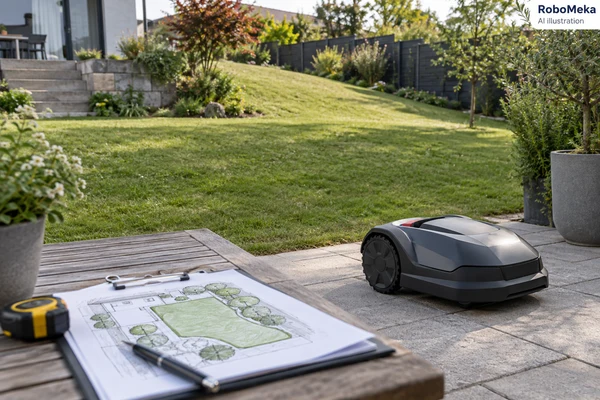
Consider a hypothetical property with an open upper lawn, a sloping connection, and a lower section beside a pond. The measured interior incline is twenty percent. One short boundary section is twelve percent, and the pond edge has an abrupt drop. These invented dimensions illustrate the decision process; they are not a safe-use recommendation for any mower.
The dealer first separates three questions: whether the mower supports the interior slope, whether the connection is a permitted route, and what protection or exclusion the pond requires. Passing the first question does not answer the other two. The property remains unqualified until all three have documented answers.
Suppose the supplier can support the upper lawn but cannot confirm the proposed lower boundary arrangement. A responsible quotation can price the upper area and list the lower area as excluded pending redesign. It should not advertise complete-property coverage based on the interior gradient alone. The customer can then compare a partial robotic solution with alternative maintenance arrangements.
For a similar project, send your slope and site requirements. Include location-coded measurements, destination market, intended mower quantity, and installation responsibility. The inquiry tool prepares a downloadable brief and an email-client handoff; it does not automatically transmit an order or inquiry.
How should navigation and terrain be assessed together?
A mower must both move through the terrain and know where it is permitted to operate. Neither capability proves the other. A slope suitable for the drive system may still create an unsuitable route because of localization restrictions, an unsupported passage, or difficult docking geometry.
For satellite-based systems, request a review of the full installation arrangement. Husqvarna's wireless installation planning guide illustrates the importance of assessing the garden and positioning requirements before installation. Treat its guidance as specific to the systems discussed, and obtain equivalent instructions for your proposed platform.
For wired systems, clarify the permitted boundary and guide arrangements through the sloping section. The route should follow the selected manual; an improvised shortcut can change the operating conditions. Our RTK versus boundary-wire buying guide explains the broader architecture decision without substituting for a site-specific installation plan.
What evidence should precede a purchase commitment?
Ask for the exact model identifier, hardware revision, operating manual, declared slope limits, and any mandatory accessories. Record which firmware and operating settings were used for a demonstration. If a different wheel kit is proposed for production, evaluate that configuration instead of assuming the earlier evidence still applies unchanged.
A proposed site trial should be designed and supervised by competent personnel, remain within all documented limits, and exclude people and animals as instructed. Never test stopping or avoidance behavior by placing a person or animal in the mower's path. Do not push a machine beyond its declared limits to discover a practical maximum.
The objective is to assess supported operation, not to stage a dramatic climb. Useful observations include route completion, documented interventions, docking consistency, turf condition, and whether the promised area remains maintainable within the allowed schedule. Record failures and interrupted runs alongside successful runs so the purchasing record is not selectively optimistic.
What should the acceptance record say?
Define acceptance before the evaluation. The record should specify the site section, permitted conditions, configuration, observation period, intervention rules, and decision owner. A conditional approval must state what remains unresolved and what evidence will close it. “Works well on slopes” is too vague to support a purchasing contract.
Factory testing may help confirm assembly or functional consistency, while shipment inspection may check the agreed configuration and supplied parts. Neither reproduces every outdoor property. Keep the factory evidence, shipment evidence, and application evidence as separate records with different purposes.
How should dealers communicate the result to customers?
Describe the approved mowing area visibly on the handover map. Mark excluded banks and the customer's continuing maintenance responsibilities. Explain the permitted operating conditions, relevant cleaning instructions, and the process for reporting a changed site. Avoid presenting the maximum slope rating as a promise for all weather or every garden layout.
Ask customers to report landscaping changes, new obstacles, damaged protection, altered drainage, or changes around a boundary. A site approval applies to an arrangement, not indefinitely to a postal address. Support staff should be able to retrieve the original plan before advising the customer to adjust settings.
Dealer staff also need a clear escalation route. If a mower behaves unexpectedly near a hazardous edge, the response should follow the manufacturer's safe-stop and service instructions, with operation suspended where appropriate. Repeated remote encouragement to “try again” is not a substitute for reviewing an unsuitable installation.
How can importers build a useful slope-focused range?
Group target properties by documented requirements instead of marketing labels alone. A compact product might address modest, straightforward lawns; another configuration may be intended for more demanding terrain. Define the application boundaries before calling either product an entry-level or premium solution.
Review compact mower configurations and terrain-oriented options against the same worksheet. Compare installation effort, consumables, service training, and evidence availability alongside unit price. A narrower but well-qualified product range can be easier to support than several loosely differentiated models with unclear limits.
When preparing OEM and ODM requirements, include the wording allowed in brochures and dealer training. Agree how changes to wheels, controls, firmware, or supplied accessories affect previous approvals. Technical documents, product listings, and installer instructions should refer to the same configuration and remain aligned after revisions.
Frequently asked questions
Is a fifty percent slope the same as fifty degrees?
No. Fifty percent means the vertical rise is half the horizontal distance, corresponding to approximately 26.6 degrees. Fifty degrees is much steeper. Record the unit on every site measurement and supplier specification, and convert deliberately before comparing the property with a model's documented operating limits.
Does all-wheel drive guarantee suitability for a steep lawn?
No. Drive layout is one part of the assessment. The exact model's working and boundary limits, surface condition, transitions, obstacles, navigation requirements, and required protection still apply. Request documentation for the complete configuration and have the intended installation reviewed before promising coverage to a customer.
Can we test a mower beyond its rating to find the real limit?
That is not an appropriate purchasing trial. Evaluate only supported operation within the manufacturer's instructions, using qualified supervision and a controlled area. A hazardous demonstration does not establish safe customer use, durability, or liability boundaries. An unsuitable section should be excluded, redesigned, or maintained by another method.
Should a dry-weather trial approve year-round operation?
No. Record the conditions actually observed and compare them with the manufacturer's permitted conditions. Seasonal ground changes and irrigation may alter application suitability. Approval should identify its limitations, and the customer should receive instructions about when operation must be suspended and when the installation needs review.
Conclusion
Qualifying robotic mowers for slopes requires more than comparing two numbers. Measure the relevant gradients, separate interior and boundary conditions, document the terrain, and define the exact area the selected configuration can maintain. A clear approval record also makes installation, customer handover, and later service more consistent.
Ask for a mower configuration review with your site worksheet, photographs, target market, and expected quantity. Prepare the inquiry brief, then use your email client to send it to info@RoboMeka.com. A review can identify the evidence needed for a purchasing decision; it is not a substitute for the selected manufacturer's installation instructions.