The short answer
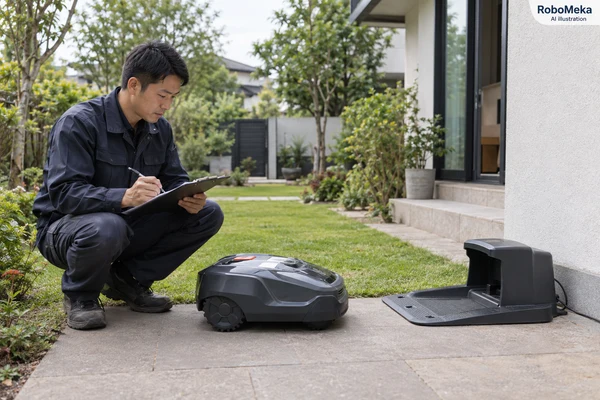
Treat robotic mowing as dependent on a clear, inspectable lawn: classify seasonal debris, park after storms, remove sticks and concealed hard objects, protect docking routes, and verify the exact model instructions before restart. Product evidence does not replace property clearance or customer responsibility.
Introduction
A robotic mower should not be treated as a garden-debris processor. Light, scattered leaves may be compatible with some installations, but sticks, branches, dense leaf mats, storm fragments, and concealed hard objects should be cleared before mowing. The exact stop, inspection, and restart decisions must follow the mower manual and the condition of the property.
That direct answer matters to buyers because “handles leaves” is too vague for product selection. A mower might cross a few dry leaves during normal work yet still be unsuitable for a lawn that receives heavy seasonal leaf fall or frequent wind-blown twigs. Object detection, wheel traction, blade arrangement, ground clearance, scheduling, and the owner’s clearance routine all affect the application.
This guide explains how distributors, installers, and property managers can turn seasonal debris into a measurable operating requirement. It covers routine leaf fall, post-storm clearance, proposed acceptance observations, customer responsibilities, and supplier evidence without claiming that an unverified RoboMeka model has processed any particular material.
Separate ordinary leaf fall from hazardous debris
Start by describing what actually lands on the lawn. “Tree debris” can mean a thin layer of dry leaves, flexible leaf stems, woody twigs, a storm-broken branch, roof fragments, wire, stones displaced from a border, or a mixture hiding one item beneath another. These conditions do not create the same cutting, traction, or service risk.
The official WORX Landroid spring-preparation guidance advises clearing debris such as sticks, leaves, and branches so the mower can move freely. That is one model family's seasonal instruction, not a universal compatibility statement. The buyer should use the exact candidate model's manual as the operating authority.
| Lawn condition | Main qualification question | Appropriate planning response |
|---|---|---|
| Scattered dry leaves | Does the model documentation permit normal operation, and can the surface still be inspected? | Observe under ordinary conditions and keep a clearance routine |
| Dense or wet leaf mat | Are grass, edges, holes, and hard objects concealed? | Park the mower and clear the area before evaluation |
| Fine woody twigs | Can they reach wheels, blade disc, or docking route? | Remove them rather than promising routine processing |
| Branches or storm fragments | Could they block, lift, trap, or damage the machine? | Treat the area as unavailable until cleared and inspected |
| Unknown mixed debris | Can the responsible person positively identify what is present? | Default to a controlled stop and manual site check |
This classification keeps a harmless-looking leaf from becoming a general waiver for everything dropped by a tree. It also lets a dealer quote the real application: automated mowing supported by property care, not unattended disposal of unpredictable objects.
Map where debris accumulates
A site survey should record tree canopy, hedge lines, prevailing wind exposure, roof edges, neighboring vegetation, collection points beside fences, and low places where leaves gather. The survey should also show the dock, guide route, narrow passages, and any area that the mower must cross to reach another lawn section.
Accumulation is often uneven. An open central lawn may remain clear while a return corridor fills with leaves. A schedule that looks acceptable from total lawn area can fail because the machine repeatedly encounters the one congested route. Link this debris map to the broader robotic mower installation checklist rather than recording tree count alone.
Photographs should show the surface in context. A close-up of one clean square metre does not establish the condition below a mature tree line. Ask for views after an ordinary windy day and after peak leaf fall if the purchasing decision is being made out of season. Label customer photographs by date and location instead of treating them as test evidence for the mower.
Record imported debris as well as trees on the property
Leaves and twigs can arrive from adjacent land. A buyer may have no authority to prune the source tree, yet still owns the mowing-area clearance decision. Note shared boundaries, public verges, delivery areas, and places where landscape contractors blow material from beds onto turf.
Customer requirements should state who clears these areas and how frequently during the relevant season. If the answer is “whenever someone notices,” the proposed installation still needs a defined method for keeping the mower parked until that person has inspected the route.
Create a seasonal clearance schedule
Do not copy one weekly cleanup interval into every property. Leaf volume can change rapidly with species, weather, irrigation, and local maintenance. The responsible person should adjust inspection frequency to observed accumulation while the mower schedule responds to remaining safe and usable windows.
The Husqvarna seasonal Automower support guide advises raking leaves and clearing debris as part of spring preparation to reduce mould and blade wear. That manufacturer guidance supports a clearance principle, but its calendar and product features must not be presented as universal requirements for other regions or machines.
A useful property record separates the normal growing season, peak leaf fall, and high-wind response. During low-debris periods, a visual check may fit the regular garden routine. During peak fall, the owner may reduce or pause mowing, add manual clearance, and reassess whether enough operating time remains. After severe weather, the recurring calendar should be overridden by an event-based inspection.
Treat storm recovery as a separate state
A storm changes more than leaf quantity. It can move stones, damage fences, expose roots, drop sharp fragments, wash soil onto turf, and disturb boundary hardware. The mower should remain secured according to its instructions until an authorized person has inspected the complete work area, dock, power arrangement, boundaries, and transit routes.
The inspection is not a challenge test. Do not send the mower toward a branch to see whether its bumper, camera, radar, or software will react. Remove the branch, identify hidden objects, resolve damaged site features, and then use a controlled normal-operation observation if the site and manual permit it.

Keep leaves and fallen fruit as distinct applications
Leaves and fruit can fall at the same time, but they create different questions. Fruit may be soft, sticky, acidic, attractive to animals, or large enough to influence clearance and cutting. Pine cones are hard three-dimensional objects, while a thin dry leaf is flexible and low-profile. One successful leaf observation cannot qualify either of those materials.
Use the separate fallen fruit and pine-cone guide when the site has orchards, fruiting ornamentals, or conifers. In a mixed site, record both requirements and apply the more conservative clearance state whenever the surface cannot be distinguished visually.
This distinction also improves inquiry quality. A buyer who sends tree species, seasonal photos, typical debris size, and cleanup responsibility gives the supplier something testable. “Must work under trees” gives no defensible acceptance condition.
Assess the mower without relying on object-avoidance language
Object-avoidance descriptions need model-specific interpretation. Sensors may be intended for objects that rise above the grass, may work only in certain modes, or may not classify flat leaves and low twigs. Detection also does not mean an object is safe to contact, push, cross, or leave in place.
Ask the supplier for the applicable operator manual, supported exclusion method, ground-clearance information, cutting-system layout, relevant warning messages, and cleaning instructions. Confirm whether any claimed sensor is standard, optional, region-dependent, or limited by software and installation conditions. Keep an unanswered capability in the requirements register instead of filling it with a general marketing statement.
The Husqvarna blade guidance identifies twigs, stones, roots, and toys as factors that can increase blade wear. Its stated service expectations belong to the referenced Husqvarna equipment. The transferable procurement lesson is that debris exposure belongs in consumable and inspection planning, not that a particular blade life applies to another product.
Design a proposed site observation
A proposed observation should use a cleared lawn in its normal condition. Confirm that the mower is correctly installed, the cutting height and schedule follow the candidate documentation, and the responsible people understand the stop control. Then observe docking access, movement through known accumulation areas, and whether ordinary scattered leaves conceal anything relevant.
Do not manufacture a pile of sticks, scatter hard objects, or recreate storm damage around a live cutting system. Such a demonstration would add uncontrolled variables and could conflict with the operator instructions. If a supplier offers a documented laboratory or factory test, request the material definition, machine configuration, procedure, pass criteria, and limitations before deciding whether the evidence relates to the customer’s site.
Record what was present, not an impression such as “handled debris well.” A credible observation note might state that the lawn had been manually cleared, the remaining dry leaves were sparse, the route was visible, and the machine completed its documented normal sequence. That note does not establish performance with wet leaf mats, twigs, branches, or storm fragments.
Send your seasonal debris requirements with site photographs, tree coverage, expected clearance responsibility, allowed mowing windows, and destination market. The review can then focus on a proposed model and documented operating limits rather than an undefined promise to handle garden waste.
Plan installation around clearance access
An installation should make manual inspection possible. Avoid creating a narrow hidden corridor that accumulates debris but cannot be seen without entering dense planting. Keep the dock approach accessible so leaves and twigs can be removed without disturbing electrical equipment or improvising around the charging station.
If a repeat accumulation area cannot be managed reliably, discuss a supported exclusion, revised route, landscape change, or seasonal work-area adjustment. Physical-wire and virtual-boundary systems use different procedures, so the installer must follow the selected platform rather than moving a line casually. Record the approved boundary state after any adjustment.
Weather and surface condition remain separate gates. A lawn may be free of branches but still unsuitable because leaves are wet and compacted over soft ground. Use the rain and wet-grass operating guide for that decision, and do not let debris clearance become automatic permission to restart.
Turn customer responsibilities into handover instructions
The handover should state who checks the lawn, what conditions require parking, which supported control is used, who may clear or inspect the machine, and how normal service resumes. Include substitute arrangements for holidays, rental turnover, or changes in the landscape contractor.
The owner should know that a “no error” screen is not evidence that the lawn is clear. Likewise, a camera image or remote status cannot necessarily reveal an object beneath leaves. Where remote supervision is part of the proposed routine, explain its limits and preserve a local physical inspection step after high wind or reported tree damage.
Training should also separate ordinary surface clearance from machine service. The user can remove garden debris from the lawn under the property procedure. Cleaning around blades, wheels, or the chassis must follow the exact shutdown, protective-equipment, and access instructions. Route damage or recurring error messages to authorized service rather than encouraging hands-on experimentation.
Include debris exposure in operating cost
Seasonal cleanup has a labor cost even when the mower itself operates automatically. A buyer should compare clearance visits, schedule management, blade inspection, callouts, and possible boundary changes alongside equipment price. The robotic mower blade service-cost guide provides a framework for separating consumables, labor, travel, and stock assumptions.
Do not promise one maintenance interval based on a clean demonstration lawn. Record debris-related inspection findings and revise the service plan from actual field evidence. If repeated stops cluster beneath one tree or beside one fence, the useful response may be a route or landscape review rather than simply replacing parts more often.
Area capacity also changes when leaf clearance removes large parts of the weekly schedule. Compare the remaining operating window with the method in the robotic mower area-capacity guide. A nominal area rating does not show that a machine can recover every delayed session during a short clear period.
Define factory testing and shipment inspection honestly
Factory testing can verify agreed features on a submitted configuration under a defined procedure. It might confirm controls, charging, programmed functions, or a documented inspection state. It cannot reproduce the buyer’s tree canopy, local wind pattern, seasonal leaf moisture, or unknown storm debris unless those variables are specifically and safely defined.
Shipment inspection can check the ordered model identity, quantities, visible condition, manuals, agreed accessories, labels, and packaging. It cannot prove that object avoidance recognizes every twig or that the destination lawn will remain clear. Keep site acceptance, seasonal housekeeping, and service response as separate deliverables.
A careful quotation should state those boundaries. If topic-specific testing is proposed, call it proposed and obtain approval for the method and pass criteria before it occurs. Never describe a hypothetical debris scene as a completed RoboMeka customer project, factory test, or shipment result.
Review the plan when conditions change
Update the debris brief when a tree matures, pruning changes the canopy, a hedge is added, a neighboring site changes maintenance, or storms become a recurring source of fragments. Compare new photographs with the installation record and confirm that the mower’s permitted area and operating window still make sense.
A complaint log should capture date, location, surface condition, debris type, mower state, and action taken. This supports responsible decisions without turning correlation into a product claim. Several interruptions after windy nights may justify a new inspection trigger; they do not prove a defect by themselves.
The strongest plan stays simple enough to follow: park when the surface cannot be verified, clear unpredictable objects, inspect after unusual weather, and restart only within the documented product and site conditions.
Frequently asked questions
Can a robotic mower run over fallen leaves?
Some documented systems may operate with light, scattered leaves, but that does not make every leaf condition suitable. Dense, wet, or piled leaves can conceal objects and change traction or cutting conditions. Check the exact manual, inspect the surface, and define a clearance threshold for the property instead of assuming all leaves are harmless.
Will object avoidance detect small twigs?
Do not assume it will. Detection depends on the specific sensor, object profile, operating mode, software, and installation. Flat or low objects may present a different case from a standing obstacle. Remove twigs before mowing unless the manufacturer documentation explicitly establishes another supported procedure for the exact model.
Should mowing restart immediately after a storm?
No automatic restart rule is appropriate. First secure the mower and inspect the lawn, return routes, dock, boundaries, power arrangement, trees, and nearby structures. Remove debris and resolve site damage. Restart only when the responsible person confirms that the site and the exact product instructions allow normal operation.
Is leaf clearance part of robotic mower installation?
Installation should define the clearance routine and responsibility, but recurring gardening labor may be a separate service. The quotation should say who performs the initial cleanup, seasonal visits, storm checks, schedule changes, and machine inspection. This prevents an equipment price from hiding an ongoing property-care requirement.
Can shipment inspection prove debris capability?
No. Shipment inspection can verify supplied equipment, documents, accessories, packaging, and visible condition. Debris capability depends on defined materials, procedures, configuration, and the finished site. Any relevant test needs agreed pass criteria and limitations; destination-site acceptance still remains necessary.
Conclusion
Robotic mowing around leaves, twigs, and storm debris is workable only when debris is treated as a changing site condition. Classify what falls, map accumulation, protect routes, pause after unusual weather, and document customer responsibilities. Model evidence can support the decision, but it does not replace a clear lawn and a controlled restart process.
Prepare a robotic mower debris brief with your lawn plan, seasonal photographs, debris types, cleanup schedule, required operating hours, and service expectations. RoboMeka can use that information to discuss a proposed configuration and evidence request without treating leaves, twigs, or storm waste as one universal application.