The short answer
Forecast robotic mower blade costs from approved replacement sets, observed condition, service labor, travel, and replenishment needs. Use the actual mower manual to define inspection and replacement, keep impact damage separate from normal wear, and revise inventory assumptions with recorded field demand instead of promising one universal blade life.
Introduction
A low price for a packet of robotic mower blades does not tell a dealer what blade service will cost. The complete job may include the approved replacement set, inspection, safe handling, labor, travel, documentation, and a follow-up check. A quotation that counts only loose blades can understate the service commitment considerably.
Robotic mower blade-cost planning connects the actual cutting system to observed condition and the method used to support it. Identify the correct parts and replacement procedure first. Then build a forecast from documented usage and service assumptions, revising it as relevant field records become available.
This guide focuses on small replaceable blades used by many robotic mowing systems. It does not assume every robot has the same cutting assembly. Its worksheets and financial examples are planning methods, not RoboMeka durability results, universal replacement intervals, or instructions for testing sharp parts by hand.
Define a replacement event before comparing prices
A replacement event is the complete approved intervention required by the actual mower instructions. It may involve a specified set of blades and fasteners rather than one loose component. Confirm which cutting assemblies are fitted and how the manufacturer defines replacement for each of them.
The supplier quotation should identify the part number, applicable model and revision, pack contents, and usable service quantity. “Thirty blades” is not a complete commercial description when the buyer does not know how many approved replacement events the package supports or whether required fasteners are included.
For example, GARDENA's listed robotics blade pack specifies blades and fastening screws together and expresses its contents as complete sets. That particular listing illustrates why pack structure matters. It does not establish compatibility with another manufacturer's mower or every possible future configuration.
Separate the cutting system from its appearance
Blades that look similar may have different approved applications. Avoid approving a substitute from shape, a photograph, or a matching hole alone. Use the manufacturer's controlled compatibility information and the exact mower identity. The consequences of an incorrect cutting component are too significant for informal warehouse substitutions.
Our mower cutting-system buying guide covers broader architecture selection. This article adds the service-unit definition needed after the system has been chosen. The purchasing record should connect that approved architecture to the parts that dealers will actually order and install.
Use condition observations without inventing a universal blade life
Blade life depends on the application and the manufacturer's definition of acceptable condition. Husqvarna's Automower blade guidance identifies visible blade damage and frayed or whitened grass tips as relevant observations for its products. It also requires original blades and screws and describes replacement precautions. Those instructions belong to the covered system and must not be transferred automatically to unrelated models.
A dealer should therefore document the actual observation and consult the correct procedure. “Grass tips look different in area B” is an observation. “The blades have reached their maximum life” is a conclusion that needs supporting assessment. Keeping those separate helps avoid replacing parts repeatedly while an unrelated application issue remains unresolved.
Do not publish one replacement interval as a promise for every customer. If the supplier offers a typical interval, retain its conditions and status as guidance. Explain how the customer or service provider will review condition under the actual instructions and what action is required when damage or abnormal behavior is reported.
Keep normal wear, damage, and uncertain causes separate
A forecasting system should distinguish routine consumable replacement from confirmed damage and from unresolved complaints. These categories have different implications for stock, training, commercial coverage, and site preparation. Combining them into one average can hide a recurring problem that the dealer could address through a better handover.
Record what was found, who assessed it, and the action taken. Where the cause is uncertain, mark it as uncertain instead of assigning impact damage merely because the blade looks worn. A claim about the customer's lawn or conduct should be supported by evidence, not used to simplify a warranty conversation.
The fallen-fruit and pine-cone guide discusses recurring debris and clearance responsibilities. Blade service planning should refer to those site conditions when relevant, without claiming that one debris type always produces a predictable number of replacements.
Do not create a dangerous inspection shortcut
Inspection and replacement must follow the exact mower manual, including stopping, securing, protective equipment, and any limits on user service. Do not touch a cutting edge to judge sharpness, run the cutting system while the mower is lifted, or bypass a protective function to observe blade movement.
If the condition cannot be assessed within the permitted user tasks, route it to authorized service. A useful cost forecast includes that handoff. It should never depend on customers performing improvised checks that the dealer would not approve as part of a documented service procedure.
Build a record around the service event
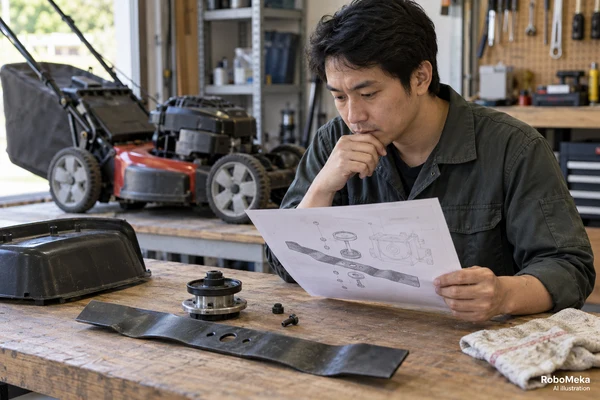
The record should explain which mower received which parts, why the intervention occurred, and what verification followed. Include the date and the relevant usage information if the platform provides it. Calendar age, operating hours, and cutting hours may be different measures; name the measure instead of using them interchangeably.
| Service-record field | What to record | Why it improves forecasting |
|---|---|---|
| Equipment identity | Model, revision, and relevant assembly | Keeps incompatible configurations apart |
| Replacement reason | Scheduled review, assessed wear, damage, or other finding | Prevents one blended demand category |
| Usage measure | Available counter and its definition | Supports comparable observations |
| Parts consumed | Approved set and fastener references | Connects warehouse demand to real jobs |
| Labor scope | Inspection, permitted replacement, and verification | Captures the complete service activity |
| Travel arrangement | Dedicated visit, combined visit, or customer workshop drop-off | Explains cost differences |
| Follow-up finding | Accepted result or unresolved issue | Reveals repeat work and open questions |
A photograph can support the record when taken safely under the service procedure. It should be linked to the identified mower and event. Avoid using an unlabeled close-up as proof of a material defect or a specific operating history that was never established.
Calculate complete service cost with transparent assumptions
Use the actual price of the approved replacement set and add the work required to provide it. A simple worksheet can express the cost per event as parts, labor, allocated travel, administration, and any agreed handling costs. Keep taxes, customer price, and dealer margin distinct from the underlying cost calculation.
Then estimate the number of events using relevant history or explicitly labeled planning assumptions. A formula does not make the assumed frequency reliable. Where the range is new, present a low, central, and high demand scenario chosen by the business, and explain that these are sensitivity cases rather than measured failure or wear rates.
Discuss your robotic mower consumable requirements with the proposed models, service method, expected installed base, and parts-documentation needs. Include whether owners or trained dealers will perform permitted replacement so that the commercial package reflects the actual support arrangement.
Compare service channels on the same basis
A customer visiting a workshop and a technician traveling to the property create different cost structures. A posted parts kit creates another. Compare the same replacement scope, documentation, and support obligation before concluding that one channel is cheaper or easier to operate.
If a blade intervention is combined with other maintenance, allocate costs consistently. Do not assign all travel to blade replacement in one proposal and none in another. The goal is a fair decision about the service model, not a conveniently low figure that excludes work someone still has to perform.
Use a hypothetical cost worksheet carefully
Imagine a dealer comparing a workshop service with a scheduled property visit. In a hypothetical worksheet, both use the same approved parts and permitted replacement procedure. The property visit adds travel and appointment coordination, while the workshop option requires the customer to bring the mower safely under the manufacturer's transport instructions.
The dealer would enter its own quoted part cost and labor rates. It would then vary the assumed number of service events to see how the offer changes. No invented currency amounts or replacement frequencies are necessary to understand the comparison, and neither option is automatically superior for every customer.
The decision may depend on service access and customer capability as much as price. An owner who cannot transport the mower may value a planned visit, while a dealer with an existing route may organize visits efficiently. Those are commercial possibilities to evaluate, not evidence of guaranteed savings.
Forecast stock by complete sets and confirmed compatibility
Plan inventory in the units technicians actually consume. Keep compatible blade sets and required fasteners available together, with clear identification. A warehouse containing many loose blades but insufficient approved fasteners may still be unable to complete the next service job.
Base reorder decisions on the installed configurations, actual demand, replenishment lead time, and the cost of a service delay. Where the supplier changes a part number, require a controlled compatibility or supersession record. Do not silently substitute a similar item because the original stock has run out.
Our spare-parts planning guide provides the broader inventory framework. For blades, retain the connection between purchasing units, service units, and installed mower revisions. That connection makes a stock shortage easier to explain and a replenishment decision easier to audit.
Handle seasonal demand without false precision
Review local service history alongside the planned sales and installation calendar. New deliveries and scheduled maintenance may create demand even when no unexpected failures occur. Separate launch kits, customer retail packs, workshop stock, and replacement for confirmed issues so that one category does not consume another unnoticed.
Do not infer a precise seasonal wear multiplier from general statements about faster grass growth. If relevant field evidence is limited, show the uncertainty and review stock more frequently. A modest, adjustable forecast is preferable to a large order justified by an unsupported universal blade-life assumption.
Evaluate the supplier's consumable package before launch
Request controlled parts lists, replacement instructions, packaging identification, and availability terms. Ask how dealers receive revisions and how compatibility is verified when a model changes. Consumables may be inexpensive per item, but confusing documentation can create expensive repeat work and unsuitable substitutions.
Factory testing should be specified according to the claim being evaluated. A documented functional check can support an agreed machine requirement; it does not by itself prove blade life in every customer's lawn. Shipment inspection can verify presented quantities, identifiers, and packaging against the order without becoming a universal durability guarantee.
For private-label projects, review the customer instructions and service packaging together. The OEM and ODM page provides a route for discussing those deliverables. A branded carton should not omit the identification and safe-use information needed to connect the spare set to its approved application.
Write a service offer that customers can understand
State whether the offer includes parts only, inspection, permitted replacement, travel, or a scheduled maintenance visit. Explain how additional findings are quoted and which tasks remain outside the package. A phrase such as “annual maintenance included” is incomplete when customers do not know how consumable events are treated.
Distinguish a review appointment from a promise that blades will remain acceptable until that date. The actual manual governs inspection and action if a problem appears earlier. Customers need a clear reporting route and safe-use instructions, particularly when a service package might otherwise encourage them to wait despite damage.
Use the dealer service planning guide to align the offer with staffing and technical authorization. The advertised promise should be something the dealer can explain, schedule, and fulfill with the available parts and training.
Review the forecast after real service work
Compare planned and observed demand by configuration and service reason. Investigate meaningful differences before changing the forecast. More parts used may reflect a larger installed base, a different service package, incomplete initial stock planning, or a confirmed field issue; it does not automatically mean the blades have become less durable.
Track repeat visits separately. If a customer repeatedly reports poor finish after replacement, reassess the case rather than treating each visit as another normal consumable event. The relevant cause may require technical or turf review, and the record should show that the complaint remains unresolved until evidence supports closure.
Update quotations and stocking policy from these findings. Preserve the assumptions used in earlier decisions so that changes can be explained to sales, service, and purchasing teams. The objective is a credible ownership-cost model that improves over time, not a fixed number maintained for marketing convenience.
Frequently asked questions
How often should robotic mower blades be replaced?
Follow the exact manufacturer's instructions and the assessed condition of the installed cutting system. Do not use one interval as a universal promise across lawns and models. Where typical guidance is supplied, preserve its conditions and explain the required inspection and reporting routine. Damage or abnormal behavior may require action outside a scheduled appointment.
Can dealers compare blade packs by price per blade?
That figure is incomplete. Compare the cost of a complete approved replacement event, including required fasteners and the correct application. Then add the relevant service work. Pack quantity, compatibility, and the number of usable service sets should be clear before a lower unit price influences the purchasing decision.
Do similar-looking blades count as compatible replacements?
No. Use controlled manufacturer compatibility information for the exact model and revision. Appearance alone does not establish the approved mounting, geometry, material specification, or safe application. If a substitute or superseded part is proposed, obtain the applicable documentation before including it in the dealer's stock or customer service kit.
Should a service forecast include travel and administration?
Yes, when those activities are part of delivering the service. Keep the assumptions transparent and compare equivalent scopes across channels. A workshop visit, mailed parts kit, and property appointment allocate work differently. Excluding necessary work can make an offer look cheaper while leaving the dealer with an unfunded obligation after sale.
Can shipment inspection prove how long the blades will last?
No. Shipment inspection can assess agreed characteristics of the presented order, such as identification, quantities, and packaging. A durability claim needs suitable evidence with defined conditions and interpretation. Keep those activities separate and avoid converting a passing shipment check into a promise of a particular replacement interval for every lawn.
Conclusion
Robotic mower blade planning starts with the approved service event and the evidence behind replacement. Build cost from complete sets, actual work, and transparent demand assumptions. Keep compatibility controlled, classify findings honestly, and revise the service offer as relevant field records improve the forecast.
Prepare a mower blade-service sourcing brief with the proposed cutting configurations, spare-set requirements, local service method, and inventory questions. Send the prepared brief to info@RoboMeka.com to discuss a consumable package and support scope that can be evaluated together.