The short answer
Rug fringe handling and mop lifting are separate compatibility questions. Loose threads can reach brushes even when a mop is raised, while thick pile can contact a lifted pad. Qualify the rug's care requirements, permitted brush use, actual wet-pad clearance and exclusion settings before approving an automated cleaning routine.
Introduction
A robot raises its mop when it detects a rug, yet a side brush still catches the fringe. In another room, the robot crosses successfully but the raised damp pad touches the taller pile. These failures concern different parts of the machine, so they need different purchasing questions and different setup decisions.
Rug fringes, carpet detection and mop clearance should be evaluated separately. A raised mop does not keep loose threads away from brushes, and a published lift distance does not guarantee clearance above every textile. Qualify the rug's care instructions, the robot's approved applications and the actual crossing route before approving automated mixed-floor cleaning.
For distributors and private-label buyers, the goal is a clear compatibility decision that customers can follow. The framework below proposes sample evaluations and documentation. It does not report RoboMeka test results or claim that an unspecified robot can clean delicate rugs, avoid every loose thread or keep every carpet completely dry.
Start with the rug rather than the robot specification
Collect the rug's material, construction, care instructions and approximate dimensions. Identify loose fringe, tassels, curled corners, raised edging and any backing that moves on the floor. Photographs should show the edge from above and from floor level, because a flat product image hides the features most relevant to entry and brush contact.
Confirm whether the rug manufacturer permits the proposed rotating brush or roller. Delicate materials can have restrictions unrelated to whether the robot can climb onto them. A successful crossing is not evidence of suitable textile care. If the care instructions are unavailable, describe the uncertainty and avoid a broad compatibility claim.
Record pile and overall thickness as different observations. The backing, underlay and edge construction can affect the approach, while the pile near a damp pad affects contact after the robot is on the rug. A single thickness number does not describe the entire transition.
Also note whether the rug moves between cleaning sessions. A fixed exclusion zone may work for a consistently placed rug but become inaccurate after furniture rearrangement or routine repositioning. Customer requirements should therefore include how the household uses the room, not only what the robot sees during initial mapping.
Treat fringe capture as a mechanical-access problem
Loose threads can extend beyond the rug boundary and enter the path of a side brush, main brush or wheel. This is separate from the robot's ability to recognize the textile underneath its sensors. Buyers should not treat carpet detection as a guarantee that all fringes are recognized as objects to avoid.
ECOVACS identifies brush tangling with fringe as a possible concern in its guide to robot vacuums on rugs. The useful purchasing implication is to review loose-edge management as its own application requirement. The manufacturer discussion does not establish how another specific robot will behave on an individual rug.
For a valuable or delicate rug, do not begin by deliberately driving a robot into loose threads. Start with the care restrictions and the robot's documented setup guidance. Where compatibility is not established, exclude the rug or remove it from the cleaning area using an appropriate household workflow.
Some manuals describe preparing loose edges, but the correct method depends on the rug and machine. Do not recommend cutting fringe, gluing it down or adding improvised attachments to the robot. A supportable solution respects the textile, follows the applicable instructions and remains understandable to the customer after the demonstration ends.
Distinguish lift travel from clearance above the rug
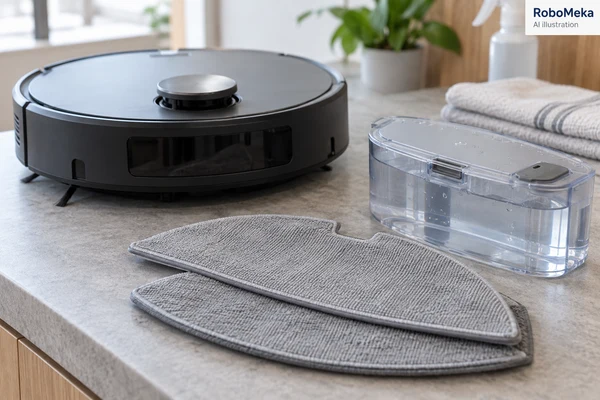
Mop lift describes movement of a mechanism or module according to a manufacturer's definition. The remaining gap over a rug depends on the starting geometry, fitted pad, robot position and textile surface. Buyers need the definition behind the number and the model's stated application limits.
Roborock's S7 MaxV product documentation provides a useful model-specific example: its notes distinguish mop-module lift from the lower carpet-pile limit stated for automatic lifting. This illustrates why buyers should read suitability notes rather than compare lift figures alone. Those limits must not be transferred to another model.
Ask whether the quoted measurement includes the supplied mop pad, how it is measured and which carpet conditions are approved. Also ask what happens at the rug edge, during a turn and on the way back to the dock. A straight pass across a flat sample addresses only part of the route.
The robot vacuum mopping systems guide explains the wider differences among pad and mop arrangements. Use that context when comparing lift, removable pads and other carpet-management options, but keep the final compatibility conclusion tied to the selected robot and textile.
Choose a rug-management strategy for each room
There is no need to force every rug into the same automated routine. One room may support vacuuming a compatible low-pile rug with the mop lifted. Another may require removing the mop for a separate vacuum pass. A third may need the rug excluded entirely because its material or fringe is unsuitable.
Clarify the meaning of app settings before relying on them. A no-mop area, a no-go area and a carpet policy may have different effects on travel. Depending on the model, a robot may be permitted to cross an area it will not mop, or may avoid it entirely. Obtain the actual behavior from the current manual and verify it.
| Rug or route condition | Strategy to assess | Key unresolved question |
|---|---|---|
| Compatible low-pile rug without loose edges | Documented lift-and-vacuum mode | Does the fitted damp pad remain clear throughout entry and turns? |
| Rug with unqualified fringe | Exclusion or approved preparation | Can threads remain outside all moving-part paths? |
| Delicate textile with brush restrictions | Exclude from robot cleaning | What separate care method does the rug maker permit? |
| Higher pile beyond documented mop suitability | Separate vacuum workflow if approved | Is the rug otherwise suitable for the robot without mopping hardware? |
| Rug across the only route to a room | Alternative dock location or split routine | Can the robot reach the destination within its carpet policy? |
| Frequently moved area rug | Review map and exclusions after movement | Does the stored boundary still represent the actual location? |
Use the table to identify what must be verified, not as automatic permission to run a machine on any particular rug. Some configurations will remain unsuitable even after changing a software setting.
Evaluate transitions before running a complete mission
First inspect the intended route with the machine stopped. Check the rug edge, loose objects, furniture clearance and access to the dock. Confirm the rug is within the documented application and the selected operating mode is appropriate. A site with an unresolved textile restriction should not proceed to a powered compatibility trial.
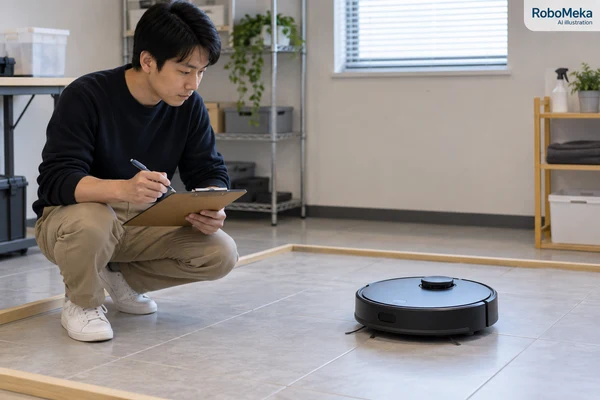
For a proposed controlled buyer evaluation, use an approved, replaceable rug sample and a safe ground-level test area. Record robot model, firmware, app version, fitted brushes, mop-pad reference and the selected carpet behavior. Establish stop conditions before beginning, including visible snagging, bunching, abnormal contact or other unexpected behavior.
Observe entry from representative directions and an ordinary turn, but do not force the machine toward an edge it has elected to avoid. Note whether the robot completes the route, repositions the rug or requires intervention. Keep physical observations separate from the app's description of what happened.
If pad clearance needs evaluation, agree a suitable observation method with the supplier using the approved sample and documented operating conditions. Do not create a wetting challenge on an expensive household rug. Stop at unintended pad contact and resolve the configuration rather than repeating the event until a favorable run appears.
Send your rug and floor requirements to RoboMeka with material details, care restrictions, edge photographs and the required travel routes. Ask for model-specific carpet-management options and a proposed evaluation before selecting a vacuum-and-mop configuration.
Record the difference between detection and outcome
A carpet icon on the map is evidence of the system's reported classification, not proof that the mop remained clear or that every fringe was avoided. Record both the reported event and the visible physical result. This distinction helps identify whether a concern involves sensing, settings, geometry or textile suitability.
Use an observation sheet with room, route, selected mode and outcome. Record whether the robot recognized the rug, changed behavior, crossed, vacuumed or avoided it. Add any displacement or intervention and the condition of the sample afterward. A short video can support the record when it shows the full approach and return.
Do not collapse every interruption into a navigation failure. A robot that avoids an excluded rug may be following its intended policy, while the household layout makes the destination inaccessible. Conversely, a visually neat map does not excuse an unsuitable physical interaction. The buyer needs both functional understanding and a practical room plan.
The obstacle-avoidance evaluation guide addresses a related distinction between advertised recognition and observed behavior. Its general method is useful, although loose textile fibers require their own care restrictions and should not be treated as interchangeable with ordinary floor objects.
Plan the route to and from the dock
A rug can be compatible for one activity but unsuitable as a transit route during another. The robot may need to return to wash a mop or recharge after cleaning part of the home. Check the complete path with the relevant pads attached and with the carpet policy active.
If the only passage is covered by an excluded rug, moving a map boundary may create an apparent solution while exposing the rug to the very condition the exclusion was intended to prevent. Consider a different dock position or a split workflow instead. Any alternative should maintain the dock's installation requirements and usable service access.
Include return trips in the proposed evaluation. The pad condition after mopping differs from the starting condition, and the robot may approach the same edge from a different direction. Observe normal dock-related travel without assuming the first successful outward crossing proves every later transition.
For multi-level homes, follow the multi-floor mapping guide when defining maps and carrying arrangements. A rug policy that works on one level should not be assumed to apply to another level with different textiles and dock access.
Make household preparation realistic
The routine must fit the amount of preparation customers will actually perform. If a demonstration requires removing several rugs, adjusting every fringe and rebuilding map exclusions before each run, describe that workload honestly. It may suit an occasional cleaning session but not the hands-off routine the marketing team intends to advertise.
Write a simple room handover based on the approved setup. Identify rugs that can stay in place, rugs that need a separate care method and changes that require checking the map again. Explain the selected app behavior in terms of what the robot will do, not only the label of a menu option.
Keep safety functions intact. Never suggest covering sensors or bypassing obstacle or drop protection to make a robot cross a troublesome textile. An access problem should be solved through supported settings, room preparation or an alternative cleaning method, not by defeating the machine's protective behavior.
Prepare support images from the actual model and app version. Illustrative photography can explain a room layout, but it should be labeled and should not serve as evidence of a successful wet-mop crossing. Customers need instructions they can match to the interface and hardware they own.
Translate sample approval into supplier requirements
Document the approved brush and mop-pad references, their installation method and the relevant software configuration. A change in pad thickness, attachment method or carpet-policy behavior can affect the application. Ask how the supplier handles such changes and what review is required before they enter the production range.
Factory testing can check agreed actuator operation, accessory detection where applicable and assembly consistency. The supplier should define a suitable functional method without representing it as a complete rug-compatibility test. Production controls support repeatability of the approved design; they cannot identify every textile a future customer may own.
Shipment inspection should verify the correct pads, brushes, instructions and accessory quantities against the approved sample. Record damaged or incorrectly fitted components and check software identity where it is part of the order specification. Retain the compatibility notes needed by distributors and customer-support teams.
For after-sales review, collect the rug details and selected settings before assuming a hardware fault. A new rug, moved boundary or changed pad can alter the application. Support teams should have a clear escalation path for suspected damage and should never ask users to repeat a harmful interaction to prove it occurred.
Frequently asked questions
Does mop lift prevent a robot from catching rug fringe?
No. Mop lifting changes the mop's position, while fringe can reach brushes or wheels elsewhere on the robot. Evaluate the textile and loose edges separately from mop clearance. Use supported exclusion or preparation methods where appropriate, and do not treat carpet detection or a high lift figure as an entanglement guarantee.
Can I compare carpet compatibility using only the lift height?
No. The measurement definition, fitted pad, starting geometry, pile and transition all matter. Ask for the manufacturer's stated carpet suitability and evaluate the complete route on an approved sample. A mechanism's travel distance is not automatically the free space available between a damp pad and the textile during operation.
Is a no-mop zone enough to protect a delicate rug?
Not necessarily. A no-mop zone may still permit travel or vacuuming, depending on the model, and those actions may be unsuitable for the textile. Confirm the specific setting's behavior and the rug's care instructions. A no-go boundary or separate cleaning workflow may be required when brush contact itself is restricted.
Should a buyer test a robot on a customer's expensive rug?
Begin with documented compatibility and a controlled, replaceable sample where testing is appropriate. Do not use a valuable rug as an experiment when the cleaning method is uncertain. Follow both manufacturers' instructions, agree stop conditions and resolve doubts before household use. Deliberately repeating snagging or unintended wet contact is not a useful qualification method.
What changes require reviewing the rug setup again?
A different rug, moved furniture, revised exclusion boundary, replacement pad or relevant software update can warrant review. The scope depends on what changed and the product instructions. Preserve the original approved configuration so support teams can compare it with the current setup and identify whether the issue concerns settings, components or a new application.
Conclusion
Successful mixed-floor cleaning depends on separating textile care, loose-edge control, mop clearance and navigation. Buyers should approve a room-specific strategy supported by the exact robot, accessories and instructions. That produces clearer customer expectations than a blanket claim that automatic mop lifting makes every rug compatible.
Ask RoboMeka for a mixed-floor configuration review with rug photographs, care requirements and the route between rooms and dock. Request a documented sample plan that treats fringe handling and wet-pad clearance as separate acceptance questions.