The short answer
Compare mopping systems by the intended cleaning task, approved floor surfaces, water handling, carpet interactions and maintenance routine. Evaluate complete configurations under repeatable conditions and record both cleaning observations and user effort. Pad motion, lift dimensions and dock features cannot independently establish superior cleaning or universal floor compatibility.
Introduction
The best robot vacuum mopping system for a product range is the one that matches the intended floors, soil, carpet interactions, and maintenance routine. Pad motion, water handling, and dock automation matter, but none of those specifications alone establishes the cleaning result. Buyers should evaluate the complete user workflow before choosing a private-label configuration.
A distributor serving mainly sealed hard floors may prioritize different features from a brand selling into mixed-floor homes. Customers may also differ in how often they are willing to wash pads, empty wastewater, or prepare rugs. These practical differences can matter more than a headline movement frequency or an impressive dock demonstration.
This guide provides a purchasing comparison and a proposed evaluation worksheet. It does not report completed RoboMeka cleaning tests or promise stain removal, disinfection, or suitability for every floor. Follow both the selected robot's instructions and the floor manufacturer's care requirements when defining an approved application.
Which mopping architectures should buyers distinguish?
Ask suppliers to describe what physically contacts the floor and how that contact is controlled. A dragged pad, an actively moving pad assembly, and a roller-based system are different architectures. Within each category, water supply, contact pressure, control logic, pad material, and maintenance arrangements can vary substantially.
Avoid declaring a universal winner from architecture alone. An actively moving system may still perform poorly if the pad is unsuitable, soil is redistributed, or the operating settings do not fit the surface. A simpler system may suit a limited maintenance application when its boundaries are stated clearly and the user accepts the required care.
Review our robot vacuum product family as a starting point for configuration discussions. Request the exact mopping assembly and included accessories rather than assuming every product in the family shares the same mechanism. The physical sample, specification, manual, and quotation should describe one consistent configuration.
What should a mechanism specification include?
Record pad or roller type, movement description, supported settings, water arrangement, and the way the assembly interacts with carpets. Ask which details are measured specifications and which are marketing descriptions. If a supplier quotes movement speed or downward force, request the method and conditions before comparing figures between products.
The useful question is how the mechanism contributes to an agreed cleaning task. A larger numerical value does not automatically establish better removal, less residue, or broader floor compatibility. Choose evaluation outcomes first, then use specifications to understand why configurations may behave differently.
What cleaning tasks should the product claim to address?
Define whether the intended application is routine maintenance of light household soil, removal of specified dried marks, or another supported task. Describe the floor and soil clearly enough for a repeatable comparison. Broad promises such as “deep cleans everything” cannot guide sample approval or customer support.
Keep vacuuming and mopping outcomes separate. Dry particles remaining before a wet pass can affect the observed result, while a visually clean floor may still show streaking after drying. Evaluate the intended sequence as a complete workflow, but record which stage contributes to each observation.
Do not imply sanitization, disinfection, or allergen reduction from ordinary mopping observations. Those claims need their own appropriate evidence and review. For a procurement trial, a clear description of visible soil removal and residue under defined conditions is more useful than unsupported health language.
How should floor compatibility be checked?
Obtain the floor manufacturer's care requirements and the robot's supported applications. Terms such as wood, laminate, stone, or tile are too broad to establish permission for a particular water or cleaning-agent routine. Surface finish, seams, condition, and manufacturer restrictions can change what is appropriate.
Use representative, approved test surfaces and a controlled protocol. Do not begin by exposing a customer's valuable floor to an unverified configuration. If compatibility remains unclear, retain it as an open question and avoid presenting the product as suitable for that material in customer-facing claims.
How should water handling be compared?
Map the path from clean water storage to the floor and, where relevant, from pad washing to wastewater storage. Ask how the selected configuration meters water, detects relevant conditions, and handles a paused cycle. Distinguish functions actually provided by the robot from functions performed at the dock.
Tank size alone does not establish useful cleaning area. Water consumption depends on the chosen mode, cleaning sequence, and any supported wash routine. Request a documented basis for area or endurance claims and verify the workflow in a relevant evaluation. A large tank can also affect handling and refill convenience.
Roborock's S7 Max Ultra support guidance gives model-specific information about washing, drying, and cleaning-agent use. It illustrates why water-system care belongs in the evaluation. Its instructions must not be generalized to other brands or treated as permission to use the same chemistry in an unrelated robot.
Should buyers test with ordinary household detergent?
Use only the cleaning agent and concentration permitted for the exact product and floor. Do not improvise mixtures, disinfectants, or additives to make a sample appear more effective. An unauthorized liquid can change the operating conditions and leave the trial unable to support the intended product claim.
The RFQ should identify whether cleaning solution is included, optional, restricted, or unnecessary for the approved procedure. Clarify supply and labeling responsibilities if a consumable is part of the customer workflow. Compare the complete supported arrangement instead of evaluating one sample with an advantage unavailable to production customers.
What should a mixed-floor evaluation examine?
List the actual transitions the product must handle: hard floor to rug, carpeted room to tiled area, or a threshold between surfaces. Ask whether the system lifts, avoids, detaches, or requires manual removal of the wet cleaning assembly. Confirm which behavior is documented for the quoted configuration.
A claimed lift dimension does not by itself prove that every carpet will remain dry. Carpet pile, rug edges, floor transitions, and the supported operating mode all belong in the assessment. Use suitable evaluation materials and the manufacturer's instructions; do not treat a successful pass over one thin mat as universal compatibility.
Record how the customer sets up the desired behavior. An app option is useful only if users can find it and understand its effect. If a rug requires a manually defined exclusion or another preparation step, include that in the product application description and the handover material.
How can a buyer compare complete mopping workflows?
Use the following original worksheet to compare configurations against the same customer task. It deliberately separates cleaning observations from maintenance and setup requirements. No row should receive a high score simply because an attractive feature name appears in the specification.
| Decision area | Evidence to request or observe | Buying implication |
|---|---|---|
| Floor contact | Assembly type and supported settings | Fit to the intended cleaning task |
| Soil removal | Defined marks and repeatable observations | Defensible performance description |
| Water control | Mode, consumption basis, residual moisture | Suitable routine for approved floors |
| Carpet interaction | Documented behavior and transition trial | Preparation needed in mixed-floor homes |
| Pad care | Removal, washing, drying, replacement | Ongoing user effort and consumable supply |
| Dock care | Tanks, tray, access, cleaning instructions | Practical maintenance burden |
| Recovery | Pause, resume, and supported fault handling | Clarity when normal operation is interrupted |
When a dock is included, evaluate the robot dock configuration as part of the bundle. Confirm exactly which functions are provided. Automatic dust emptying does not establish automatic mop washing, and mop washing does not establish every other maintenance function a customer might assume from the dock's appearance.
Send your mopping-system requirements with target floors, cleaning tasks, carpet use, desired dock functions, and expected quantity. The contact workflow prepares a downloadable inquiry brief and email-client handoff; it does not automatically send the information or place a sample order.
What would a controlled comparison look like?
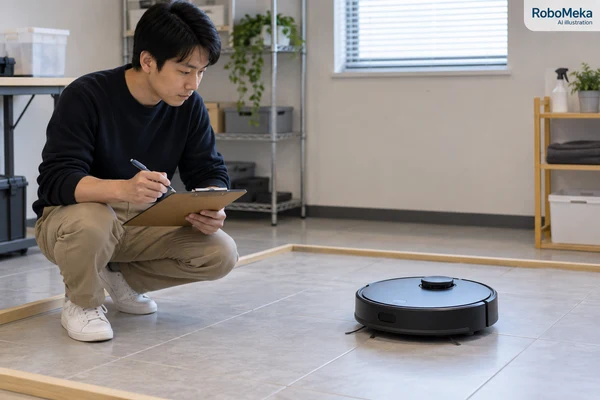
Consider a hypothetical buyer comparing two configurations for routine care of an approved sealed tile surface. The buyer defines three repeatable soil scenarios, a fixed preparation method, permitted cleaning settings, and observations after the floor dries. This is a proposed protocol, not a report of actual results.
Use comparable samples and record pad condition, water preparation, cleaning sequence, and manual interventions. Keep initial conditions consistent enough that differences have an interpretable basis. If a run is interrupted, document why and whether the result remains valid instead of quietly replacing it with a successful run.
The observation sheet can distinguish visible soil remaining, streaking, missed areas, water left behind, completion time, and hands-on maintenance. Where numerical scoring is used, define the scale with reference photographs or clear descriptions. An unexplained score such as nine out of ten gives future reviewers little information.
Suppose one hypothetical configuration removes the selected marks with fewer passes but requires more pad handling. Another leaves a different residual pattern while simplifying cleanup. The purchasing decision depends on the target customer and agreed acceptance criteria. The example does not establish that either architecture generally performs better.
How should before-and-after images be used?
Keep lighting, camera position, surface condition, and evaluation timing consistent. Photograph the floor after the agreed drying period as well as any relevant immediate observation. An image taken while water masks a mark may tell a different story from the final customer-visible result.
Images should support the written protocol rather than replace it. Retain the sample identifier and run reference with each file. AI-generated visuals can explain the setup, but they must be labeled as illustrations and must never appear as evidence of a completed cleaning result or factory test.
Why does pad maintenance influence product selection?
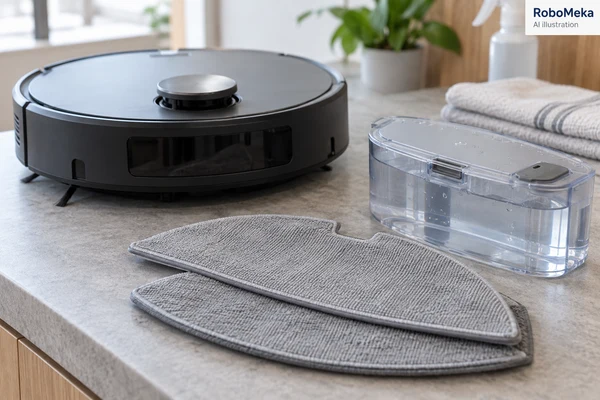
A mop assembly is part of an ongoing cleaning routine. Buyers should examine whether users can remove, clean, dry, and reinstall the contact material correctly. The required care should be practical for the intended customer and clearly explained in localized instructions.
Xiaomi's Mi Robot Vacuum Mop FAQ links the condition and cleaning of its mop to the mopping workflow. That is a model-specific example, not a universal replacement schedule. Request the appropriate care and replacement guidance for the product being sourced.
Evaluate spare-pad identification and supply. Record the compatible part number, material specification where relevant, and whether a revised pad changes the approved cleaning conditions. A visually similar replacement may not behave identically, so consumable substitutions should be controlled rather than chosen solely on price.
What should be observed at the dock?
Ask a representative user to perform the permitted routine care: handling tanks, accessing the wash area, removing residue, and reinstalling components according to the manual. Observe clarity and effort without encouraging shortcuts. A technically advanced dock can still be inconvenient if ordinary maintenance steps are awkward or poorly explained.
Record the full sequence rather than only active cleaning time. Refilling, wastewater handling, tray care, pad replacement, and troubleshooting all contribute to the experience. Avoid promising hands-free ownership merely because one task is automated. Define the remaining user responsibilities in the product description.
Which interruptions deserve evaluation?
Within the manufacturer's supported procedures, examine ordinary events such as a paused task, a required refill, or a user-requested return to the dock. Confirm that the product explains what happened and what the user should do next. A vague error message can turn a manageable event into a service call.
Do not create leaks, bypass safeguards, or introduce prohibited liquids to investigate failure behavior. Procurement evaluation should assess supported use and documented recovery. Questions about safety, abnormal conditions, or component durability belong with qualified specialists using appropriate procedures.
Where an app controls the mopping mode, record the version and relevant settings. A later software change can alter the user workflow even when the physical assembly is unchanged. Include version control in sample approval and ask which changes trigger a review of instructions or performance claims.
How should mopping requirements enter an OEM brief?
Specify the target application, exact assembly, approved consumables, required dock functions, and acceptance protocol. Include customer instructions and the claims that may appear in listings. This aligns engineering, purchasing, packaging, and support around the same intended use instead of leaving each team to interpret a broad feature label.
Discuss those details through OEM and ODM planning. A proposed factory test might verify assembly presence or agreed functions; shipment inspection might check supplied pads, tanks, labels, and accessories. Neither replaces the application evaluation used to support cleaning claims on selected surfaces.
Ask how the supplier will notify the buyer of changes to pads, pumps, tanks, software, or approved cleaning agents. Determine which changes require targeted reevaluation. A signed reference sample is useful only when the production configuration remains traceable and meaningful deviations are reviewed before shipment.
How should a distributor present the product honestly?
Use clear language about the intended maintenance task and required preparation. State the supported floor types with appropriate qualifications, describe carpet interactions accurately, and explain the remaining care routine. Avoid allowing stock images or short social videos to imply capabilities not established by the evidence.
Customer requirements should guide the product tier. Some buyers may accept manual pad care for a simpler bundle, while others prioritize a dock that automates selected tasks. The comparison should explain that practical trade-off and the verified features of each configuration rather than assigning a universal premium label to one mechanism.
Prepare support material around the questions observed during evaluation. If users misunderstand water settings or pad installation, improve the explanation before launch. The manufacturing review process can include those controlled documentation and packaging requirements alongside the product specification.
Frequently asked questions
Are rotating mop pads always better than a moving flat pad?
No architecture guarantees the best result in every application. Contact material, water control, settings, floor compatibility, and the defined soil all affect the comparison. Evaluate complete configurations under repeatable, permitted conditions, and include maintenance effort. A mechanism description explains how the system works but does not establish universal cleaning superiority.
Does mop lifting guarantee that every carpet stays dry?
No. Check the model's documented carpet behavior and evaluate representative transitions within its instructions. Pile, rug edges, and the supported mode can affect the application. Some configurations may require exclusions or manual preparation. Explain those requirements instead of converting a lift specification into an unrestricted mixed-floor promise.
Can any floor-cleaning liquid be added to the tank?
Use only the liquid and concentration permitted for the exact product and floor. Household cleaners, disinfectants, and improvised mixtures may fall outside the supported procedure. Ask the supplier to identify the approved routine and consumable requirements, then use that same arrangement for sample evaluation and customer-facing instructions.
Does an automatic washing dock eliminate maintenance?
No. Automation covers specified tasks, while users may still need to refill clean water, handle wastewater, clean accessible areas, and replace consumables according to the manual. Evaluate the complete routine and describe the remaining responsibilities clearly. The dock's size or appearance does not establish which maintenance functions it actually provides.
Conclusion
Choose robot vacuum mopping systems by the cleaning task, approved surfaces, carpet routine, and ongoing care required. A repeatable evaluation makes the differences between configurations useful, while controlled documentation keeps production and customer claims aligned. Mechanical specifications should explain observed performance rather than substitute for it.
Prepare a mopping product inquiry with your floor applications, desired functions, market, and quantity range. Send the prepared brief to info@RoboMeka.com through your email client to discuss a configuration and evaluation plan that matches the customers you intend to serve.