
The short answer
Buyers should evaluate lawn mower safety and maintenance through intended-use documentation, configuration-specific evidence, understandable controls and a workable service process. A machine is not adequately qualified because it starts and cuts during a demonstration. Confirm who may operate it, where it may be used, how it is made safe for permitted maintenance and who handles faults.
Introduction
Buyers should evaluate lawn mower safety and maintenance through intended-use documentation, configuration-specific evidence, understandable controls and a workable service process. A machine is not adequately qualified because it starts and cuts during a demonstration. Confirm who may operate it, where it may be used, how it is made safe for permitted maintenance and who handles faults.
This article is a procurement checklist for importers and distributors, not an operating manual or legal determination. Requirements vary with mower format, market and use. Competent specialists should determine the applicable compliance and workplace obligations. No certification, inspection outcome or safety performance is claimed for RoboMeka products in the examples below.
Define the product and its intended users
Start with a precise product classification and configuration. Walk-behind, ride-on and robotic mowers involve different operating arrangements and hazards. Power source, accessories and intended duty also matter. A supplier's document covering one category should not be assumed to establish the suitability of another because both products cut grass.
Identify the intended user group and sales channel. A domestic product supplied through an online retailer may reach someone with no demonstration or workshop support. Professional use can involve workplace procedures, training and different duty expectations. Do not infer that a machine is suitable for commercial work merely because it appears robust or has a large deck.
Ask the supplier to identify exclusions in plain language. Terrain, environmental conditions, operator limitations and prohibited tasks should be understandable to the buyer and the eventual user. An unclear intended-use statement creates uncertainty throughout the approval process because reviewers cannot tell which application the evidence is meant to support.
Keep sales ambitions separate from approved use
A brand may wish to serve a broader market than the sample was designed for. That is a development question, not permission to broaden the listing. Record the desired application and ask what additional engineering and conformity work would be required. Until that work is resolved, retain the documented limits in purchasing and marketing materials.
The lawn mower site-fit guide helps collect application information. It does not authorize operation on a particular slope or surface. The safety review must connect the actual site to the exact machine's instructions and the relevant local assessment.
Build an evidence map, not a folder of logos
List each purchasing question and the document or observation that answers it. The package may include intended-use instructions, declarations, test reports, inspection records and component information. Check the model identities, revisions and scope. A document with an impressive logo is not useful if it applies to a different machine or an obsolete configuration.
Different assessment activities serve different purposes. NIST's conformity-assessment overview distinguishes testing, inspection, certification and related processes. Use that distinction when reviewing supplier claims. A quality-management certificate does not automatically establish every safety requirement for the complete mower sold in a destination market.
Ask a competent specialist to determine which standards and legal requirements apply to the actual product and market. The U.S. Consumer Product Safety Commission's mower standards resource illustrates the existence of different mower categories. It should not be treated as a universal checklist that approves an unreviewed import configuration.
Keep unresolved evidence visible. If a report is incomplete, the model relationship is unclear or a component change has not been assessed, mark the approval conditional. Do not let missing information disappear into a supplier questionnaire marked “yes.” A clear open item gives the purchasing team a release condition to manage.
Review controls and instructions with the intended user
The user should be able to identify the controls and understand the normal start, stop and permitted adjustment procedures from the supplied instructions. Review the terminology, diagrams and translations against the actual machine. A correct technical document can still fail as customer guidance if labels and illustrations do not match what the owner sees.
Observe a permitted setup and use sequence with suitable personnel. Note confusion, repeated attempts or reliance on verbal explanations that are absent from the manual. These observations can identify usability questions, but they are not a substitute for formal safety evaluation. Never defeat an interlock or guard to make the demonstration easier.
Check how the instructions address foreseeable interruptions: an obstruction, unusual noise, a damaged component or a fault indication. The correct response must come from the manufacturer. Buyers should not create their own recovery shortcuts or encourage customers to continue operating an abnormal machine because a sales deadline is approaching.
Include accessories and optional configurations
An accessory can change the operating task and the instructions required. Confirm the approved combinations and the procedure for fitting or removing them. The presence of an item in a carton does not establish that the supplied manual covers its use. Keep optional configurations separate when their evidence or instructions differ.
For robotic equipment, installation and site control become part of the ownership process. Use the robotic mower installation checklist to organize those questions. Do not assume autonomous operation removes the need for correct setup, supervision arrangements or periodic review of the site.
Make maintenance achievable without improvisation
Ask which tasks the owner may perform and which require trained service. The answer should identify the relevant instructions, tools and parts rather than simply say “easy maintenance.” A distributor needs enough clarity to prepare support information and to avoid advising customers beyond the approved service boundary.
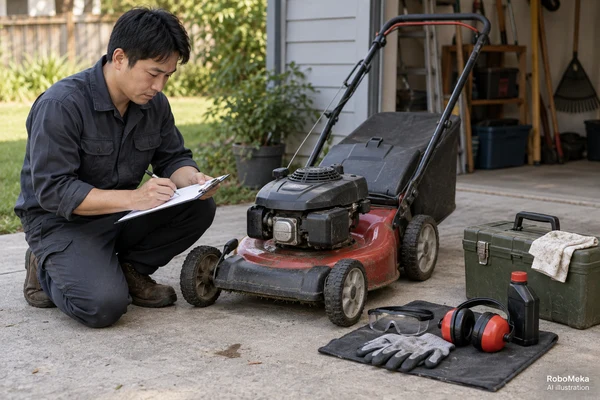
Maintenance planning should consider access, handling and the safe condition of the machine. The Health and Safety Executive's maintenance guidance emphasizes planned work, competence and safe isolation. For a mower, the exact stopping, isolation and handling procedure must come from its manufacturer; a general article cannot define it for every architecture.
Check whether the manual distinguishes cleaning from repair. A permitted external cleaning method does not imply that owners may open electrical housings, service battery cells or modify cutting components. Where washing is discussed, obtain the actual limitations rather than infer permission from a broad water-resistance phrase in a brochure.
Review maintenance intervals and conditions without inventing universal numbers. Some tasks may be time-based, use-based or condition-based according to the product instructions. The purchasing team should verify that the guidance is specific enough for the intended customer and that replacement items can be identified when needed.
Use a safety-and-service release worksheet
A release worksheet should show the evidence owner, current status and the condition that must be satisfied. It is not a substitute for expert assessment, but it makes the purchasing process traceable. Distinguish a document review from a completed test and distinguish an accepted limitation from an unresolved defect.
| Review area | Evidence or practical question | Release record |
|---|---|---|
| Intended use | Product category, users, duty and exclusions | Approved application statement |
| Market requirements | Specialist review of applicable obligations | Evidence references and unresolved items |
| Controls and instructions | Agreement between machine, labels and manual | Reviewed versions and usability observations |
| Maintenance | Owner tasks, service tasks and safe procedures | Support boundaries and responsible party |
| Parts | Approved identities and supply arrangements | Compatibility and replenishment records |
| Change handling | Review triggers for altered components or documents | Authorization and revalidation requirements |
Attach the actual document versions reviewed. A link to a supplier's changing download folder may not preserve what was approved. Keep enough record to identify the configuration and evidence if a later question arises. Access to confidential engineering records can be managed through agreed channels without publishing them on the website.
Send your mower safety and maintenance requirements with the target market, intended use and local support model. Identify the documents and service questions still open. Product suitability and compliance must be confirmed for the specific project rather than assumed from this educational checklist.
Prepare the distributor's fault-handling process
Define how an owner reports a concern and what information support staff request. Useful identifiers can include the model, serial or lot reference, configuration and a description of the event. Ask for evidence through a safe reporting process. Do not instruct an owner to recreate a hazardous event or continue using a suspect machine to capture a better video.
Separate routine support from potential safety issues. A missing accessory, an unclear instruction and an abnormal operating event may require different escalation routes. Agree who can authorize a replacement, a service action or a stop-use instruction where appropriate. The supplier and distributor should not improvise responsibility after the product has reached customers.
Preserve traceability across replacements and revisions. If a component is changed during service, record the approved replacement identity and relevant instructions. This helps prevent incompatible parts from entering the installed base. It also makes later analysis more useful because the service history refers to actual configurations rather than generic model names.
Workplace use requires additional operational context. OSHA's landscaping hazard guidance covers machinery and other risks in landscaping work. Buyers serving professional customers should support competent local procedures, not imply that possession of a product manual alone resolves every workplace responsibility.
Plan parts and training before the first order
Create a parts list that distinguishes user consumables, routine service items and restricted repairs. Ask for model and revision relationships, not only photographs. A small part can become a major support issue if its identity is unclear or the only documented remedy is an unexpectedly large assembly replacement.
Public manufacturer systems illustrate the value of precise identification. Toro's parts and manuals lookup connects support to specific equipment. Request an appropriate equivalent for the proposed range. Do not assume that a part from another brand or a similar-looking machine is an approved substitute.
Training should match the channel. A workshop network may need technical service information, while an online retail team needs clear boundaries for remote advice and escalation. Identify what each team is permitted and competent to do. A single presentation labeled “training completed” does not explain whether the relevant tasks and responsibilities are covered.
For a hypothetical launch, a buyer might classify ten recurring support questions into setup, routine care and specialist service. The number is an illustrative planning choice, not a standard. The useful output is a documented answer and owner for each question, with a process for adding real issues as the range enters use.
Link sample approval, production control and shipment inspection
Include a practical support rehearsal before release. Give the distributor's support team a hypothetical report containing a model identity, an unclear fault description and an incomplete photograph. Ask the team to identify the safe next question, the approved escalation route and the information it must not improvise. The exercise is not a safety certification, but it can reveal gaps in the handover.
Record the outcome as a documentation or training action, not a fictional customer incident. For example, the team may discover that two revisions use different manuals or that the service contact is missing from the distributor pack. Close those issues before launch and retain the updated material. This makes the support plan operational without inventing field experience or encouraging hazardous diagnostic demonstrations.
Sample approval should identify the machine and supporting documents reviewed. Production control should preserve that configuration or route proposed changes through review. Shipment inspection should verify agreed aspects of the lot before release. These are connected activities, but none should be described as replacing all the others.
Changes to controls, guards, cutting assemblies, power systems, labels or manuals may affect the basis of approval. Require the supplier to describe the change and its implications before implementation. A change presented as a cost saving can still require technical or conformity review. The purchasing team needs a defined authorization route.
Inspection criteria should be clear enough for the inspector to apply without improvisation. State permitted checks and avoid hazardous demonstrations. Where sampling is used, NIST's acceptance-sampling introduction provides the conceptual distinction between a lot decision and exhaustive certainty. Do not advertise a passing inspection as a guarantee that no defect can exist.
Keep a record of rejected or conditional items and the evidence used to close them. A photograph of a corrected sample does not automatically establish that every affected production unit was corrected. Agree the verification required for the particular issue and retain the release decision with the lot identity.
Frequently asked questions
Does a supplier certificate prove a mower is safe for every market?
No. Check what the document covers, which model and revision it identifies, and which requirements apply in the destination market. Different assessment documents answer different questions. A competent specialist should review the complete evidence package; a general factory certificate is not a universal product approval.
Should buyers test safety by bypassing controls?
No. Do not defeat guards, interlocks or other protections during an improvised purchasing demonstration. Safety evaluation requires appropriate methods, equipment and competent personnel. A buyer can review documentation and permitted operation while referring specialized testing to qualified parties. Convenience or a tight delivery deadline does not justify unsafe shortcuts.
What maintenance information should a quotation include?
Request the applicable manual, owner-versus-service task boundaries, replacement identities and the proposed support route. Clarify any special tools, training or environmental restrictions. The phrase easy maintenance is not enough. The buyer needs to understand how the customer will perform permitted care and how faults will be escalated.
Can a distributor write its own blade-replacement procedure?
It should not invent one. Use the manufacturer's approved, model-specific instructions and have appropriate personnel review any localized support material. Cutting systems and isolation arrangements differ. A procedure copied from a similar-looking mower can omit important requirements and should not be treated as an approved service method.
Why does change control belong in a safety review?
Because the evidence and instructions apply to an identified configuration. Altered components, controls or documents can change the basis of approval. Require a description, impact review and any necessary renewed evaluation before release. Keeping the same commercial model name does not establish that an engineering change is immaterial.
Conclusion
Lawn mower safety and maintenance sourcing requires a traceable connection between intended use, evidence, instructions and service. Review the complete configuration, preserve its limits and make support responsibilities clear before ordering. A credible purchasing process does not replace specialist assessment; it ensures that important questions reach the right people before release.
Prepare your mower safety and service brief, review the downloaded file and email info@RoboMeka.com to discuss project scope. The form does not automatically send the inquiry or certify a product. Availability and applicable requirements need project-specific confirmation.