
The short answer
Buyers should match a lawn mower to mowable area, site layout, access and permitted terrain rather than selecting from plot size alone. Measure the actual grass zones, identify hazards and check the exact model's operating limits. A capacity statement is useful only when its conditions resemble the customer's property and mowing schedule.
Introduction
Buyers should match a lawn mower to mowable area, site layout, access and permitted terrain rather than selecting from plot size alone. Measure the actual grass zones, identify hazards and check the exact model's operating limits. A capacity statement is useful only when its conditions resemble the customer's property and mowing schedule.
This guide is for distributors qualifying customer sites and importers defining a mower range. It turns a broad question about lawn size and terrain into a documented application brief. The worked site is hypothetical, and no slope, area or traction capability is claimed for RoboMeka equipment. Conventional mower formats are discussed for purchasing education, not as an unverified catalog expansion.
Measure the grass that must be maintained
Start with mowable area, not the property boundary. Exclude buildings, paved surfaces, ponds, planted beds and areas that the proposed machine cannot access. Keep the original sketch or map and note how the measurements were obtained. If the dimensions are estimates, identify them as estimates rather than presenting an exact-looking area as surveyed data.
Divide the site into zones that reflect how mowing actually happens. A front lawn, rear lawn and narrow side strip may require separate preparation or transport even when they share one address. Record the connection between zones and any step, gate, surface change or permission needed to move the machine. Those transitions can matter more than a modest difference in total area.
For a simple hypothetical rectangle measuring 20 m by 15 m, the gross area is 300 m². If a 30 m² patio occupies part of that rectangle, the remaining area is 270 m² before other exclusions. The arithmetic is straightforward; the important purchasing question is whether the measured shape and exclusions accurately represent the actual cutting task.
Complex boundaries need a sensible measurement method rather than false precision. A buyer can use a documented survey, suitable mapping tools or a carefully recorded estimate. Whatever method is chosen, retain enough information for another reviewer to understand it. The supplier should not have to guess whether “500 m²” includes the driveway and flower beds.
Describe shape, obstacles and edge work
Open area and intricate area should not be treated as equivalent workloads. Trees, beds, furniture, narrow corridors and frequent turns reduce the proportion of time spent on a full-width cutting pass. They may also create separate trimming or finishing tasks. Ask which parts of the desired result the mower is intended to deliver and which require another method.
Measure critical passages at their narrowest relevant point. Include gate hardware, fixed obstacles and the complete operating envelope of the machine. Cutting width alone cannot establish access. A collection attachment or handle arrangement may affect clearance, and a transport configuration is relevant only if the manufacturer's instructions permit it.
Identify edges that cannot be approached in the same way as open grass. A raised border, drop, water feature or fragile planting area introduces different concerns. Do not assume that a mower can cut every edge because a promotional image shows a neat boundary. Request the model's instructions and clarify any residual work that the customer must expect.
For robotic systems, obstacles and boundaries interact with navigation and installation. The robotic mower installation checklist addresses that separate workflow. A property suitable for an operator-led mower is not automatically ready for autonomous mowing, and a clear satellite image does not establish positioning or boundary performance on the ground.
Treat slope as a measured condition, not a marketing adjective
Record gradients using a defined method and distinguish degrees from percent grade. Percent grade is rise divided by horizontal run, multiplied by 100. In a hypothetical measurement with 0.2 m rise over 1 m horizontal run, the grade is 20%, corresponding to about 11.3 degrees. A 20% grade is not a 20-degree slope.
This calculation does not approve mowing on that slope. The exact machine's limits, operating direction, surface condition, nearby hazards and instructions determine suitability. Never infer a safe operating limit from wheel size, a powerful drive motor or a short video of the machine climbing. Travel capability and safe mowing use are different questions.
Map changes in gradient as well as the steepest point. A crest, hollow or abrupt transition can affect clearance and handling even when the average slope appears modest. Identify places where the operator would need to turn, reverse or approach an edge. A site assessment should describe the route, not merely report one maximum number.
Workplace guidance illustrates why site-specific assessment matters. OSHA's landscaping hazard resources cover machinery and related operational hazards. Use those resources as context for a competent local assessment, not as a substitute for the mower manufacturer's instructions or applicable local requirements.
Account for ground and grass condition
Terrain includes more than slope. Soft soil, ruts, exposed roots, loose material and uneven transitions can alter handling or the cutting result. Record whether a condition is permanent, seasonal or temporary. A product that fits a maintained lawn in one season may be inappropriate when the surface becomes unstable or the route is obstructed.
Do not treat wet-weather capability as established unless the exact instructions and evidence support the intended use. A water-resistance description for a component does not automatically permit mowing in rain, crossing standing water or using a pressure washer. Ask the supplier to distinguish operating, storage and cleaning conditions.
Grass condition also affects the task. Record the normal mowing interval, initial height and intended height reduction, along with any local turf expectations. University of Maryland Extension discusses how low cutting and uneven ground can contribute to lawn problems. A sourcing trial should not ignore those application conditions and blame every poor result on the motor.
When a site contains overgrown or rough areas, decide whether those areas belong in the product's intended use at all. Do not quietly include them in an ordinary lawn-capacity promise. Excluded conditions should be visible in the customer brief and sales guidance, with a suitable alternative assessment where necessary.
Convert the site into an operating route
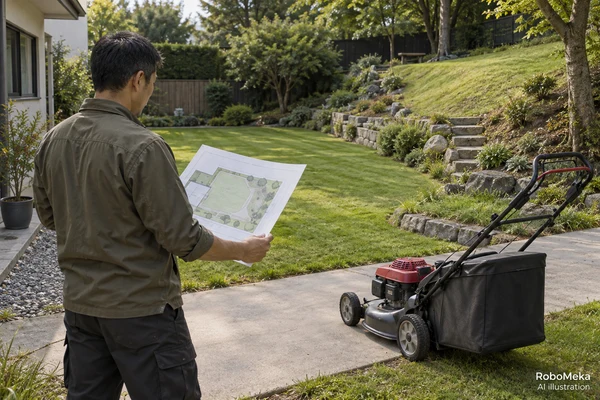
An operator-led mower needs a practical sequence for reaching, cutting and leaving each zone. Include retrieving the machine, opening gates, moving between lawns, handling clippings and putting equipment away. These activities explain why nominal area alone does not determine the time the customer experiences.
The power arrangement adds route constraints. A corded model requires a suitable electrical supply and cable-management approach specified for the product. A battery model needs a plan for finishing the task and replenishing its energy source. An engine model introduces different preparation and maintenance tasks. Evaluate the selected architecture rather than assuming all machines with the same deck width share one workflow.
Robotic mowing should be mapped as recurring maintenance over an available schedule. Installation, docking access, exclusion zones and changes to the property may determine whether that schedule remains practical. Use the robotic slope-assessment guide for robot-specific questions instead of transferring an operator-led route assessment unchanged.
Keep finish expectations explicit
Define whether the customer expects collection, mulching or another approved clipping arrangement. Record how material is handled and where it goes. A full collection bag can interrupt the route; mulching may require different operating conditions. Neither choice is merely an accessory preference when estimating the whole session.
Send your lawn layout and terrain requirements with zone areas, access measurements, photographs and unresolved site questions. The purpose is to establish project fit and the evidence needed for a recommendation, not to receive a universal capacity promise based only on square meters.
Use a practical site-qualification worksheet
A useful worksheet distinguishes measured facts, customer descriptions and open questions. It should be understandable to the sales team, technical reviewer and supplier. Keep unsafe or unresolved conditions visible rather than burying them in a total score. If a mandatory site condition is not supported, the product should remain unapproved for that application.
| Site feature | Information to collect | Purchasing consequence |
|---|---|---|
| Mowable area | Zone measurements, exclusions and measurement method | Defines the actual maintenance task |
| Access | Narrowest passages, steps and transport requirements | Determines whether the complete machine can reach the task |
| Terrain | Measured gradients, transitions and surface condition | Requires comparison with model-specific permissions |
| Boundaries | Water, drops, roads, beds and other hazards | Defines exclusions and risk-assessment questions |
| Grass routine | Species context, mowing interval and intended finish | Informs cutting configuration and evaluation conditions |
| Operating infrastructure | Supply, storage, charging or installation arrangements | Tests whether the ownership workflow is feasible |
Photographs should show context, not only the most attractive part of the lawn. Include the access route and areas that may be unsuitable. Where a dimension matters, record the measurement separately and identify the location on the plan. An image can help explain a question, but it should not be treated as proof of a precise gradient or clearance.
Record the source and date of the site information. A plan prepared before landscaping changes may no longer describe the route. Assign responsibility for notifying the supplier or dealer when the property changes. This is especially relevant where installation arrangements or boundaries form part of the product's approved application.
Work through a hypothetical divided property
Consider a proposed customer profile with a 270 m² rear lawn, a 120 m² front lawn and a 35 m² side strip. The calculated total is 425 m². The rear lawn is reached through a narrow gate, while the front lawn is separated by a paved route. These numbers are illustrative and do not define a recommended mower capacity.
The buyer first checks access using overall machine dimensions. If the candidate cannot pass through the gate in a permitted configuration, its advertised area rating becomes irrelevant for the rear lawn. The buyer then reviews the side strip's width and turning requirements, because a wide deck may not use its theoretical coverage advantage there.
Next, the route is reviewed for surface changes and any gradient requiring model-specific approval. An unresolved slope question stays unresolved; it is not offset by a favorable total area. The buyer asks for appropriate technical guidance and may exclude part of the site from the proposed application rather than testing an unsafe condition.
Finally, the customer session is evaluated in the approved configuration. Preparation, zone transfers, clipping handling and replenishment are recorded alongside actual cutting. A machine can be a sensible choice for the 425 m² task without matching the quickest theoretical area calculation. Conversely, a large nominal capacity does not rescue a poor access or support fit.
Verify the recommendation and preserve its limits
Use the site brief to define a representative sample evaluation. Record the machine identity, settings and observations. If the evaluation property differs from the target profile, describe the difference and what remains unproven. A convenient demonstration lawn should not silently stand in for every customer site in the planned market.
Keep instructions available throughout the review. Toro's parts and manuals service is an example of model-based documentation access; buyers should request the corresponding documents for the actual proposed equipment. General advice from another brand is not permission to use a different mower in the same way.
After approval, convert the site conditions into a readable recommendation record. State the intended application, exclusions, remaining customer tasks and required infrastructure. Train sales staff to ask the same critical questions. A detailed technical assessment has little value if the final listing reduces it to “suitable for large gardens” with no qualifications.
Review maintenance access as part of the recommendation. HSE's maintenance guidance emphasizes safe planning and competent work. A storage location that makes approved handling or maintenance impractical is an ownership problem even if the mower performs well on the lawn itself.
Reassess when the site or product changes
New beds, fences, trees, paving or storage arrangements can change the task. So can a different mowing schedule or clipping preference. Establish a simple process for reviewing those changes instead of assuming the original recommendation remains valid indefinitely. The customer should know which changes merit contacting the supplier or dealer.
Product changes also matter. A substituted deck, wheel, power pack or attachment can affect access, handling or completion. Ask the supplier to identify changes that require rechecking the original application assumptions. This connects site qualification to production change control rather than treating the sample review as a one-time marketing exercise.
For larger purchasing programs, retain a small library of clearly described customer profiles. Update them using real inquiries and support information, without inventing a universal regional average. The aim is to improve the questions asked before sale, not to claim that every property in a country resembles one demonstration lawn.
Frequently asked questions
Should mower size be selected from total property area?
No. Use mowable grass area and record excluded surfaces, separate zones and access routes. Total plot size can substantially misrepresent the cutting task. Even an accurate grass area needs context: obstacles, terrain, clipping handling and the available operating schedule affect whether the complete machine fits the customer's requirements.
Is a mower's maximum area claim enough for selection?
No. Ask how the claim was established and compare its configuration, conditions and schedule with the target property. A stated area does not prove gate clearance, terrain suitability or acceptable session time. Treat it as one piece of evidence, not as a complete recommendation for any lawn below that number.
Are percent slope and degrees interchangeable?
No. Percent grade describes rise relative to horizontal run, while degrees describe an angle. Convert carefully and keep the original unit in the record. Neither measurement alone approves operation: the manufacturer's limits, operating instructions, surface condition and site-specific hazards still determine whether the application is suitable.
Can a dealer qualify terrain from photographs alone?
Photographs can identify questions but may not establish dimensions, gradients, ground condition or hidden hazards. Combine them with reliable measurements and a competent assessment where needed. Mark uncertain information clearly. Do not issue a confident terrain recommendation merely because the site looks similar to an advertising image.
When should a mower recommendation be reviewed again?
Review it when the site layout, boundaries, access, storage, mowing routine or product configuration changes in a way that affects the original assessment. Keep the approved assumptions accessible to the customer and dealer. A recommendation is tied to defined conditions, not a permanent guarantee for every future version of the property.
Conclusion
Lawn mower lawn size and terrain assessment should produce an application record, not just an area label. Measure the grass zones, understand the route, verify access and compare terrain with the exact model's permissions. This gives buyers a defensible basis for selecting equipment and explaining its limitations.
Prepare your mower site-assessment brief and include the property layout, operating routine and questions requiring confirmation. Review the local download before sending it to info@RoboMeka.com. Availability and project suitability must be established separately from the educational examples in this guide.