The short answer
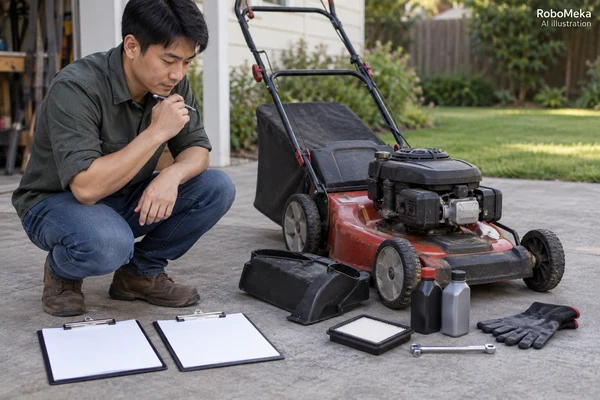
Buyers should compare lawn mower prices only after matching the machine configuration, included accessories, evidence package, delivery assumptions and after-sales responsibilities. A lower unit quotation is not necessarily a lower-cost purchasing program. It may exclude a battery, charger, collection accessory, inspection activity or replacement-parts commitment that another supplier has included.
Introduction
Buyers should compare lawn mower prices only after matching the machine configuration, included accessories, evidence package, delivery assumptions and after-sales responsibilities. A lower unit quotation is not necessarily a lower-cost purchasing program. It may exclude a battery, charger, collection accessory, inspection activity or replacement-parts commitment that another supplier has included.
The practical objective is not to find a universally correct mower price. It is to understand what each offer delivers for a defined customer application, and which costs remain with the importer, distributor or end user. That comparison becomes especially important when quotations mix walk-behind, ride-on and robotic products under the broad term lawn mower.
This guide provides a commercial evaluation method, not a current price list or a quotation from RoboMeka. Examples are hypothetical. Availability, minimum order quantity, customization scope, warranty and shipping terms must be confirmed for the specific project before they become purchasing assumptions.
Establish a reference specification before requesting prices
A quotation without an agreed reference specification is an invitation to compare different products. Identify the intended user, property conditions, power architecture, cutting system and required package. Decide whether the purchase concerns a complete ready-to-use kit, a machine without energy components, or a robotic system that also needs site preparation.
Include the functions that materially affect cost. Self-propulsion, collection arrangements, folding mechanisms, battery configuration, charging equipment and connectivity can change the bill of materials and the support burden. Do not treat them as interchangeable marketing features. Connect each requirement to a genuine customer need before assigning it value.
Separate mandatory requirements from optional alternatives. For example, a collection accessory may be essential for one sales channel but optional for another. Ask suppliers to quote the reference package first, then price clearly identified variations. This makes the cost of a feature visible without allowing the underlying configuration to drift unnoticed.
The lawn mower selection guide can help establish the application brief. The relevant grass-management requirements should also be realistic: University of Minnesota Extension's mowing guidance explains why mowing frequency, height and blade condition affect lawn care. A cheaper machine that does not fit those needs can generate avoidable dissatisfaction.
Separate the factory price from the complete commercial offer
The machine price is only one layer. Ask what packaging, manuals, accessories, inspection documents and labeling are included. Identify the named delivery term, location and cost responsibilities precisely. Do not infer those responsibilities from a casual phrase such as shipping included; the commercial agreement should remove ambiguity.
Currency, quotation validity and payment milestones also matter. Two offers can have similar nominal prices but different exposure to exchange movements or advance-payment requirements. Record these assumptions in the comparison rather than burying them in email. Seek qualified commercial advice where a term creates unfamiliar obligations.
Discounts should be evaluated against the exact quantity and configuration to which they apply. A lower price for a much larger order may introduce inventory and demand risk. Likewise, a mixed-model order may not qualify for the same economics as a single standard SKU. Ask the supplier to show the applicable boundaries rather than assuming every volume can be combined.
Keep one-time project costs separate from recurring unit costs. Artwork development, samples, tooling, translations or technical evaluation may be quoted independently. Their treatment should be explicit so that the first order and later replenishment orders can be compared on a consistent basis.
Build a quote-normalization worksheet
Use a worksheet that records both the amount and the evidence behind each line. Mark exclusions and unresolved items openly; a blank cell should not silently become zero. The following structure is an evaluation aid, not a standardized accounting model or a statement of what any particular supplier includes.
| Comparison item | What to normalize | Question for the supplier |
|---|---|---|
| Machine identity | Model, revision and power format | Which exact configuration is quoted? |
| Customer package | Battery, charger, bag and accessories | What will the buyer receive in the carton? |
| Technical evidence | Reports, manuals and approved claims | Which documents match this configuration? |
| Project charges | Samples, artwork and engineering | Which charges recur on later orders? |
| Logistics | Carton data and agreed responsibilities | Which shipping-related costs remain excluded? |
| Quality controls | Inspection scope and release process | Who pays for agreed checks and reinspection? |
| Service provision | Parts, diagnosis and claim handling | What support obligations are included? |
| Inventory exposure | Order quantity and replenishment assumptions | What happens if demand differs from the forecast? |
Where a cost cannot yet be calculated, assign an owner and a date for resolving it. This is more useful than introducing a speculative percentage that appears precise but has no basis. Finance, logistics and service staff should review the worksheet before the purchasing team recommends an offer.
Preserve the original supplier quotations alongside the normalized version. A comparison spreadsheet is an interpretation, not a replacement for the commercial documents. If a supplier later clarifies a package or changes a specification, record the revision and update every affected line.
Understand why similar-looking mowers can cost differently
External appearance reveals relatively little about the complete cost structure. Differences may lie in the drive system, material specification, tolerances, battery pack, charging equipment, controller, assembly controls or service documentation. A higher price does not prove better quality, but a lower price does not prove that the products are equivalent.
Ask suppliers to explain differences in terms that can be checked. For example, a claim of improved durability should lead to a defined evaluation method and applicable configuration, not only a stronger adjective. Similarly, a claimed performance advantage should refer to mowing conditions and the finished result.
Avoid assigning value to a component name alone. Buyers need to understand the assembled product and its application. A particular motor label, battery capacity or deck material does not automatically establish the best customer outcome. Review the evidence and service implications together with the specification.
The NIST introduction to conformity assessment is a useful reminder that different assessment activities answer different questions. A document should be evaluated for its scope and relevance, not treated as a generic premium badge that justifies any price difference.
Compare energy packages and operating assumptions
Battery products require a clear distinction between a bare tool and a complete kit. Specify the number and identity of packs, the approved charger and the operating configuration. A machine requiring two installed packs should not be compared with an offer that includes only one unless the shortfall is explicitly priced and technically resolved.
For engine-powered equipment, operating cost discussions depend on the actual application, fuel arrangements and maintenance plan. For mains-powered equipment, access and approved supply arrangements matter. For robotic equipment, installation preparation, site suitability and support may be significant. Do not collapse these different operating models into a single universal running-cost figure.
Manufacturer claims are tied to their own products and conditions. EGO's mower information, for example, identifies variables that affect runtime. Such material illustrates why conditions matter; it does not establish equivalent endurance or cost for a different manufacturer's machine.
Send your mower quotation requirements with the proposed package, destination market and items that must be included. Use the downloaded brief to request a configuration-specific discussion with RoboMeka. This contact step does not establish a price or confirm availability of every mower format discussed here.
Account for logistics without inventing a universal freight rate
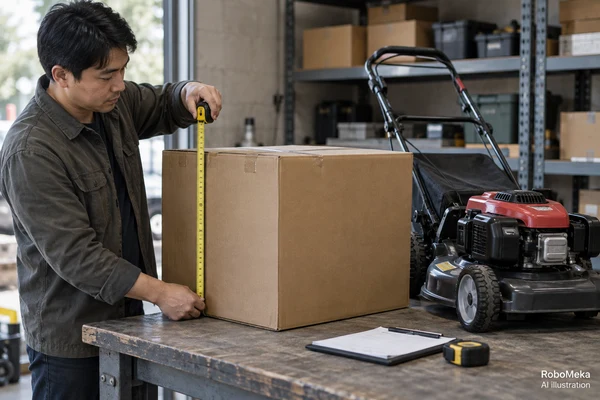
Carton dimensions, gross weight, packaging method and shipment configuration affect logistics planning. Ask for data from the intended production package, not an early sample carton. A change in handle assembly or accessory arrangement can alter packing efficiency and receiving work even when the mower itself appears unchanged.
Battery shipments require particular attention to classification, documentation and transport mode. IATA's battery transport resources provide a starting point for air-transport planning. A qualified logistics provider should assess the actual shipment; do not assume that a general battery document resolves every packaging or carriage requirement.
Include destination-side costs that your own business must bear, using verified quotations or advice where necessary. These may depend on the market, contractual responsibilities and shipment details. This article does not supply customs rates, tax advice or a landed-cost guarantee.
Packaging should also be judged against damage prevention and handling. A smaller carton is not automatically a better commercial solution if it creates assembly problems, missing-part risk or inadequate protection. Ask receiving and service teams to review the packing concept before treating a packaging reduction as a confirmed saving.
Price the support commitment, not just the spare part
After-sales cost includes diagnosis, communication, replacement logistics and the availability of correct parts. A low-priced component can become expensive if the model identity is unclear or the replacement process requires repeated customer contact. Request a parts list tied to the exact revision and a practical route for technical questions.
Review which tasks customers can perform under the manual and which require competent service. HSE's machinery maintenance guidance emphasizes planned maintenance and appropriate competence. It is not a mower-specific repair procedure, but it supports the need to budget for a safe, defined maintenance model.
Warranty wording should identify the responsible parties and the handling process. Clarify the agreed coverage and exclusions with the supplier and obtain appropriate advice for obligations in the destination market. Do not treat a headline warranty duration as a complete description of the support service.
Use your own verified sales and service history where available. If this is a new category, model a range of possible support outcomes and label the assumptions. Do not invent a failure rate to make a business case appear complete. A pilot order can help resolve uncertainty, provided its limitations are acknowledged.
Evaluate savings against the risks they introduce
Consider a hypothetical offer that removes a spare accessory, simplifies packaging and changes the battery bundle. These are three different proposals. The accessory change affects customer contents; the packaging change affects handling; the battery change may alter performance, evidence and transport considerations. They should not receive one blanket approval as cost reduction.
For each proposal, identify the expected saving, the affected requirement and the validation needed. An apparent saving that creates a new service obligation may still be worthwhile, but only if the business understands the trade-off. Keep engineering, quality and commercial decisions connected.
Factory testing and shipment inspection should have defined scopes. Reducing an inspection budget does not remove the underlying need for production controls. NIST's acceptance-sampling overview explains the role of sampling in lot decisions; it should not be represented as a guarantee that every unit is defect-free.
Finally, test sensitivity to order volume and replenishment timing. A unit-price advantage can disappear if an oversized order creates slow-moving stock or requires additional storage. The preferred offer should remain understandable when the forecast changes, not only under the most optimistic sales scenario.
Record the decision and its sensitivity
Before approving an offer, write a short decision note explaining the reference configuration, material exclusions and reasons for selection. Include the quotation revision and the assumptions that would cause the decision to be reviewed. A useful note might identify order quantity, currency validity or a particular accessory as a dependency without pretending that every future cost can be predicted.
Then test a few realistic alternatives using confirmed information where available. What changes if the first order is smaller, if one color sells more slowly, or if the customer requires a different approved kit? The purpose is not to manufacture a precise forecast. It is to see whether the preferred offer remains understandable when ordinary business conditions differ from the initial plan.
Share the note with the people who will receive and support the product. They should know which responsibilities the business accepted and which remain with the supplier. A purchasing saving is easier to evaluate when the downstream teams can see the same agreement, rather than discovering exclusions only after the first customer inquiry.
Frequently asked questions
Why do lawn mower quotations vary so much?
They may cover different configurations, accessories, quantities, evidence requirements and delivery responsibilities. Start by matching those elements before attributing the difference to quality or supplier margin. Ask each supplier to identify exclusions and assumptions so that the comparison reflects the same purchasing scope rather than similar product photographs.
Is a higher-priced mower always a better purchase?
No. A higher price may fund features or support that your customers value, but it can also include unnecessary complexity. Evaluate application fit, documented performance, production consistency and service readiness. Price should be assessed against verified requirements rather than used as a shortcut for quality.
Should buyers compare bare tools with complete battery kits?
Only after normalizing the package. Identify the approved packs, charger and number of batteries needed for operation, then add any missing items using confirmed prices. Check compatibility before making the calculation. A nominally inexpensive bare tool may serve existing platform owners well but be unsuitable as a first purchase.
How should an importer estimate after-sales cost?
Use verified historical data where it applies, and clearly labeled scenarios where it does not. Include diagnosis, parts, communication and logistics as well as the component price. Agree the supplier's responsibilities in writing. Do not present an assumed failure rate or service cost as measured product performance.
Can RoboMeka provide one standard mower price list?
Request current information for the product and project scope you need. The articles discuss several mower formats for buyer education and do not confirm that RoboMeka supplies every format. A useful inquiry states the destination, application, configuration and expected volume so that availability and quotation terms can be assessed.
Conclusion
The most useful lawn mower price comparison is a documented comparison of complete offers. Match the application and package, separate recurring and project costs, clarify logistics, and make support assumptions visible. A defensible purchase decision explains both the price and the responsibilities that come with it.
Ask for a configuration-based mower quotation, review the downloaded requirements document and email it to info@RoboMeka.com. The form prepares a local brief; it does not send email automatically or confirm commercial terms.