The short answer
Choose a lawn mower by matching the machine type to the property, the person responsible for mowing and the service arrangement available after purchase. Cutting width, power and price matter only after that fit is established. For an importer, the best shortlist is a small set of clearly defined configurations, each with evidence supporting its intended customer job.
Introduction
Choose a lawn mower by matching the machine type to the property, the person responsible for mowing and the service arrangement available after purchase. Cutting width, power and price matter only after that fit is established. For an importer, the best shortlist is a small set of clearly defined configurations, each with evidence supporting its intended customer job.
This guide is for distributors, retailers and private-label purchasing teams building a mower assortment. It explains how to select a product category before negotiating an order, rather than recommending a universal winning model. The examples are proposed buying exercises, not accounts of RoboMeka customer projects. Discussion of petrol, electric or ride-on equipment does not establish that RoboMeka supplies those formats; its published product focus includes robotic mowing.
How to choose a lawn mower around a customer job
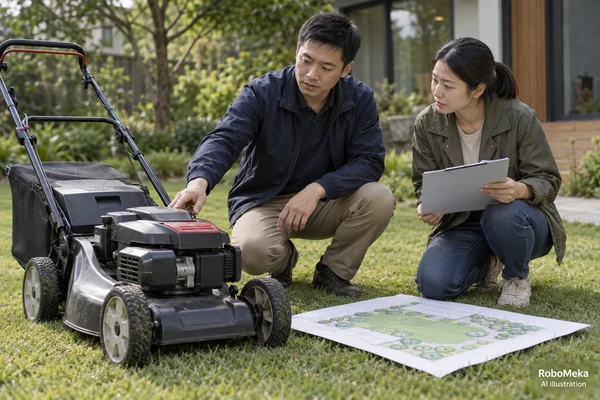
Start with a description of what the customer needs to finish. A homeowner maintaining one enclosed lawn has a different requirement from a contractor visiting several properties, even if the total grass area is similar. The first customer may value compact storage and simple starting; the second may need transport practicality, predictable turnaround and a repair route that fits working hours.
Describe the normal mowing session in order: retrieving the machine, preparing the site, cutting, handling clippings, cleaning and storing it. Note who performs each step and what interrupts the sequence. A product demonstration often concentrates on the cutting pass, but the owner experiences the whole session. Procurement should therefore examine the complete routine, not just the most attractive few minutes.
Collect customer requirements from a defined segment instead of combining every possible preference into one specification. For example, a hypothetical small-garden range might prioritize narrow access and simple handling, while an open-lawn range emphasizes efficient coverage. Neither segment automatically needs the largest motor, the widest deck or the most advanced controls. Record the reason for each requirement so the shortlist remains understandable when sales or engineering personnel change.
Separate requirements from preferences
Mandatory conditions should eliminate unsuitable candidates before scoring begins. These might include a documented intended use, a compatible electrical arrangement, safe access or an acceptable service pathway. Preferences can then distinguish the remaining products: storage convenience, adjustable handles, collection capacity or appearance. This prevents a low purchase price from compensating on paper for a basic mismatch that customers cannot work around.
Select the operating format before comparing features
A walk-behind mower needs an operator throughout the mowing task. A ride-on machine changes the access, storage and operating requirements. A robotic mower introduces a different workflow involving site suitability, installation and recurring autonomous operation within its approved limits. These formats should not be ranked solely by nominal cutting width because they organize the work differently.
Within walk-behind equipment, distinguish manually pushed and powered-drive machines. Powered travel can help with some workloads, but it does not remove terrain restrictions or make every machine suitable for a slope. Evaluate the controls, turning effort, stopping behavior and handling with the actual user group. A feature that improves straight-line movement may add complexity when navigating tight corners or moving between disconnected lawns.
Power-source selection is another branch, not the entire decision. Corded equipment needs a suitable supply and an approved cable arrangement. Battery models require an appropriate pack, charger and replenishment plan. Petrol models introduce fuel and engine-maintenance considerations. For robotic options, use the separate RTK versus boundary-wire comparison before assuming that wire-free operation removes installation preparation.
Manufacturers organize instructions and spare parts around specific models. Toro's parts and manuals lookup is one example of that model-level documentation approach. Request equivalent clarity from any shortlisted supplier; another manufacturer's published documents do not validate the product you intend to buy.
Turn the property into a selection brief
Measure mowable area rather than the complete plot. Buildings, patios, ponds, planting beds and inaccessible strips should not silently remain inside the area used for sizing. Record the number of separate grass zones and the route between them. A single large rectangle and several narrow lawns may have the same area but require very different maneuvering and setup time.
Access dimensions deserve their own line. Gate clearance, passage width and storage openings relate to the machine's overall dimensions, not just its cutting width. Include the collection attachment and the handle position used while passing through the opening. Where lifting or steps are involved, obtain the manufacturer's permitted handling method and determine whether the intended operator can perform it safely.
Terrain descriptions should identify gradients, uneven transitions, soft areas and nearby hazards. Do not substitute a photograph labeled “hilly” for a measured site assessment. Slope permissions are model-specific and may differ by operating direction or machine format. A machine that can move uphill during a demonstration has not thereby established safe mowing suitability on that site.
Grass expectations also change the selection. Species, desired finish and mowing frequency influence the practical cutting-height range and clipping burden. University of Minnesota Extension's mowing guidance illustrates why mowing practice and turf context matter. Its regional advice should inform questions, not become a universal cutting-height requirement for every overseas market.
Build a comparison that exposes missing evidence
Use a common worksheet for the shortlist. Ask suppliers to answer against the same application description and identify the exact machine, blade, power source and accessory bundle. If a specification is unavailable, mark it unknown. An empty cell is more useful than an optimistic assumption because it shows where the purchasing decision is still conditional.
| Decision area | Evidence to request | What it helps decide |
|---|---|---|
| Intended customer and duty | Manual, intended-use statement and exclusions | Whether the format belongs in the range |
| Property access | Overall dimensions and handling instructions | Whether the machine reaches and leaves the lawn |
| Cutting result | Defined grass conditions and sample observations | Whether the offered configuration suits the finish |
| Work-session completion | Recorded cutting, interruption and turnaround times | Whether ownership expectations are realistic |
| Maintenance and parts | Service identities, permitted tasks and supply terms | Whether the local support model is viable |
| Production consistency | Approved configuration and change-control process | Whether later deliveries match the reviewed sample |
Avoid converting every row immediately into a numerical score. First distinguish confirmed, unconfirmed and unsuitable conditions. Scoring can then help compare products that pass the basic gates. Otherwise, a candidate with excellent styling and a low price can appear competitive despite missing evidence about its intended use or replacement parts.
For product documentation, distinguish testing, inspection, certification and other assessments. NIST's conformity-assessment overview explains those as different activities. A supplier's general certificate should not be treated as a substitute for evidence covering the offered mower configuration and destination market.
Evaluate a complete sample session
Write the evaluation questions before the sample arrives. Identify the property conditions, permitted settings, configuration and observations that will inform the selection. Keep the exercise within the manufacturer's instructions and use competent people. Do not improvise hazardous tests, defeat guards or deliberately exceed a stated operating limit to see what happens.
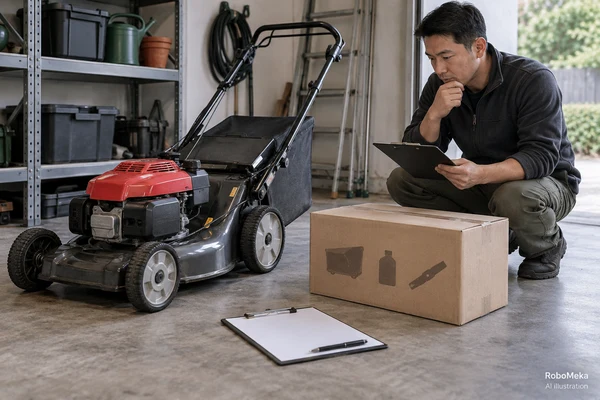
Begin with the delivered package. Check whether the contents match the proposal and whether assembly instructions are understandable to the intended customer. Record the preparation tasks and any special tools or knowledge required. A mower can cut acceptably yet create avoidable support demand if the carton contents, handle setup or accessory instructions are unclear.
During product application review, observe the finish, turning effort, clipping handling and interruptions. Record the grass condition and the amount being removed, not merely “tested on lawn.” Keep observations separate from conclusions: “a second pass was needed in this area” is an observation; “the product is unsuitable for all dense grass” would require substantially more evidence.
Repeat important comparisons under reasonably comparable conditions and retain the run identifiers. Change one relevant factor at a time when diagnosing a difference. Factory testing can help establish controlled observations, while a local evaluation can reveal application questions that a factory lawn does not reproduce. Neither should be presented as an exhaustive reliability study.
If the intended application is already clear, send your mower selection requirements with the lawn layout, customer segment, preferred format and unresolved evidence questions. RoboMeka can review whether the project fits its available product scope; an inquiry is not confirmation that every mower type discussed here is offered.
Compare ownership rather than purchase price alone
Ask how the customer obtains routine consumables and how the dealer identifies the correct replacement item. A drawing, part number and revision relationship are more actionable than a statement that “spares are available.” Clarify which maintenance tasks belong to the owner and which need trained service. Instructions should agree with the actual machine and accessories in the carton.
Consider the consequences of each support model. Direct online sales need clear self-service information and a practical escalation process. A dealer channel may support demonstrations and workshop work but needs training, documents and parts replenishment. The same machine can require different commercial preparation in those two channels, even when the physical product remains unchanged.
Maintenance planning should follow the machine's instructions and local requirements. The Health and Safety Executive's maintenance guidance emphasizes planning, competence and isolation. For purchasing, the useful question is whether the supplier makes safe maintenance achievable through appropriate instructions, access and support—not whether a brochure says the machine is maintenance-free.
For battery products, include replacement-pack identity and compatibility limits. For engine products, clarify the engine service route. For robotic machines, consider installation support and site changes. These are different ownership obligations; a single generic warranty paragraph cannot explain all of them. Obtain the terms applicable to the exact configuration and sales channel.
Use a hypothetical assortment decision
Suppose a distributor is considering two segments: compact residential gardens and larger, relatively open domestic lawns. Its planning examples use 300 m² and 900 m² of mowable area, respectively. These are illustrative customer profiles, not recommended capacity limits. The buyer also records a 700 mm gate in one profile and a separate storage constraint in the other.
A proposed 460 mm cutting width does not prove that the first product passes the gate. The distributor requests overall width and the required operating configuration. It then reviews the complete session on a representative permitted site, including collection handling and storage. If another machine has a narrower cut but simpler access and turning, it may better fit that segment without being technically superior in every respect.
For the larger profile, the buyer asks whether the chosen power and replenishment arrangement can finish the intended task with an acceptable margin. The answer must come from configuration-specific evidence rather than an “up to” area statement copied from a different bundle. If robotic mowing is considered, its recurring schedule and installation requirements are evaluated separately from a weekly operator-led session.
The distributor might retain two configurations, reject one and leave a third conditional on service documentation. That is a legitimate outcome. The purpose of comparison is not to force one universal winner; it is to define which product belongs in which customer promise and what evidence remains necessary before ordering.
Convert the shortlist into an approval record
The final selection document should name the approved configuration, its intended users, exclusions, evidence references and unresolved conditions. Attach the agreed accessory list and the version of the manual reviewed. Record who can authorize substitutions. Without that record, an approved sample can gradually become a different production package through small, individually plausible changes.
Connect the approval to shipment inspection. Inspectors need an understandable specification, not a sales conversation summarized as “same as sample.” State which identities, contents, appearance criteria and permitted functional checks they should verify. Keep acceptance decisions distinct from claims about long-term performance; a dispatch check cannot establish a multi-season service life.
Plan the first commercial review around actual information as it becomes available. Dealer questions, assembly difficulties and service cases can reveal where customer expectations or documentation need improvement. Do not invent an industry return rate to populate the plan. Start with explicit assumptions, assign owners and update the range using observed evidence.
Frequently asked questions
Is a wider lawn mower always a better purchase?
No. A wider cut can reduce passes in an open area, but overall size, turning space, storage and load also matter. Compare the complete machine on the intended property. A width advantage that disappears at narrow passages or frequent obstacles may not improve the customer's total mowing session.
Should buyers choose electric or petrol equipment first?
Choose the application and operating format first, then assess the power source. Electrical access, battery support, fuel handling and maintenance responsibilities can change the practical answer. Avoid deciding from a single headline specification. Request evidence and instructions for the complete configuration being considered, including its intended duty.
Can robotic and walk-behind mower capacities be compared directly?
Not without explaining the operating schedule. A robotic machine may maintain grass through recurring sessions, while a walk-behind product is often judged on one operator-led mowing visit. Compare the required outcome, site limitations and available time. A nominal area figure alone does not make those workflows equivalent.
What should accompany a sample request?
Send the target market, customer segment, mowable area, access restrictions, terrain description and preferred clipping method. Add the proposed power arrangement, required documents and questions the sample should resolve. This gives the supplier a usable brief and helps prevent a demonstration model from being mistaken for an approved production configuration.
Does a successful sample approve every future shipment?
No. A sample supports a decision about an identified configuration under recorded conditions. Production controls, change notification and shipment inspection remain necessary. Keep the approved sample references linked to later orders, and require review when changes affect performance, safety information, compatibility, packaging or the customer promise.
Conclusion
The practical way to choose a lawn mower is to connect customer work, property conditions, complete-configuration evidence and ownership support. Specifications become useful when they answer those questions. A defensible shortlist explains both why a product fits a segment and where it must not be recommended.
Prepare your lawn mower sourcing brief with the application, preferred format and purchasing questions. The website prepares a local brief for review; it does not send an email automatically. You can then contact info@RoboMeka.com to confirm project fit and discuss the available product scope.