The short answer
Buyers should check lawn mower noise and emissions using clearly defined measurements and claim boundaries. Distinguish sound power from sound pressure, compare equivalent operating conditions and separate local engine exhaust from broader environmental impacts. An electric mower may avoid combustion exhaust during use, but that does not make it silent or establish zero life-cycle emissions.
Introduction
Buyers should check lawn mower noise and emissions using clearly defined measurements and claim boundaries. Distinguish sound power from sound pressure, compare equivalent operating conditions and separate local engine exhaust from broader environmental impacts. An electric mower may avoid combustion exhaust during use, but that does not make it silent or establish zero life-cycle emissions.
This guide is for procurement and marketing teams reviewing mower specifications, tender requirements and product claims. It provides questions for suppliers and qualified reviewers rather than a universal legal checklist. No sound level, emissions result or environmental certification is claimed for RoboMeka. Any numerical examples are illustrative and must not be used as product specifications.
Identify whose noise question you are answering
Operator exposure, sound reaching nearby residents and a product's declared acoustic information are related but different questions. A buyer serving professional groundskeepers may need evidence relevant to workplace assessment. A residential retailer may need to explain what the product is like during ordinary mowing. A market-access review may require particular declarations and procedures.
Write the question before requesting a number. Ask whether the supplier's figure describes sound power, sound pressure at a defined position or another measurement. Record the weighting, operating condition and test method where applicable. A value labeled only “noise: 70 dB” leaves too much unspecified for a defensible comparison.
Do not promise that a product will be acceptable at every property because it is quieter than another machine. Local rules, operating hours, distance, surroundings and the nature of the sound can all matter. A purchasing article cannot determine site-specific legal acceptability from a brochure number.
Professional use requires appropriate assessment of exposure and working arrangements. OSHA's landscaping hazard resources include noise among the relevant hazards. Buyers should support competent local decisions rather than advise that electric power automatically removes the need to consider hearing protection or other controls.
Distinguish sound power and sound pressure
Sound power characterizes acoustic emission from a source under defined conditions, while sound pressure describes the sound measured at a location. The two should not be placed in the same comparison column as if they were interchangeable. Ask suppliers to identify the quantity explicitly and provide the associated conditions.
Distance and environment are particularly important when interpreting sound pressure. A measurement near a wall or in a reflective setting may not describe an open lawn in the same way. A microphone position close to the operator answers a different question from a position at a property boundary. Preserve those details with the reported value.
Decibel scales are logarithmic, so simple arithmetic language can mislead. A reduction of a certain number of decibels should not casually be described as the same percentage reduction in perceived loudness. Unless a claim has an appropriate, clearly explained basis, use the measured comparison itself and its conditions rather than inventing an intuitive percentage.
Ask what uncertainty and variability remain
Request the complete report or an appropriate summary, not only a promotional extract. Identify the sample, configuration, method and relevant uncertainty information. A small difference between published values may not support a strong comparative claim when the underlying methods or conditions differ. The technical reviewer should determine what conclusion the evidence permits.
For outdoor-equipment requirements in relevant European markets, consult the European Commission's outdoor noise information. Applicability and the required conformity route should be determined for the actual product by competent specialists. A reference to the directive is not evidence that an unreviewed mower complies.
Compare equivalent mowing conditions
The cutting system, operating mode and workload can affect the sound produced. Ask whether the reported result was obtained during the relevant operating condition and whether the comparison uses equivalent configurations. A stationary or unloaded demonstration should not silently become a claim about normal cutting on the customer's lawn.
Record blade or cutting assembly, deck, drive settings and clipping configuration. If a supplier changes one of those elements, ask whether the acoustic evidence remains applicable. A quieter demonstration with a different blade does not establish the same result for the package actually being purchased.
Observe sound character as well as the headline level, while avoiding unsupported technical conclusions. An operator may notice an intermittent vibration, rattle or tonal component that requires investigation. Record the observation and circumstances, then seek a competent diagnosis. Do not label every unfamiliar sound a defect or dismiss it because the average numerical level looks acceptable.
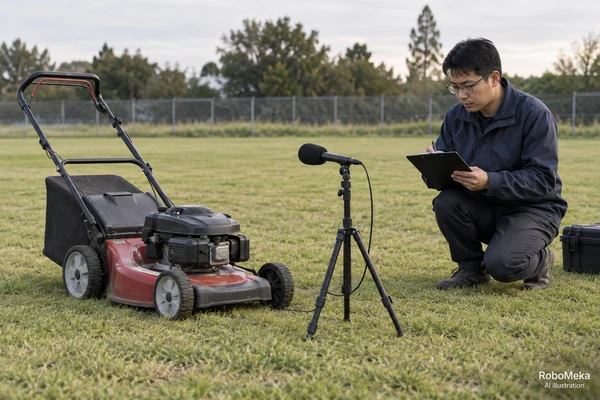
Keep evaluation and marketing photography separate. A staged image of a mower beside a microphone illustrates a proposed review; it is not a test record. Where AI-generated imagery is used, label it clearly and avoid showing invented instrument readings. The evidence should be a traceable report or observation record, not a convincing-looking picture.
Define the boundary of an emissions claim
For an engine mower, combustion and fuel-related emissions are relevant considerations. The U.S. Environmental Protection Agency's small-equipment emissions resource describes its regulatory framework for relevant engines. A buyer must determine the requirements applicable to the actual engine, equipment and market rather than extrapolate from a general statement.
For an electric machine, the absence of an onboard combustion engine changes local use-phase exhaust. It does not answer questions about electricity generation, manufacturing, transport, maintenance or end-of-life treatment. Be precise about the boundary: a statement about operation at the lawn is not a complete environmental comparison.
Battery-powered and corded equipment also differ in their supporting systems. Battery production, replacement and charging are relevant to a life-cycle assessment; corded equipment has its own materials and electricity use. Without suitable data and a defined method, buyers should not claim a universal percentage advantage for every electric product over every engine product.
Use a functional comparison
A meaningful environmental comparison should define the useful task delivered, such as maintaining a specified lawn to an agreed standard over a defined period. Comparing two machines without aligning the task can hide important differences in use and replacement. This guide does not calculate a life-cycle result; it explains what information a qualified assessment would need.
The mower power and runtime guide helps establish the operational evidence behind such comparisons. Energy use, duration and finished work need clear definitions before they are converted into broader environmental statements.

Create a supplier claim-review worksheet
The purchasing team should maintain a record of the proposed wording, evidence and approved scope. This prevents a qualified engineering statement from becoming an absolute marketing slogan as it moves between departments. Keep unknowns explicit and route specialized interpretation to competent reviewers.
| Proposed claim area | Evidence required | Boundary to preserve |
|---|---|---|
| Acoustic value | Identified quantity, method, configuration and conditions | Do not mix sound power and sound pressure |
| Quieter comparison | Equivalent test basis and defined comparison product | Do not generalize beyond the evaluated comparison |
| Local exhaust | Accurate power-source description and operating scope | Do not imply zero life-cycle impact |
| Energy use | Defined task, measurement approach and configuration | Do not substitute nameplate energy for measured consumption |
| Market requirements | Product-specific specialist review and applicable records | Do not treat a generic statement as conformity evidence |
| Environmental benefit | Defined method, boundary and supporting data | Do not invent a universal percentage or certification |
Use version control for approved wording. If a supplier later changes the motor, cutting assembly or energy system, flag related claims for review. The unchanged commercial model name should not automatically preserve a comparison that depended on the earlier configuration.
Send your mower noise and emissions requirements with the target market, customer setting and the claims you need to substantiate. Include whether the requirement concerns operator exposure, neighborhood sound, product declarations or a broader environmental assessment. These are different evidence requests.
Evaluate maintenance as part of the real operating picture
A machine's condition can affect its behavior during use. Ask how routine care, wear and fault reporting are addressed in the instructions. Do not assume that an initial sample measurement describes every future condition. Equally, do not invent a predictable deterioration rate without evidence.
Maintenance must remain safe and model-specific. HSE's work-equipment maintenance guidance provides general principles for planned, competent work. It does not authorize a buyer to alter a blade, enclosure or control setting to obtain a lower sound result. Changes intended to affect performance require an appropriate engineering review.
Review the support response to abnormal noise. The customer should know how to stop using and report a suspect machine according to the instructions, rather than receive a generic assurance that all sounds are normal. Support staff should collect the model identity and circumstances without asking the user to recreate an unsafe condition.
Service parts and revisions also affect the integrity of claims. An unapproved replacement cutting part may invalidate the original basis of a comparison. Keep the spare-parts planning process connected to the technical configuration so that after-sales support does not quietly create a different system.
Work through a hypothetical tender comparison
Suppose a buyer receives two mower proposals for a noise-sensitive customer. Proposal A gives a sound-power figure; Proposal B gives sound pressure at an unspecified distance. The buyer cannot rank the products from those numbers. The first action is to request the missing definitions and a comparable evidence basis.
The same tender includes a request for “zero emissions.” The buyer asks what the customer means: no engine exhaust during operation, a particular equipment requirement or a documented life-cycle criterion. Without that clarification, different suppliers may answer different questions while all marking the requirement compliant.
For an illustrative energy worksheet, the buyer might define a 500 m² maintained lawn and a specified evaluation session. These values are planning inputs, not a capacity claim. The reviewer then identifies what consumption and work-output information would be needed for the selected comparison. No environmental percentage is calculated from unsupported assumptions.
The outcome may be a revised tender requiring clear acoustic quantities, qualified operational wording and separate evidence for broader environmental claims. That is a more useful procurement result than selecting the product with the smallest unexplained number or the strongest green slogan.
Approve the published wording carefully
Consider operating patterns when explaining the customer experience. A shorter, more noticeable mowing session and a longer recurring schedule can affect neighbors differently even when one reported sound level is lower. The comparison needs the relevant schedule and site context. Do not assume that a lower single-number rating automatically makes every timing pattern acceptable.
For robotic mowing, ask how the proposed operating window relates to site access and local expectations. For operator-led equipment, include preparation and permitted task duration in the planning discussion. These observations help define a useful customer brief; they are not substitutes for local rules or a competent acoustic assessment where one is required.
Also separate a product decision from a communication decision. The buyer may accept a configuration for its application while rejecting an unsupported marketing claim supplied with it. Record that distinction explicitly. Removing an absolute environmental slogan does not mean the equipment has no useful attributes; it means the public wording should describe only the benefit that the evidence actually establishes.
Prefer statements that name their scope and conditions. If a comparison is supported only for a defined configuration, preserve that qualification near the claim. Avoid words such as silent, pollution-free or universally compliant unless an appropriately scoped basis genuinely supports them. Broad absolutes usually ask more of the evidence than a supplier brochure can establish.
Check consistency across the website, carton, manual and sales presentation. A cautious technical document does not correct an unqualified claim on the product page. The marketing review should use the same configuration identity and evidence references as purchasing, so customers receive one coherent description.
Do not fabricate third-party approval. A supplier's reference to a standard, a laboratory or an environmental concept is not permission to display a certification badge. Obtain the actual scope and authorization where a mark is proposed. If evidence is absent, remove or qualify the claim rather than create a persuasive-looking substitute.
Frequently asked questions
Are electric lawn mowers silent?
No. Electric drive removes engine combustion noise, but cutting, airflow, propulsion and mechanical behavior can still produce sound. Evaluate the complete machine under relevant conditions. A claim about lower noise needs a defined comparison and supporting evidence; it should not be converted into a promise of silent operation.
Can two decibel figures be compared directly?
Only when the quantities, methods and conditions are sufficiently comparable. Sound power and sound pressure are different, and measurement position matters for sound pressure. Ask for the report context before ranking products. An unexplained number in a brochure is not a reliable basis for a strong comparative statement.
Does no engine exhaust mean zero environmental impact?
No. It describes a limited operating boundary. Electricity generation, manufacturing, batteries where used, transport, service and end-of-life treatment remain separate considerations. Use precise wording and avoid claiming a life-cycle advantage without an appropriate assessment. The absence of local combustion exhaust is not a complete environmental analysis.
Should buyers accept a universal percentage emissions reduction?
Not without a clearly defined comparison, method, task and evidence. Results can depend on the products, energy supply, use pattern and assessment boundary. Request the underlying basis and specialist review. Do not transfer a percentage from another study or model to the proposed private-label mower.
What belongs in a noise-sensitive customer brief?
State the location and operating context, the applicable customer requirements, the acoustic quantity needed and any relevant operating-hour constraints. Distinguish neighborhood sound from operator exposure and product declarations. This allows the supplier and competent reviewers to answer the actual requirement rather than submit unrelated low-looking numbers.
Conclusion
Lawn mower noise and emissions procurement depends on precise definitions and defensible boundaries. Compare equivalent acoustic evidence, separate local exhaust from life-cycle questions and keep approved wording tied to the actual configuration. Clear qualification builds more trust than absolute claims that the evidence cannot support.
Prepare your mower acoustic and environmental brief, then review the downloaded file before contacting info@RoboMeka.com. The inquiry does not certify compliance, automatically send an email or confirm that every mower type discussed is available; those questions require project-specific review.