The short answer
Buyers should evaluate lawn mower power as the ability of an identified cutting system to perform its intended task, and runtime as the duration achieved under stated conditions. Neither a motor label nor a fuel or battery capacity figure proves that a customer can finish a lawn. Request complete-configuration evidence and a record of the whole mowing session.
Introduction
Buyers should evaluate lawn mower power as the ability of an identified cutting system to perform its intended task, and runtime as the duration achieved under stated conditions. Neither a motor label nor a fuel or battery capacity figure proves that a customer can finish a lawn. Request complete-configuration evidence and a record of the whole mowing session.
This article helps B2B buyers compare power architectures without treating unlike numbers as interchangeable. It distinguishes cutting performance, energy supply and operational availability. It is a purchasing framework, not a product test report. Numerical examples are hypothetical calculations, and references to different mower formats do not imply that RoboMeka supplies every format discussed.
Separate three questions before comparing quotations
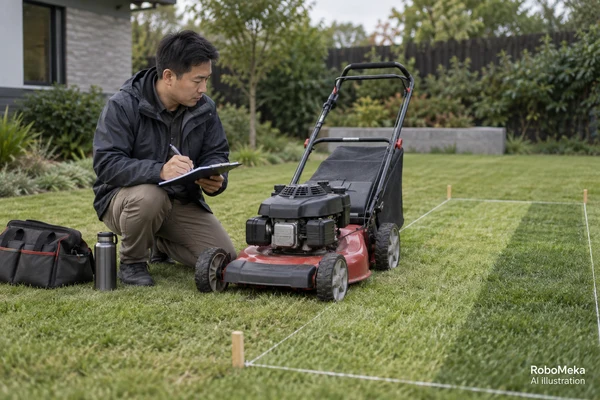
First ask whether the machine can maintain an acceptable cutting result under the intended grass conditions. This is a performance question. The relevant evidence includes the configuration, grass condition, height reduction, travel behavior and observed finish. An unloaded motor-speed video answers only a limited part of that question.
Second ask how long the identified energy supply supports that task. This is an endurance question. For a battery machine, the pack arrangement and control behavior matter; for an engine machine, fuel use and operating conditions matter. A corded machine has a different constraint: the supply arrangement and operating duty must be appropriate, rather than relying on a finite onboard energy store.
Third ask how long it takes to return the product to useful operation after an interruption. This is an availability question. Charging, cooling, refueling where applicable, collection handling and maintenance can all affect the session. A mower with a longer advertised runtime is not automatically the better choice if its ownership workflow is poorly matched to the customer.
Keep those questions in separate worksheet fields. Suppliers can then identify which claim each document supports. If one brochure number is offered as the answer to all three, request clarification before using it in a range decision or customer-facing comparison.
Understand what the published power number means
Power is a rate of energy transfer, but product literature may describe different measurement points and operating conditions. Electrical input, mechanical output, peak capability and sustained operation are not the same quantity. Ask where the number was measured, under what conditions, and which configuration it covers. Do not compare two values merely because both are expressed in watts.
For engine products, clarify the stated rating and its basis. A purchasing team should not convert an engine label into a promise about cutting quality at every grass height. The deck, blade, drive arrangement and operating conditions remain part of the result. The appropriate comparison is the customer task performed by the complete machine.
For electric products, nominal voltage alone is not a power rating. Higher voltage does not establish greater usable output, longer runtime or a better finish. Current limits, pack behavior, controller settings and system efficiency affect what reaches the cutting process. Obtain evidence about the offered assembly instead of constructing a ranking from voltage labels.
Keep units and rating conventions visible
Use a worksheet column for the exact supplier wording and another for the buyer's interpretation. Record whether a battery voltage is nominal or a maximum marketing designation. Do not silently mix the two in calculations. Where the supplier does not explain the rating convention, keep the comparison unresolved rather than replacing the missing definition with an assumption.
The electric mower power guide addresses input and control questions in more detail. For a broad assortment decision, the essential principle is simpler: similar-looking labels can represent different evidence, and unlike labels may not be suitable for a direct numerical comparison.
Compare endurance on the same customer task
A runtime statement should identify the machine, energy source, blade or cutting assembly, clipping mode and drive settings. It should also describe grass height, grass condition, height reduction and the stopping criterion. “Runs for an hour” is incomplete if the buyer cannot determine what work occurred during that hour.
Manufacturer disclosures can illustrate the importance of conditions. EGO's riding-mower information identifies factors that influence its runtime results. Those figures must not be transferred to another supplier's equipment. The sourcing lesson is to request similarly explicit conditions for the actual proposed configuration.
Separate productive cutting time from elapsed session time. If the mower stops for collection emptying, moving between lawns or another task, record that interval. Decide in advance whether the customer promise concerns blade-on duration, time until energy depletion or time to finish the property. These measures can all be useful, but they answer different questions.
Avoid comparing the best result from one configuration with an average or unfavorable result from another. Use a defined comparison method, disclose important differences and retain individual observations. A small sample evaluation can inform a shortlist without supporting a universal claim about all climates, lawns or users.
Use energy calculations to expose assumptions
For a hypothetical pack rated at 36 V nominal and 5 Ah, the nominal energy calculation is 180 Wh. This is a mathematical nameplate estimate, not a measurement of usable energy at the mower. It does not account for reserve limits, temperature, aging, load behavior or losses within the complete system.
If an illustrative system drew an average 360 W from a fully usable 180 Wh store, the simple quotient would be 0.5 h, or 30 minutes. The calculation is intentionally simplified. Real current demand changes during mowing, and the entire nominal energy may not be available. Do not publish the result as the runtime of an actual product.
The same distinction applies to fuel-based estimates. Tank volume alone does not supply a runtime because the consumption rate depends on the operating task and machine. A supplier should substantiate a claim using a defined method. Buyers should not fill the gap with a generic consumption value from another engine or deck size.
Make uncertainty actionable
List which inputs are measured, supplied, calculated or estimated. If the average demand is unknown, identify the evaluation needed to establish it. If the customer task varies widely, define representative cases rather than pretending there is one exact answer. A useful calculation points to the next evidence requirement; it does not replace that evidence.
Define a safe, repeatable sample evaluation
The protocol should begin with permitted operating conditions and the correct instructions. Identify the sample and its components, the lawn area, the grass condition and the chosen settings. Assign competent personnel and exclude unsafe conditions. Never bypass protections or deliberately operate outside stated limits to obtain a more impressive endurance result.
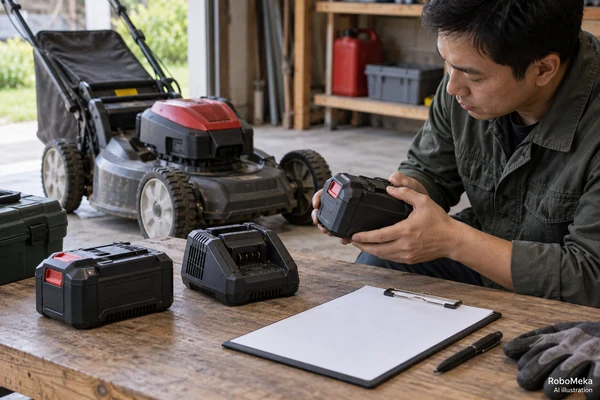
Record the start condition of the energy source and how it was prepared. For batteries, document the pack and charger identities and the relevant preparation procedure. For other power architectures, record their applicable preparation. The aim is traceability, not a universal test recipe that overrides the manufacturer's manual.
During each run, record cutting observations and interruptions with timestamps. If the machine changes behavior, note the circumstances without assuming the cause. A stop may relate to energy depletion, a protection function, an operating error or a different issue. Diagnosis should follow the supplier's approved process, not speculative resetting or unsafe repeated attempts.
| Protocol field | Buyer should record | Why it matters |
|---|---|---|
| Configuration | Machine, blade, accessories and power-source identities | Prevents comparisons between different bundles |
| Grass and site | Area, initial condition, target cut and permitted terrain | Defines the actual workload |
| Operation | Travel settings, clipping method and session sequence | Explains demand and interruptions |
| End condition | Defined stop event and remaining task | Separates depletion from other stopping reasons |
| Turnaround | Approved replenishment and any waiting interval | Connects runtime to useful availability |
| Result | Finish, completed area and unresolved observations | Supports the buying decision without overgeneralization |
If a trial question concerns a robotic machine, its recurring schedule requires a different protocol from one continuous walk-behind session. Do not force the same runtime label onto both. Link the robot's observed operation to the agreed site and schedule, then assess whether the maintenance outcome is acceptable.
Send your power and runtime evaluation requirements with the intended task and the definitions you want suppliers to substantiate. Include which figures are still assumptions. The inquiry can then focus on suitable evidence and project fit rather than requesting a single unsupported maximum number.
Investigate load and cutting finish together
Mowing height reduction, grass density, moisture and clipping method can change the workload. The buyer should record these conditions because a favorable duration obtained with a light cut may not describe a neglected lawn. Do not compensate for an unsuitable task by recommending operation outside the product's instructions.
Cutting practice also matters to turf condition. University of Maryland Extension discusses problems associated with poor mowing practice. Procurement should therefore evaluate a sensible intended application, not define success as removing the largest possible quantity of grass in one pass.
Observe whether an acceptable finish requires slowing, overlapping more or making another permitted pass. Those changes can alter the practical completion time even if the machine never stops. A runtime figure without a quality criterion can reward a setup that continues running but does not deliver the agreed result.
Keep diagnosis structured when two samples differ. Check configuration identity and recorded conditions before concluding that one motor is weaker. The difference may involve the blade, deck, drive settings or preparation. Escalate unresolved observations to the supplier with the evidence package; do not invent an engineering explanation because it seems plausible.
Include replenishment and service in availability
For battery equipment, the time between sessions may include an approved charging process and a temperature-related waiting period. Do not assume a quoted charge time begins immediately after every mowing task or applies to every compatible pack. Obtain the manufacturer's conditions and evaluate the intended customer schedule.
For corded equipment, availability depends on a suitable power source and permitted cable arrangement. Toro's residential support material directs users to model-specific instructions for cord connection. The buyer should obtain the applicable manual for the offered machine rather than prescribe a universal extension-lead specification.
Service also affects whether performance can be sustained. Ask how the customer obtains the correct cutting parts, how maintenance is documented and who handles faults. A product that meets the initial sample target still needs a workable support arrangement. The spare-parts planning guide provides a framework for defining identities and replenishment responsibilities.
Maintenance should be planned and performed safely by suitable personnel. HSE's work-equipment guidance provides general principles; the actual mower procedure remains model-specific. Do not present an improvised maintenance shortcut as a way to restore power or extend runtime.
Approve claims and control production changes
The approved claim should state what was evaluated and avoid implying conditions that were not covered. A qualified duration statement is more credible than a universal guarantee. If a supplier offers an area claim, request the underlying mowing schedule or session definition and the relationship between the area and the reported runtime.
Retain the test configuration as part of the purchase record. Changes to the pack, controller, motor, blade, deck or drive system may require review before the same claim is reused. Packaging and product listings should not continue displaying an old result simply because the model-family name remains unchanged.
Shipment inspection can verify specified identities and agreed checks, but it should not be described as proving the entire endurance distribution of the batch. NIST's overview of acceptance sampling explains the lot-decision purpose of sampling. Design evaluation, production control and lot release each contribute different evidence.
When a result remains uncertain, preserve the uncertainty in the approval record. A conditional purchase decision can specify the additional evidence required before a claim or configuration is released. This is more useful than forcing every supplier answer into a pass field and leaving the customer-support team to discover the qualification later.
Frequently asked questions
Does a higher voltage mower always have more power?
No. Voltage is only one system characteristic. Usable output depends on the complete electrical and mechanical configuration and its operating conditions. Confirm the rating convention and request task-specific evidence. Comparing a nominal voltage with another product's maximum voltage designation can make an already incomplete comparison even less meaningful.
Can amp-hours be used to compare all battery runtimes?
No. Amp-hours do not describe energy without the relevant voltage, and nominal energy still does not establish usable runtime. Different loads, configurations and control limits matter. Use watt-hours as a clearly qualified planning input where appropriate, then evaluate duration and completed work with the actual machine and pack.
What is the most useful runtime test result for a buyer?
The useful result connects a defined configuration to a representative customer task and an acceptable finish. It should identify preparation, grass conditions, settings, interruptions and the stopping criterion. A raw duration can support that record, but it should not replace evidence about how much useful work was completed.
Is a corded mower's runtime unlimited?
Not as a purchasing promise. It does not depend on depleting an onboard battery, but supply suitability, permitted operating duty, thermal behavior, site conditions and maintenance still apply. Follow the exact instructions and assess the complete task. Avoid replacing an energy-storage limitation with an unsupported claim of unrestricted operation.
Should factory testing replace a local application review?
No. Controlled factory observations and representative local use answer different questions. The first can improve repeatability; the second can reveal site and customer-workflow issues. Both need an identified configuration and clear limits. Neither a short demonstration nor one local session establishes performance for every market or operating condition.
Conclusion
Lawn mower power and runtime should be purchased as documented task capability, not as disconnected headline numbers. Define the required finish, identify the power architecture, record the complete session and review replenishment. Clear evidence boundaries make quotations easier to compare and customer expectations easier to support.
Prepare a mower performance sourcing brief containing the application, proposed configuration and evidence gaps. The form downloads a brief for your review; email it to info@RoboMeka.com if you want to discuss whether the project matches the available product range.