The short answer
Buyers should evaluate a lawn mower blade as part of a complete cutting system: blade or reel, deck, drive, controls and approved clipping arrangement. Check the intended turf result, exact component identities, safe maintenance instructions and replacement supply. A sharp-looking blade or a large motor specification cannot independently establish cutting quality.
Introduction
Buyers should evaluate a lawn mower blade as part of a complete cutting system: blade or reel, deck, drive, controls and approved clipping arrangement. Check the intended turf result, exact component identities, safe maintenance instructions and replacement supply. A sharp-looking blade or a large motor specification cannot independently establish cutting quality.
This guide helps importers compare cutting architectures and prepare a useful technical brief. It covers rotary, reel and robotic concepts without claiming they are interchangeable or all available from RoboMeka. The recommended checks are proposed purchasing controls, not reports of completed factory testing. Model-specific instructions always govern operation and service.
Choose the cutting architecture for the intended finish
A rotary mower uses a rotating cutting assembly within its designed enclosure. A reel system uses a different cutting relationship and maintenance approach. Robotic lawn mowers may use still different blade arrangements and recurring mowing schedules. These architectures should be compared by intended application, finish and ownership requirements rather than ranked from a single component photograph.
Define the turf context before specifying the system. The desired height, grass condition and maintenance frequency influence what the customer expects. A machine intended for routine lawn maintenance should not automatically be presented as suitable for rough clearing or neglected vegetation. Ask the supplier to state the intended use and exclusions in documents supplied with the product.
The operating workflow also matters. A customer who collects clippings has a different requirement from one choosing an approved mulching setup. A robotic system normally forms part of a recurring maintenance arrangement rather than a one-off heavy reduction. Keep those tasks separate when asking for performance evidence.
For the broader selection decision, use the lawn mower buyer guide. This article examines the cutting assembly after the customer job is understood, so that a technically attractive part is not selected for the wrong machine or mowing routine.
Treat blade geometry and the deck as one configuration
Blade length, shape, mounting interface and mass distribution belong to an engineered assembly. Buyers should not assume that a replacement with similar length and mounting appearance is suitable. Ask for the approved part identity and the applicable machine revisions. A generic description such as “universal blade” is not enough to support a procurement approval.
The deck influences clearance, material flow and the way clippings leave or remain within the cutting area. Different clipping modes may require different approved components. Evaluate the exact combination offered in the quotation and sample. Do not transfer a result from one blade or insert to another simply because both fit within the same model family.
Ask what the supplier controls in production and what evidence is available for those controls. The answer may involve drawings, material specifications, dimensional checks or other engineering records, but the buyer should not prescribe an unsupported process based solely on appearance. A useful review connects each requirement to an identified method and acceptance decision.
Avoid unsupported material rankings
Material names, hardness claims and surface finishes can be relevant, but they do not establish the complete performance of a blade. Manufacturing consistency, geometry and the intended loading environment also matter. Request the basis for any comparative claim and its scope. Do not turn an isolated material property into a promise of longer service life without supporting evidence.
If the supplier proposes a component substitution, ask what changes and which prior results remain applicable. A lower-cost alternative may require renewed review even when the dimensions appear similar. Keep the original approval and the proposed revision distinguishable so the production team cannot accidentally mix them.
Understand clipping modes as system choices
Collection, mulching and discharge should be treated as distinct approved configurations. The required accessories, installation steps and operating conditions need to be clear. A machine advertised with several modes should include documentation explaining how each mode is configured, not merely several accessories in the carton.
Evaluate how the customer changes between modes using the instructions. Check component identification, storage of unused parts and the risk of assembling an incomplete configuration. Any review involving the cutting area must follow the manufacturer's safe stopping and isolation procedure. Never demonstrate a shortcut with moving blades or defeated protections.
Consider the full ownership task. Collection involves handling and emptying material; mulching depends on suitable mowing practice; discharge introduces its own site and operating considerations. The purchasing decision should reflect the intended customer routine rather than assume that more advertised modes always create greater value.
Agronomic context remains important. University of Minnesota Extension's mowing guidance explains the relevance of mowing practice and clipping management in its regional setting. Use local turf knowledge when defining the application, rather than treating any one mode as universally preferable across markets.
Define cutting quality in observable terms
Agree what reviewers should observe before the sample arrives. Useful observations can include missed strips, uneven appearance, clipping distribution and whether a further permitted pass is needed. Record the grass condition, intended height reduction and machine configuration. “Good finish” is too vague to explain a disagreement between a supplier and a buyer.
Separate the cutting result from the operator's experience. A product may produce an acceptable finish while requiring unexpected effort, frequent interruption or a slower pace. Conversely, easy handling does not prove that the finish meets the customer's expectation. Both observations belong in the comparison, but they should not be merged into one unexplained score.
Use a defined observation area and a consistent review approach. Photographs can help when taken from comparable positions and linked to the run record. Avoid presenting an attractive after-photo as proof of performance if the starting condition, settings and intervention are unknown. AI-generated visuals are suitable for illustrating a proposed setup, not documenting an actual result.
Diagnose differences without guessing
If samples perform differently, confirm identities and conditions before attributing the difference to blade design. Check whether the clipping mode, height setting, operating pace or grass condition changed. Raise a specific question with the supplier and retain the evidence. A small trial can identify an issue without proving a universal engineering explanation.
Send your cutting-system evaluation brief with the turf application, clipping preference and observations the sample must address. State whether you are comparing complete configurations or requesting a change to one approved assembly. That distinction makes the supplier's technical response more useful.
Build a cutting-system approval worksheet
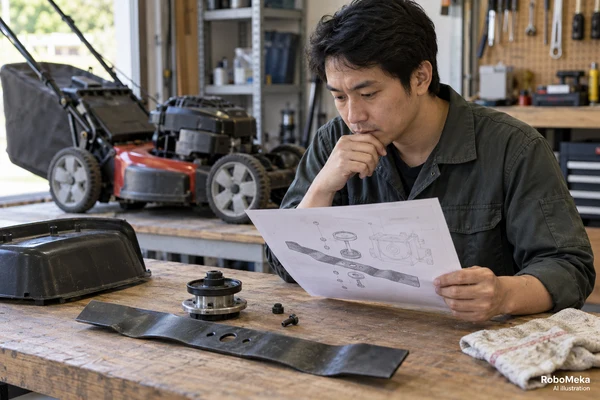
The worksheet should connect the intended result to component identity, evidence and service. Keep missing information visible. A buyer may be able to inspect a delivered part, but that does not replace the engineering evidence required to establish its suitability in the machine.
| Approval topic | Evidence or clarification | Buyer decision |
|---|---|---|
| Architecture | Intended use and operating workflow | Whether the cutting concept fits the target customer |
| Assembly identity | Blade or reel, deck and accessory revisions | Which exact configuration is being approved |
| Finish | Recorded application conditions and observations | Whether the demonstrated result meets the brief |
| Production control | Agreed methods and acceptance records | How consistency will be checked |
| Maintenance | Model-specific instructions and service boundaries | Whether the local support route is practical |
| Replacement | Approved part numbers and revision relationships | How future compatibility will be maintained |
Use the same identities in the quotation, manual, spare-parts list and shipment specification. If a supplier uses different names internally and commercially, request a mapping. This prevents a service team from ordering a part that appears correct in a catalog but belongs to another production revision.
NIST's conformity-assessment overview distinguishes several forms of assessment. Apply that distinction when reviewing the evidence package: a supplier declaration, an inspection photograph and a test report are not interchangeable documents. Each should answer a defined purchasing question.
Plan a safe sample-review sequence
Begin with documentation and external identification. Confirm the machine and approved accessories before any application trial. Review the instructions for assembly, use, clearing obstructions and maintenance. If the provided documents do not match the sample, resolve the mismatch rather than improvising a procedure from a similar machine.
Next, conduct the permitted application review with competent operators and suitable site controls. Record the initial grass condition and selected configuration. Observe the output without placing people in hazardous positions or entering the cutting area. Any interruption requiring intervention must be handled through the exact approved stopping and isolation procedure.
After operation, follow the manufacturer's instructions for safe inspection and care. General principles from HSE's maintenance guidance emphasize planning and competent work. They are not a substitute for model-specific blade access, removal or installation instructions, which should not be invented in a purchasing article.
Keep the findings in separate categories: documentation issue, application observation, service question and suspected defect. This makes escalation clearer. For example, uncertainty about which replacement part applies is a support problem even if the sample cut is satisfactory. A complete approval should resolve both rather than allowing the performance demonstration to overshadow the service gap.
Specify replacement supply before launch
Replacement cutting parts need a reliable identity and an agreed supply route. Ask which parts the owner may replace and which tasks require authorized service. Clarify packaging, labeling and the instructions accompanying a replacement. A bare part with no traceable application information can create avoidable mistakes in a distribution network.
Model-based lookup is a useful support pattern. Toro's parts and manuals resource provides one public example. Buyers should request equivalent clarity for the offered product without assuming another manufacturer's part or procedure is compatible. A shared nominal cutting width is not a replacement-parts specification.
Discuss changes and discontinuation. If a blade revision supersedes an earlier item, the supplier should explain which machines it covers and what supporting documents change. Do not accept an undocumented substitution merely to keep a shipment moving. Compatibility questions should be resolved before the part reaches the customer or repair bench.
Opening stock should reflect the planned service model and explicitly stated assumptions. Do not invent a universal replacement interval or failure rate. Actual demand depends on use and conditions as well as the product. Start with a documented replenishment arrangement and update the forecast as real information becomes available.
Separate inspection from durability evidence
Shipment inspection can verify specified identities, quantities, packaging and agreed observable characteristics. It may also include permitted functional checks under a defined plan. It does not automatically establish multi-season durability, resistance to every impact or a universal replacement interval. Keep those claims tied to the evidence actually available.
A proposed sample comparison might use three identified machines under several representative, permitted grass conditions. Those numbers describe the plan, not a statistically sufficient reliability study. Decide in advance what the observations can support. A few successful passes can justify further evaluation without proving that every production unit will perform identically.
For lot decisions, consult competent quality personnel about the appropriate sampling approach. NIST's acceptance-sampling guidance explains why a sample-based release decision is different from exhaustive knowledge of the lot. Avoid translating a passing inspection into a zero-defect or lifetime-performance claim.
Where the buyer needs stronger durability evidence, request a documented engineering evaluation appropriate to the product and intended use. Do not create an unsafe improvised impact test or infer long service life from material appearance. The question is whether the evidence supports the customer promise, not whether a demonstration can be made visually impressive.
Review the final customer promise
Product listings should state the intended cutting and clipping configurations clearly. Identify included accessories and avoid implying that optional or unapproved parts are supplied. If a performance description depends on a particular setup, keep that qualification near the claim rather than hiding it in an unrelated document.
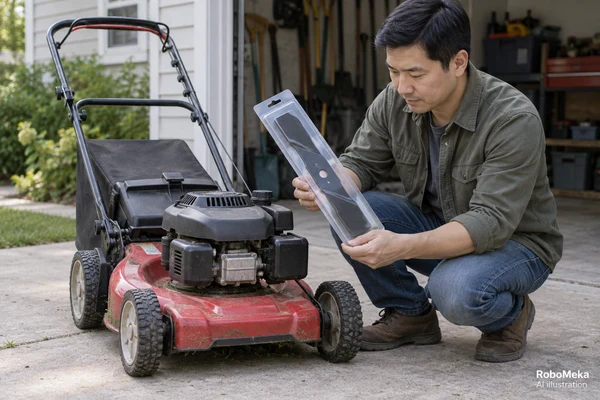
Use photographs and diagrams that match the offered assembly. An image of an exposed replacement blade should not imply that owners are expected to service it without instructions or appropriate competence. For AI illustrations, label their purpose and avoid treating the pictured geometry as a verified product drawing.
Finally, check that the manual, listing and service catalog use consistent terminology. Customers should not have to determine whether “mulching kit,” “insert” and a supplier's internal code refer to the same item. Clear identities reduce ambiguity at purchase, assembly and replacement without requiring exaggerated claims about superior technology.
Frequently asked questions
Can buyers compare mowers by blade material alone?
No. Material is one part of an engineered cutting assembly. Geometry, manufacturing control, mounting, deck relationship and operating conditions also matter. Ask what evidence supports the intended result and any durability claim. A material label should not be converted into a universal service-life or cutting-quality ranking.
Are blades interchangeable when cutting widths match?
Not necessarily. Matching nominal width does not establish an approved mounting interface, geometry, balance or system compatibility. Use the exact part identity and the manufacturer's documented application. Do not approve a substitute from appearance alone or assume that a part suitable for one revision covers every related model.
Does a three-mode mower always offer more useful value?
Only if the intended customers need the modes and the approved configurations are practical to use. Check included components, instructions, changeover and storage. Additional modes can add support complexity without solving the customer task. Evaluate the complete routine rather than counting brochure features as automatic benefits.
What should a cutting-quality sample test record?
Record the machine and cutting-system identities, grass condition, height reduction, clipping mode, operating approach and observable result. Keep photographs linked to the run. Explain interruptions and any further passes. This allows a meaningful review without claiming that one attractive result proves performance across every turf condition.
Can shipment inspection prove blade durability?
Not by itself. Inspection can verify agreed aspects of the presented lot, while durability requires appropriate engineering evidence and a defined interpretation. Keep those activities separate. A passing release check should not become a claim about years of service, every possible impact or a guaranteed replacement interval.
Conclusion
Lawn mower blade and cutting-system sourcing should approve a complete assembly for a defined turf task. Connect the architecture, components, clipping mode, evidence and replacement route before negotiating the final package. The strongest buying decision explains both the intended result and how the system will be supported after sale.
Prepare your mower cutting-system requirements and review the downloaded brief before emailing info@RoboMeka.com. Include the application and evidence questions, and confirm product scope separately; this guide does not promise that every conventional or robotic configuration discussed is available.