
The short answer
When sourcing a lawn mower, first identify what its battery actually powers. A starter battery, a removable cutting-system pack and the battery in a robotic mower have different duties and support requirements. Check the complete battery–machine–charger relationship, the approved operating conditions, replacement identity and transport documentation before comparing capacity or charge-time claims.
Introduction
When sourcing a lawn mower, first identify what its battery actually powers. A starter battery, a removable cutting-system pack and the battery in a robotic mower have different duties and support requirements. Check the complete battery–machine–charger relationship, the approved operating conditions, replacement identity and transport documentation before comparing capacity or charge-time claims.
This guide addresses battery and charging decisions across a mower assortment. It is intended for importers and category managers who need to avoid treating every battery-equipped product as the same purchasing problem. It does not prescribe repair procedures or claim that any pictured or discussed configuration is supplied by RoboMeka. All planning examples below are hypothetical.
Identify the battery's role in the machine
A battery may start an engine without supplying the energy used throughout cutting. In another mower, the battery supplies the cutting motor, travel drive and controls. A robotic machine adds a recurring relationship with its docking and charging arrangement. Those roles determine the questions buyers must ask about capacity, replenishment, replacement and customer expectations.
Put the role in the specification before entering electrical values. A useful description identifies the loads served, whether the battery is normally removable by the user and what the approved replenishment method is. Do not infer that an electric-start engine mower has the same charging workflow as a cordless walk-behind model.
Where the machine uses more than one battery, request an explanation of the arrangement. Packs may operate together or in another manufacturer-defined sequence. The mere presence of two slots does not establish double runtime, continued operation after one pack is removed or compatibility with every pack in a brand's range. Obtain the documented operating configuration.
Keep architecture and chemistry separate
The word battery does not establish chemistry, construction, protection arrangements or serviceability. Ask for the exact identity and the relevant documentation. Do not recommend substituting a pack based on appearance, connector fit or a matching voltage label. Electrical compatibility includes more than a mechanical connection, and the supplier should state which combinations are approved.
For an assortment that includes several mower formats, create a compatibility matrix rather than a general promise of commonality. Each row should identify a machine and each approved pack or charger relationship should be explicit. Empty cells should remain unapproved until the supplier provides the required evidence.
Read capacity and voltage without overinterpreting them
Capacity stated in amp-hours describes one electrical quantity, not the mowing task the customer can complete. For a nominal-energy calculation, voltage and amp-hours must use compatible rating conventions. A hypothetical 36 V nominal, 5 Ah pack corresponds to 180 Wh nominal energy. That calculation does not establish the energy delivered during a particular mowing session.
Two packs with the same nominal watt-hours may behave differently under load or within their approved control systems. Temperature, state of charge, age and the machine's demand can affect useful operation. Buyers should therefore use the nominal calculation to organize questions, then request evidence for the exact machine and pack combination.
A higher-capacity option may also change weight, balance, handling, charging time and package cost. Do not assume it is an unqualified upgrade. Review insertion, removal and storage with the intended customer group, following the instructions. A pack that improves an endurance estimate can still complicate the ownership routine.
For the performance side of this decision, consult the mower power and runtime guide. This article focuses on architecture and support: which battery is being purchased, how it is replenished and how the same approved identity remains available after the initial sale.
Treat the charger as part of the approved system
The charger must be identified in the quotation and sample package, not described only as “included.” Request its model, supported batteries, supply requirements and instructions. Confirm the version intended for the destination market. A different plug does not by itself establish that the charger's electrical input and documentation are appropriate.
Charge-time statements need conditions. Ask which pack is involved, the starting state, the completion definition and any relevant temperature or preparation requirements. A time measured for one capacity or charger should not be reused for another bundle without evidence. Avoid presenting a best-case figure as the customer's guaranteed turnaround after mowing.
Manufacturers publish system-specific support information. EGO's FAQ resource is an example, but its compatibility statements and terms apply to its own products. Request the corresponding documentation for the offered system. Do not extend one brand's ecosystem claims to a superficially similar private-label product.
Clarify simultaneous charging
A device with several slots may not replenish all inserted packs in the same way. Ask whether operation is simultaneous, sequential or otherwise controlled, and request the applicable instructions. For a range requiring several batteries, the actual replenishment sequence matters more than the number of visible slots in a promotional photograph.
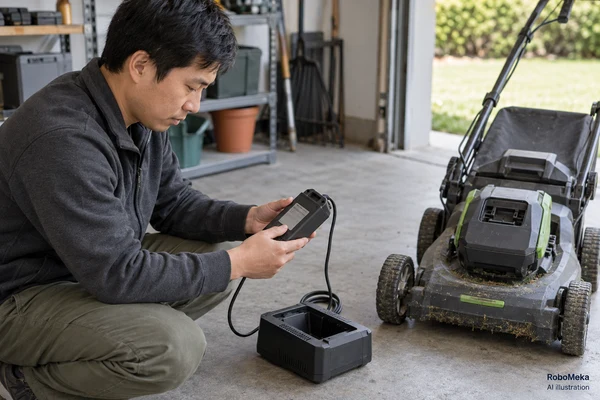
Also clarify whether charging occurs on the machine, on a separate charger or through a dock. Those arrangements create different space, handling and infrastructure requirements. Record the permitted environment and installation preparation for the exact system instead of assuming that every garage, shed or outdoor socket is suitable.
Evaluate turnaround using a customer schedule
Start with the interval between intended mowing sessions. A domestic owner who mows one lawn and stores the machine until another day has a different replenishment problem from a contractor moving between sites. The buyer should not automatically purchase extra packs or a faster charger without understanding that schedule.
Build a timeline with separate blocks for mowing, approved waiting where needed, charging and readiness for the next task. Use measured or supplier-supported values when available and label estimates. Do not erase cooling or other preparation intervals simply because the charger itself has a short advertised time.
For a hypothetical planning exercise, suppose one task uses 35 minutes of productive mowing and the next begins 90 minutes later. The buyer must establish whether the approved system can be ready within that interval under the intended conditions. The numbers do not imply that any particular pack or charger achieves that result. They define the question the sample evaluation must answer.
Robotic mowing requires a different schedule. Charging occurs within a recurring maintenance cycle, so docking access, available operating windows and the desired lawn outcome need consideration. Use the robotic mower installation guide to connect power infrastructure with the actual site rather than treating the battery as an isolated accessory.
Create a procurement matrix for the battery system
The purchasing record should make every configuration traceable. Include the machine, pack, charger and relevant revisions together, along with the destination-market package. This helps prevent a later substitution from entering production because it looks similar or has the same headline capacity.
| Procurement field | Required clarification | Decision supported |
|---|---|---|
| Battery role | Starting, cutting, travel, controls or combined duty | Defines the relevant performance questions |
| Identity | Model, revision, chemistry description and approved machine pairings | Prevents unsupported substitution |
| Charger | Exact model, input version and supported batteries | Establishes the intended replenishment system |
| Conditions | Operating, charging and storage instructions | Tests whether the customer environment is suitable |
| Replacement | Part identity, supply terms and revision handling | Defines support beyond the launch order |
| Transport | Current documents for the offered configuration and route | Supports competent shipment preparation |
Ask the supplier to flag which documents are final and which are provisional. A preliminary pack drawing should not be mistaken for a released production identity. Tie approval to the final configuration, and identify any tests or document reviews needed when that configuration changes.
Send your battery-system requirements with the mower format, customer schedule, target market and proposed kit contents. Include whether your priority is initial kit simplicity, shared approved components or service continuity. Available configurations and commercial terms must be confirmed for the project.
Plan replacement stock without inventing failure rates
Replacement planning begins with the installed product base, the agreed service route and supplier lead times. Where actual field demand is not available, use explicitly labeled planning assumptions. Do not invent a standard battery failure percentage to justify a large opening order or a claim about product reliability.
Separate customer-purchased extra packs from warranty replacements and service stock. They may use the same physical part but have different ownership, accounting and replenishment arrangements. Clarify who decides a claim, how a compatible replacement is identified and what happens when the original revision is no longer supplied.
Storage instructions deserve practical review. Ask how stock should be managed, inspected and rotated under the manufacturer's guidance. Do not assume batteries can remain in any warehouse condition indefinitely without consequences. Assign responsibility for following the approved storage requirements and for escalating damaged or suspect items.
Model identity is essential to service. Toro's parts and manuals lookup illustrates how support can be tied to specific equipment. Buyers should request an equally clear identification route for the proposed battery system, without assuming that a general catalog description will be enough for future replacement decisions.
Review safe handling and service boundaries
Before approving the package, rehearse a replacement-order request using only the material a dealer will receive. Ask the reviewer to identify the machine revision, the installed pack and the permitted replacement. If the answer depends on an undocumented conversation with the factory, improve the identification system before launch. This exercise tests the service information without opening or electrically testing the battery.
Repeat the exercise for a charger request. A dealer should be able to distinguish the destination-market input version and supported pack relationship from the records. Keep photographs as supporting information, not the sole identifier. Similar enclosures can contain different configurations, so a visual match should not override the approved model and revision mapping.
The user manual should explain the tasks an owner may perform and when trained service is required. It should address normal removal or connection where applicable, approved charging and the response to a damaged or abnormal battery. A purchasing guide should not substitute improvised repair instructions for that documentation.
Keep battery servicing separate from ordinary external care. Do not open packs, alter protection systems or propose adapters to make an unapproved combination work. If a supplier cannot explain the approved service boundary, treat that as an unresolved support issue. A low purchase price does not make uncertain repair practices acceptable.
General maintenance principles include safe isolation and competent work. HSE's maintenance guidance provides context, while the mower's specific instructions determine the actual procedure. Removing one energy source may not explain every stored-energy or moving-part risk in a complex machine; service personnel need the correct information.
Review the customer-facing labels and instructions as part of sample approval. They should distinguish ordinary operating indications from conditions requiring the user to stop and seek assistance. The buyer should not rely on a sales representative's verbal explanation if the end customer receives only a brief translated leaflet.
Check transport documents before promising delivery
Battery transport requirements depend on the battery, configuration, route and transport mode. Equipment containing batteries, batteries packed with equipment and separately shipped packs may raise different questions. Confirm the current requirements with qualified logistics personnel and the carrier rather than using a generic rule copied from an old shipment.
The International Air Transport Association's battery guidance is a primary reference for air-transport preparation. Obtain the documents applicable to the actual offered battery identity. A document for a related cell or an earlier pack should not be accepted without determining whether it covers the configuration being shipped.
Keep transport evidence distinct from product conformity. UN 38.3-related documentation does not by itself establish every electrical, machinery or destination-market requirement for the complete mower. Likewise, a general product certificate does not answer all battery freight questions. Assign separate owners for technical compliance review and shipment preparation.
Include the documentary review in the delivery schedule before the goods reach dispatch. Late discovery of an identity mismatch can disrupt a launch even when production is physically complete. The buyer should know which release conditions remain outstanding and who is responsible for resolving them, rather than receiving an unconditional delivery promise too early.
Frequently asked questions
Does every battery-equipped mower use the battery for cutting?
No. Some batteries primarily support starting or controls, while others supply cutting and propulsion. Robotic systems also depend on an approved charging arrangement. Identify the battery's actual role before comparing capacity, runtime or replacement requirements. Similar-looking electrical specifications do not make these duties equivalent.
Can a matching voltage prove compatibility?
No. Compatibility depends on the complete approved system, including electrical characteristics, interfaces, controls and instructions. Connector fit and voltage labels are insufficient. Request a documented machine–pack–charger matrix and avoid unapproved adapters or substitutions, especially when the supplier has not identified the exact versions involved.
Is a faster charger always the better kit choice?
Not necessarily. Compare the customer's schedule, supported pack, permitted environment, charging conditions and cost. A faster quoted time may not resolve other turnaround constraints. Choose the system that supports the intended ownership routine with clear documentation, rather than treating one charger headline as a universal upgrade.
Should an importer order a large stock of spare batteries immediately?
Not without a documented inventory and storage plan. Consider the installed base, customer demand assumptions, service arrangements, replenishment time and approved storage conditions. Separate optional extra-pack sales from warranty stock. Update the plan using actual information instead of relying on an invented industry-wide failure rate.
Does battery transport documentation prove the mower is compliant?
No. Transport documentation and complete-product conformity answer different questions. Confirm the battery identity and applicable freight requirements, then separately review the mower and charger for the destination market. Qualified specialists should determine the scope of the required evidence; one document should not be used as a universal approval.
Conclusion
Lawn mower battery and charging procurement starts with the battery's role and ends with a traceable ownership system. Approve the machine, pack and charger together; evaluate the customer's schedule; and plan replacement and logistics before ordering. Capacity and charge-time figures are useful only within that complete context.
Prepare your mower battery and charging brief, then review the downloaded document and email info@RoboMeka.com to discuss project fit. The website does not send the brief automatically, and this educational guide does not establish the availability of every mower architecture described.