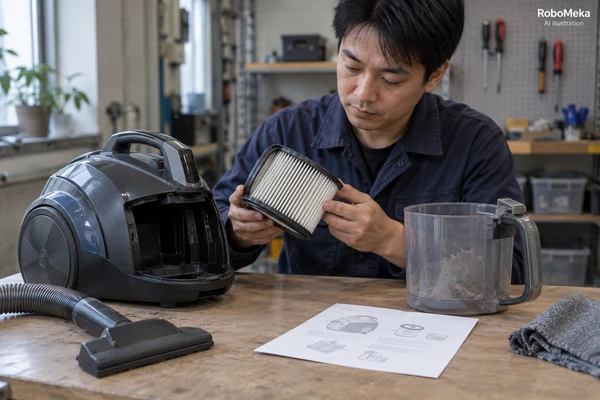
The short answer
Evaluate what self-cleaning actually covers, how drying is defined and what manual care remains. Include wastewater disposal, roller handling and permitted storage. An automated cycle or temperature display does not independently prove complete dryness, maintenance-free ownership or a microbiological outcome.
Introduction
The cleaning demonstration is over, but the owner still has a wastewater tank to empty and a damp roller to store. That short sequence is where many floor-washer promises become unclear. “Self-cleaning” may describe a flushing programme, while “drying” may describe a separate process with different conditions and remaining manual responsibilities.
For a B2B buyer, the useful question is which parts of post-use care are automated, which remain manual, and whether the intended customer can complete the whole routine. Evaluate the washer, dock, wet components, consumables and instructions together. Do not treat a single button or a heated-air feature as evidence of maintenance-free ownership.
This article offers a proposed maintenance evaluation and supplier checklist. It contains no measured RoboMeka drying results, microbiological findings or customer return statistics. Any claim concerning hygiene, odour prevention or organism reduction needs evidence appropriate to that claim, beyond an ordinary visual sample review.
Define the boundary of self-cleaning
Ask the supplier to draw or explain the path covered by the automated cycle. Does it flush the roller, internal liquid path, recovery opening or another part? What must be removed or emptied first? A cycle can perform its intended job while leaving unrelated surfaces for the owner to clean manually.
Separate actions during floor washing from actions after the machine is placed on its base. A roller may be continuously wetted or scraped during use, yet still need an after-use routine. Similarly, a dock tray that catches water is not necessarily an automated cleaning or drying station.
The Dyson WashG1 user manual provides model-specific care instructions for tanks and other accessible components. Its existence illustrates an important purchasing principle: the maintenance instructions, not the feature label alone, define what the owner must actually do.
Ask for a complete sequence
Request the steps from the end of floor cleaning to safe storage. Include required battery state, clean-water preparation, wastewater disposal, programme selection, accessible component cleaning and the final storage arrangement. If a step is optional, ask under what circumstances it becomes necessary.
Use one controlled document rather than combining instructions from an old manual, a sales video and an informal chat message. When those sources disagree, obtain a corrected approved version before sample sign-off. Conflicting care instructions can create support problems even if the hardware performs acceptably.
Distinguish flushing, spin drying and heated drying
Flushing moves permitted cleaning liquid through specified areas. A spinning action can remove some retained liquid from a roller. Airflow or heat may support further drying. These mechanisms address different parts of the routine, and the presence of one does not establish the effectiveness of all the others.
Tineco's FLOOR ONE S5 PRO 2 explanation distinguishes its self-clean cycle from centrifugal drying. This is a named product example, not a description of every washer. Ask each supplier to identify its own mechanism, operating conditions and end state without relying on similar-looking dock designs.
| Function | Evidence to request | Common assumption to avoid |
|---|---|---|
| Automated rinse | Covered components, liquid and start conditions | Every hidden surface is cleaned |
| Roller spin | Supported sequence and remaining moisture observations | Spin completion means fully dry |
| Air drying | Air path, programme conditions and endpoint | All wet parts receive the same airflow |
| Heated drying | Controlled design and documented instructions | A temperature headline proves hygiene performance |
| Storage mode | Permitted component positions and ventilation | A closed cabinet is suitable for every device |
A purchasing comparison should describe the resulting user workflow before ranking the technology. A simpler routine can be a better fit when it is understandable and supportable. Conversely, additional automation may be valuable if it demonstrably removes an inconvenient step without creating difficult servicing or installation requirements.
Design an ordinary-use maintenance trial
Begin with an approved floor-cleaning task rather than loading the machine with an unrealistic mixture. Record the surface, permitted soil, liquid, operating mode, duration and component condition. Post-use care cannot be compared fairly when one sample begins with much more residue or a different cleaning solution.
Follow the supplied routine without improvising extra rinses or wiping steps. Record the result after the official sequence, then separately document any additional supported intervention. Otherwise the evaluator's effort can make a weak routine appear fully automatic.
Use safe, non-hazardous test materials and appropriate handling controls. Do not cultivate contamination or use biological waste to make an odour demonstration more dramatic. If a buyer needs a health-related performance claim, commission an appropriate professional assessment rather than treating a workshop experiment as sufficient evidence.
What should the observer record?
Record active user time, unattended programme time, component handling, spills, visible residue and readiness for the next permitted use. Note whether the user needs a sink, drying rack, spare roller or dedicated ventilated storage area. These requirements can affect the product's suitability in a small apartment.
Ask a person unfamiliar with the sample to follow the instructions. Observe where they pause, confuse tanks, miss a latch or assume the cycle has finished. The exercise evaluates the clarity of the supplied system; it should not become a test of whether a trained engineer can compensate for poor instructions.
Set a defensible drying endpoint
“Dry” can mean different things: no visible surface droplets, a roller that feels dry at selected points, or a measured moisture condition. Specify the endpoint before comparing products. Record how it is assessed, at what time, and under which ambient conditions.
Do not publish a drying-time claim based only on a display countdown. Programme completion is an observable event, but it is not automatically proof that every relevant component reached the claimed condition. Check the areas that matter to storage and next-use preparation without dismantling restricted assemblies.
If quantitative moisture testing is required, use a suitable professional method with a defined sample procedure and limitations. The purchasing team should understand what the measurement covers. A precise number without a meaningful endpoint may be less useful than a carefully recorded operational observation.
Ambient conditions belong in the record
Room temperature, ventilation and surrounding moisture can affect drying observations. A demonstration in a spacious conditioned showroom may not represent a compact utility cupboard. Evaluate within the model's instructions and state the conditions alongside any result.
Do not enclose an operating dock or obstruct airflow to create a worst-case demonstration. Instead, identify whether the customer's intended storage location is permitted. If it is not, that is an application mismatch requiring a different location or configuration, not a reason to override the instructions.
Send Your Requirements with the intended storage location, household routine and maintenance tasks customers are willing to perform. A clear ownership brief helps determine which automation features are genuinely useful.
Wastewater handling often determines convenience
Observe how the tank is removed, carried, opened, emptied and returned. Tank capacity matters, but so do grip, cap placement, balance and the path to the disposal point. A large vessel that is awkward for the intended user may be less convenient than its specification suggests.
Record whether the user can identify the correct disposal procedure for liquids and collected solids. Follow the product instructions and applicable local disposal requirements. Do not assume all debris may be flushed down a sink, or that wastewater should remain inside until the next cleaning session.
Check whether accessible corners and openings can be cleaned using the permitted method. A part described as washable may have specific limitations on water temperature, immersion, detergents or dishwasher use. The statement should identify the part, not imply permission to wash the whole appliance.
Roller removal and reassembly deserve their own review
With the machine safely isolated, ask the evaluator to remove and refit user-serviceable components exactly as instructed. Check whether alignment is visible, latches give clear feedback and loose components remain accounted for. Do not force a part that appears to fit only when installed incorrectly.
Distinguish the roller sleeve from bearings, end caps, drive connections and covers. Suppliers may offer different replacement units, and the spare part must match what the customer or service centre is allowed to handle. Record the part number and approved procedure together.
Review the floor washer edge and recovery guide when judging the consequence of reassembly. A maintenance routine is not complete if the appliance can be put away easily but returns to the floor with an incorrectly seated cover or impaired recovery path.
Test instructions after ordinary interruptions
A user may stop care to answer the door or return to the device after an unattended cycle. Check whether the interface makes the current state understandable. Ask what happens after a normal interruption, using the manufacturer's permitted procedure rather than disconnecting equipment at unsafe moments.
Separate expected restart behaviour from a fault. The instructions should explain when a cycle must be repeated and when a component is ready to reinstall. A service team needs those distinctions to avoid advising unnecessary part replacement or unsupported shortcuts.
Do not turn an odour observation into a health claim
A buyer may record whether an ordinary-use sample develops an objectionable smell during a defined, permitted storage routine. That can be relevant to customer experience. It does not identify microorganisms, establish disinfection or prove that a device prevents health problems.
Claims such as antibacterial, sterilizing or germ-free require a separate evidentiary and regulatory review appropriate to the target market and exact claim. Supplier brochures and generic certificates are not enough if they do not cover the offered configuration, method and conditions.
Keep the wording proportional to the evidence. Describing accessible tanks, a defined rinse cycle or documented roller-care steps is different from claiming a biological outcome. Precise maintenance language can be useful without promising more than the evaluation established.
Build the after-sales package before approving the order
Ask for a model-specific parts list covering the user-replaceable roller, relevant filters, seals, caps and dock components. Clarify regional availability and how revision changes will be communicated. A spare roller that looks similar but has a different drive interface can create a preventable support problem.
Decide whether the launch bundle should include a second approved roller or another consumable. Base the decision on the documented care routine and intended usage, not on an assumed universal replacement interval. Keep optional accessories separate from essential items required for the advertised workflow.
The cleaning-product spare-parts guide provides a broader service framework. For a wet appliance, add the care and storage requirements of replacement parts before they reach customers, including protection against damage or contamination during handling.
Prepare a support decision tree
A useful first response identifies the model, programme, component seating, approved liquid and observed symptom. It should tell users when to stop and contact service rather than encouraging repeated operation with a leak, damaged part or unexplained fault.
Use photographs of the actual released configuration in support material. A generic roller-removal video can be misleading when a latch or cap changed between versions. Retain earlier instructions for products already sold instead of overwriting the only copy with the newest revision.
Connect sample approval with factory and shipment checks
An approved care routine depends on the production configuration. Changes to tank mouldings, seals, roller materials, air paths or control logic may require review. Ask the supplier to identify which changes trigger renewed application testing and revised documentation.
Factory testing should verify relevant functions using a documented safe procedure. Request the actual scope and records rather than assuming every unit receives a complete wet cleaning and drying trial. Production controls can include component identity and assembly checks even where detailed application evaluation occurs on selected samples.
During shipment inspection, check the exact dock, tanks, covers, consumables and instructions against the approved bundle. Confirm that the carton does not claim fully automatic maintenance when the manual specifies remaining care. The wet and dry floor cleaner page is a starting point for discussing configurations, not proof of a particular drying system.
Check packaging after the care routine is understood
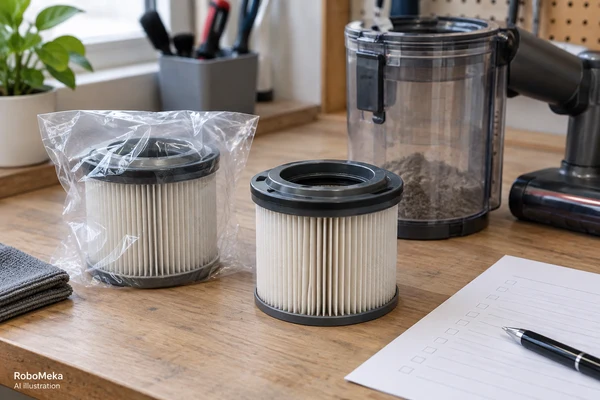
The package should accommodate the approved components without encouraging users to store them in a prohibited state. A spare roller can arrive protected for shipment while needing a different ventilated arrangement after use. Explain that distinction instead of implying that the original protective wrapping is a permanent storage accessory.
Review the quick-start card as a sequence, not a collection of attractive icons. A customer should be able to find the first-use preparation, ordinary cleaning, post-use care and stop-and-contact-support conditions. If an icon suggests that a powered base can be rinsed, correct it even when a longer paragraph elsewhere gives the right instruction.
Keep translations tied to this approved sequence. Ambiguous words such as wash, rinse, wipe and dry should identify the component and action precisely. The resulting document is part of the product's maintenance system.
Frequently asked questions
Does self-cleaning mean the tank can remain full?
Do not assume so. Follow the exact model's instructions for wastewater handling and post-use care. An automated rinse may address specified internal paths while leaving disposal and tank cleaning to the owner. The routine should be demonstrated and documented before the buyer approves low-maintenance marketing language.
Does heated drying prove that a roller is disinfected?
No. A heating feature and an indicated temperature do not independently establish a microbiological result. Such a claim requires appropriate evidence covering the actual configuration and conditions. For ordinary purchasing decisions, describe the supported drying routine and its observed operational endpoint without adding unsupported health claims.
Is a spare roller always necessary?
It depends on the approved care routine, usage frequency and available drying time. A second compatible roller may improve convenience for some users, but it should not be presented as universally required. Confirm storage and replacement guidance and ensure the spare is the correct revision.
Can customers use a different detergent to reduce odour?
They should use only the product and concentration permitted for the appliance and floor. An improvised cleaner can fall outside the supported procedure. If odour persists despite correct care, the appropriate next step is model-specific support, not trial-and-error mixing or adding stronger chemicals.
Conclusion
Assess self-cleaning and roller drying as a complete post-use workflow. Define what the automated cycle covers, what dry means, what remains manual and what the owner needs for storage. Clear instructions and available parts are as important as the mechanism shown in a demonstration.
Contact Us with your maintenance expectations, target market and desired accessory bundle. Send the prepared brief to info@RoboMeka.com to discuss the evidence and support scope needed for a practical floor-washer offer.