The short answer
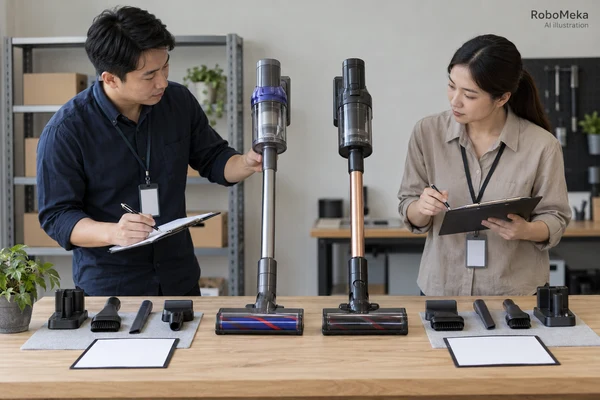
Assess edge access, visible soil removal and residual water separately. Use the same approved surface, liquid, pass sequence and viewing conditions for each sample, including supported reverse passes. Record manual finishing and component identity before turning an edge-to-edge feature description into a customer-facing claim.
Introduction
A floor washer can reach close to a cabinet and still leave an obvious wet line after the return pass. It can also remove a visible mark while leaving soil in a corner that the roller never contacted. Edge reach, soil removal and water recovery are connected, but they are not the same purchasing requirement.
Buyers should evaluate the complete edge-cleaning sequence on approved surfaces, in both travel directions, using a recorded amount of permitted soil. Inspect the result immediately and after drying. Include the time needed to finish inaccessible corners manually. This produces a more useful comparison than measuring only the distance from a roller to the outside of its housing.
The procedures here are proposed procurement checks, not completed RoboMeka laboratory tests. Any example dimensions or acceptance categories are planning tools, not product specifications. Follow the appliance manual and surface-care instructions, and use controlled evaluation areas rather than experimenting on a customer's finished floor.
What does edge-to-edge cleaning actually mean?
The phrase may refer to one exposed roller end, both sides of the head, a front approach, or an additional mechanism that extends toward the wall. Ask which physical edge is meant and whether the claim concerns contact, dry debris pickup, wet washing or the final floor finish. A single label can hide several different capabilities.
Measure the active contact region separately from the overall head width. Side housings, wheels and protective bumpers can determine how close the working material gets to a baseboard. A head that approaches a straight wall effectively may still leave an inside corner or recessed cabinet toe-kick inaccessible.
Tineco's FLOOR ONE S5 page describes its edge-cleaning design as a product feature. The useful procurement response is to ask the offered supplier for equally specific geometry and supported directions, then observe the result. A competitor's feature description does not establish the performance of a different machine.
Why should the return pass be recorded?
Users rarely move through a room in one uninterrupted forward line. They pull back from cabinets, turn around chair legs and pause while repositioning furniture. Direction changes may alter the interaction between a wet roller, recovery path and floor. Test the motions allowed by the manual instead of assuming the forward result represents every movement.
Do not tilt the machine beyond its permitted angle or deliberately operate it with missing components to expose a weakness. The goal is to compare normal supported handling, not to create a misuse demonstration. Record any limitation that a customer must understand before using the product.
Separate three outcomes in the purchasing brief
Write an edge-access requirement, a visible-cleaning requirement and a residual-water requirement. This prevents a strong result in one dimension from concealing a problem in another. It also helps identify the correct corrective action: changing a pass pattern is different from redesigning a head or narrowing a marketing claim.
| Outcome | Observation to record | What the observation does not prove |
|---|---|---|
| Edge access | Untouched strip beside a defined straight boundary | Complete cleaning inside every corner |
| Visible soil removal | Remaining agreed soil after the specified passes | Disinfection or removal of invisible contaminants |
| Water recovery | Visible liquid, streaks and drying observations | Universal floor compatibility or slip resistance |
| Direction change | Marks following a supported reverse pass or turn | Performance at prohibited machine angles |
| Manual finishing | Extra steps required around inaccessible geometry | A defect merely because a tool has a physical limit |
Avoid a single overall “edge score” until the individual outcomes are visible. Two products with the same total can impose very different ownership routines. A retailer may accept a narrow untouched strip but reject a prominent return-pass mark, while another customer group may prioritize reach under a specific cabinet shape.
Build a representative test area
Choose a permitted hard-floor sample with a known finish and a repeatable boundary. Record whether the edge is a vertical wall, skirting board, cabinet recess or furniture leg. These features create different approach angles and clearances. Keep the trial modest enough that an unexpected result can be contained safely.
Document floor condition before introducing soil. Existing scratches, uneven joints, residue from earlier cleaners and surface coatings can affect the visible finish. If the comparison uses multiple sample panels, ensure that they represent the same relevant surface conditions rather than merely sharing a colour.
Use the supplier-approved liquid and concentration where a cleaning solution is specified. Record water preparation, tank fill state and roller condition. An apparently better result with an improvised detergent does not validate the intended retail package and may fall outside both appliance and flooring instructions.
Control the viewing conditions
Take observations from consistent positions under ordinary but repeatable lighting. Low-angle light can reveal streaks that disappear in a front-facing photograph. Retain the camera position and exposure settings when possible, while acknowledging that photos remain a visual record rather than a chemical cleanliness measurement.
Do not compare one damp surface against another that has already dried. Record elapsed time from the final pass and relevant room conditions. If drying time is important to the customer, agree a suitable assessment method instead of selecting whichever photograph looks most persuasive.
Use a repeatable sequence without coaching the result
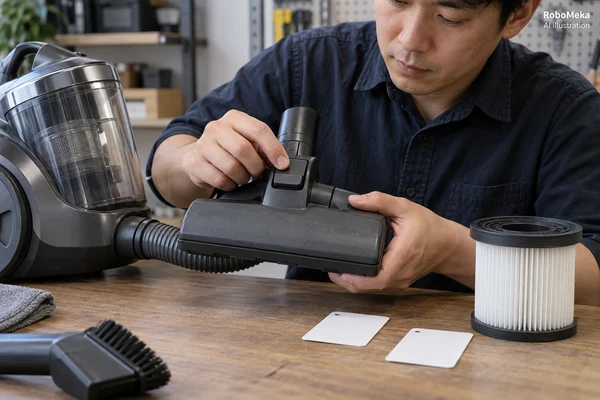
Start each run with the correct components installed and the sample in the prescribed operating state. Define where the operator begins, how the head approaches the boundary and how many passes are allowed. A comparison becomes difficult to interpret when one sample receives several extra passes or a specially favourable angle.
Record the operator's interventions. Repositioning the whole machine, wiping the edge by hand or switching modes may be legitimate parts of ownership, but they should not disappear from the result. Keep the initial result and the result after permitted finishing as separate records.
Repeat enough trials to understand whether the observation is consistent, using a sample plan appropriate to the purchasing risk. This guide does not prescribe a universal test count. A single successful pass may be useful for familiarization, but it should not be presented as proof of repeatability or production capability.
For broader selection context, use the wet-dry washer versus stick vacuum comparison. This edge protocol addresses one purchasing question within that larger category decision; it does not replace evaluation of the full household cleaning task.
How should water recovery be interpreted?
A clean-water tank's capacity tells you how much it can hold under its specified definition, not how dry a floor will be after washing. Recovery depends on the complete mechanism and operating conditions. Ask how the supplier defines any recovery or drying claim, including surface, mode, liquid, travel pattern and endpoint.
Visible residual water is useful to document, but it is not automatically a quantified recovery percentage. A mass-balance method would need to account for water retained in rollers and internal paths, wastewater collected, evaporation and other relevant losses. Do not calculate a convincing-looking percentage from only the two tank levels.
Dyson's WashG1 mode explanation illustrates that hydration settings are part of the cleaning task. For another offered model, obtain its own mode definitions and test them. Never transfer a competitor's mode names or drying expectations directly into your specification.
Keep streaks and remaining soil separate
A streak may come from liquid distribution, residual soil, a wet component or another condition that needs investigation. Describe what was observed before naming its cause. Repeating a controlled run after the approved maintenance routine can help identify whether the symptom follows the sample condition, task or surface.
If the cause remains uncertain, keep the result open and ask for engineering review. A sales explanation is not a substitute for a controlled comparison. Equally, avoid concluding that every visible line is a permanent defect when it may depend on an unrepresentative or unsupported condition.
Send Your Requirements with photographs of the intended floor edges, permitted floor-care routine and the finishing steps customers are willing to accept. This gives the supplier a specific application to review.
Examine the recovery components during safe maintenance
With the appliance isolated according to its instructions, examine accessible roller ends, recovery openings, covers and seals. Record whether the operator can see trapped debris and whether permitted cleaning tools reach the relevant surfaces. Do not disassemble sealed electrical or battery sections as part of a routine buyer trial.
A transparent or easily opened wastewater path may make routine inspection easier, but accessibility must be evaluated together with correct reassembly. Look for positive seating, clear orientation and components that are difficult to install incorrectly. A loose cover can undermine an otherwise promising demonstration.
Inspect the sample again after the agreed trial sequence. Photograph ordinary wear or residue without exaggerating what a short test establishes. A few evaluation cycles can reveal usability issues; they cannot establish years of seal durability or resistance to every cleaning agent.
Ask which components are replaceable
Identify roller, scraper, squeegee, accessible gasket and tank-cover part numbers where applicable. Clarify which replacements users may perform and which require authorized service. An inexpensive consumable is not useful if the local distributor cannot identify the correct version or obtain it when needed.
Link this review to the spare-parts planning guide. Keep the parts list tied to the configuration approved for edge and recovery performance, because a different material or fit can change the result without an obvious exterior redesign.
A hypothetical comparison worksheet
Suppose Sample A reaches the left cabinet edge consistently but requires the operator to approach from a particular direction. Sample B permits either-side access yet needs an extra permitted pass to achieve the buyer's preferred visible finish. Those observations describe trade-offs; they do not establish that either sample is universally better.
The buyer might favour Sample A for a simple kitchen layout and straightforward instructions. Sample B might fit a channel that values flexible handling and accepts the additional pass. If either sample fails a mandatory surface or safety requirement, however, that issue should not be offset by convenience points.
Use a decision record with four fields: the customer requirement, observation, evidence location and release decision. Add an owner for unresolved questions. This makes a follow-up sample review much more effective than asking the supplier to “improve edge performance” without specifying what needs to change.
Translate the accepted result into production controls
An application approval must identify the relevant hardware and software configuration. Record the roller assembly, recovery components, operating modes and accessory kit. Agree how a supplier will notify the buyer of changes that could affect edge access or water handling.
Factory testing should use agreed checks that are practical for the production process. A detailed application trial may be suited to engineering validation, while routine assembly verification checks correct components and function. Ask the supplier to explain that distinction and provide evidence of the controls actually used.
Shipment inspection should include the correct head assembly, accessible component seating, accessories, labels and instructions within the agreed inspection scope. It should not invent destructive or unsafe liquid tests at the loading area. Any functional sampling must follow a safe, documented procedure with suitable facilities.
The manufacturing review page provides a route to discuss these requirements. Factory area or a production photograph cannot establish a particular edge-cleaning result; the evidence must match the offered configuration and agreed method.
Write claims that a customer can use
A useful claim names the supported edge or task and leaves relevant conditions visible. If the product requires a particular approach direction, show that direction in the instructions. If a corner needs manual finishing, do not use an illustration implying complete unattended coverage.
Keep a claim-evidence register alongside approved artwork. For each statement, identify its supporting test or source, configuration, conditions and review date. Withdraw or revise wording when the configuration changes or when evaluation reveals a narrower supported application.
Avoid converting visual floor observations into claims about sterilization, allergen removal or universal slip safety. Those are different questions with different evidence requirements. The strongest product description is often the one that explains exactly what the user should expect after a normal pass.
Preserve enough evidence for a repeat order
Keep the approved route drawing, floor-sample identity, liquid instructions, pass sequence and original observations together. A later order should not depend on someone's memory that the first demonstration looked good. If a test surface is replaced, record the change and consider whether the new observation remains comparable.
Give unresolved items a specific owner and due date. For example, a supplier may need to confirm whether a different recovery cover is part of the next production lot, while the buyer needs to approve revised artwork. Separating these actions prevents a successful sample trial from being mistaken for permission to ship an unreviewed configuration.
Frequently asked questions
Does a roller that reaches the housing edge clean every corner?
No. A straight wall, inside corner, recessed cabinet and furniture leg present different geometry. Evaluate the specific locations relevant to the customer and document any manual finishing. Roller position is a useful design detail, but it does not establish complete access in every room.
Can tank measurements establish a water-recovery percentage?
Not by themselves. Liquid may remain in the roller and internal paths, and other losses may matter. A quantitative claim needs a defined method and accounting boundary. For an ordinary procurement trial, consistent observations of residual liquid and dried finish may be more appropriate.
Should every cleaning mode be compared?
Compare modes that are intended for the buyer's actual task, while recording their settings and limitations. Do not compare a maximum-output mode on one sample with an economy mode on another without explaining why. Automatic modes also need their starting conditions and observed behaviour documented.
Is a streak after one pass enough to reject a supplier?
It is a reason to investigate, not automatically a final verdict. Confirm the surface, liquid, maintenance state and permitted technique, then repeat the relevant task. Reject or restrict a configuration when the evidence fails agreed requirements, rather than relying on a single unexplained visual impression.
Conclusion
Evaluate edge reach, visible cleaning and water recovery as separate but connected outcomes. A controlled route, consistent viewing conditions and clear component records make results comparable. The accepted configuration should determine production controls and marketing language, not the other way around.
Get a Quote using an application brief that includes floor finish, edge geometry, operating modes and required evidence. Send it to info@RoboMeka.com to discuss a model-specific evaluation and quotation scope.