The short answer
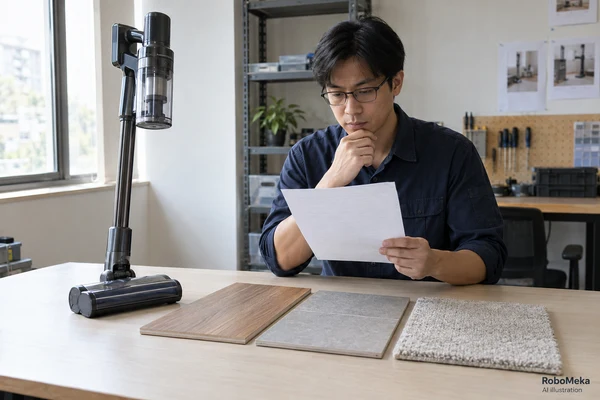
Floor-washer compatibility requires the exact flooring manufacturer to permit the method and the exact washer configuration, solution and process to support that surface. Unknown, worn, waxed or unsealed floors should remain unresolved or excluded until reliable documentation and controlled evidence are available.
Introduction
A wet-dry floor washer should not be sold as suitable for “all hard floors.” The practical buyer answer is narrower: use depends on the exact flooring product, its finish and condition, the washer model, approved solution and the flooring manufacturer's care instructions. “Sealed” is a qualification question, not a universal green light.
Two floors described as hardwood can have different factory finishes, site-applied coatings, joint construction, age, wear and warranty terms. Tile may be water-tolerant while grout, transitions or a damaged subfloor are not. Laminate and resilient planks can carry product-specific limits. A machine that recovers most liquid still places liquid and mechanical action on the surface.
This guide proposes a validation workflow for importers and private-label buyers. It does not report RoboMeka floor testing or promise compatibility with a material family. For the broader choice between wet cleaning and dry vacuuming, see the wet-dry floor washer versus stick vacuum guide.
Start with permission from both product systems
Compatibility requires two permissions. The washer documentation must allow the surface and operating mode, and the flooring manufacturer must allow the cleaning method, moisture level and chemistry. If either side is unclear, the buyer should not create permission by inference.
BISSELL's current hard-floor recommendation guide repeatedly directs users to the flooring manufacturer's instructions and distinguishes sealed bamboo, sealed hardwood, sealed laminate, engineered wood and other surfaces. It also gives product-category limits for finished concrete. This is a useful manufacturer example, not evidence for an unrelated washer.
The National Wood Flooring Association advises routine sweeping, dust mopping or vacuuming and warns against wet mops and steam mops because moisture can damage finish and wood over time. Its wood-floor maintenance guidance also recommends a cleaner made for the specific finish. That broad industry advice shows why a seller should not equate a finished-looking wood floor with permission for a powered wet washer.
“Sealed” does not describe the whole installation
A surface coating may be intact in the centre of a plank while edges, gaps, scratches, thresholds or cut ends remain vulnerable. Site-finished wood may have a different joint condition from factory-finished boards. A refinished floor may use chemistry not identified by the homeowner. Wax, polish and restorative coatings can interact with water, detergent and rollers.
Ask what the floor actually is, who made it, which product or collection it belongs to, how it was installed and what care document applies. Visual inspection can reveal obvious damage but cannot reliably identify every coating. A water-beading trick is not a substitute for product documentation and could itself mark an uncertain floor.
Build a surface identity record
The buyer needs a repeatable intake process that distributors and support teams can use. Record the flooring manufacturer, product name or code, material construction, finish, installation date where known, room, current condition and care instructions. Photograph the overall surface and any worn joints without collecting unnecessary household details.
If the customer cannot identify the floor, classify it as unknown rather than “probably sealed.” Offer dry cleaning methods permitted by the appliance instructions or refer the owner to the flooring supplier. A qualified flooring professional may be needed where refinishing, water damage or disputed warranty coverage is involved.
| Floor record | Why it matters | Acceptable evidence |
|---|---|---|
| Product identity | Links the surface to its care rules | Invoice, carton label, manufacturer record |
| Finish or coating | Determines permitted chemistry and moisture | Manufacturer or installer documentation |
| Joint and edge condition | Reveals routes for liquid entry | Ordinary inspection and dated photographs |
| Prior treatments | May explain residue or incompatibility | Named product and application history |
| Washer configuration | Defines liquid, roller and mode | Exact model, manual, roller and solution |
Do not ask support staff to pronounce on a floor warranty. The flooring manufacturer or seller controls its terms. The appliance brand can describe the intended use of its machine and help interpret its own manual, but it should not promise that using the appliance preserves another company's warranty.
Read floor-care instructions literally
Care terms that sound similar may permit different methods. “Damp mop” does not automatically mean a powered washer is approved. “Water-resistant” is not identical to waterproof under unlimited exposure. “Suitable for kitchens” does not answer whether rotating rollers, repeated wet passes or a particular detergent are allowed.
Shaw's current hardwood care page says not to use wet or steam mops and recommends its specified hard-surface cleaner with a dry mop. This manufacturer example is deliberately more restrictive than a generic claim that sealed wood can always be washed. The exact purchased flooring instructions take priority.
Read exclusions for waxed floors, oiled finishes, unfinished wood, cork, porous stone, damaged laminate, loose tiles and unsealed grout. Check temperature, concentration and dwell-time limits for solution. Review whether immediate drying is required and whether the manufacturer calls for dry soil removal first.
Treat unknown transitions as separate surfaces
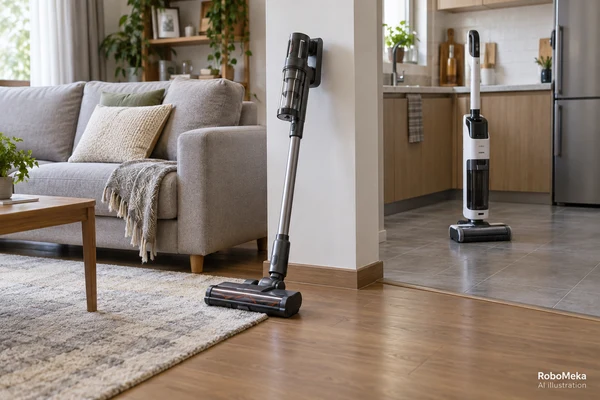
A kitchen may combine tile, a wood threshold, resilient flooring and an unfinished edge under cabinetry. The machine can cross those areas in seconds, but the permissions may differ. Map transitions and exclude any uncertain strip from the wet route until it is qualified.
Baseboards, floor vents, expansion gaps and damaged sealant also matter. A test in the open centre of a room does not establish safe use at every edge. Installation preparation should include a route plan, protected exclusions and a place to set the machine without leaving a wet roller on the floor.
Match the washer's delivery and recovery behavior
Two floor washers can leave different amounts of liquid. Delivery rate, roller saturation, scraper geometry, suction path, cleaning mode, travel speed and dry passes all affect the surface. Published tank capacity does not state how much remains on a square metre of floor.
Ask the supplier for the supported modes, approved solutions, priming procedure and pass technique. Verify whether the machine dispenses automatically or only with a trigger. Confirm what happens when the dirty tank reaches its limit, a float activates, the filter becomes wet or the recovery path is restricted.
For an example tied to one product family, BISSELL's CrossWave Edge setup guidance describes hard-floor mode for sealed hard floors and gives a recommended movement pace. A buyer must not copy that pace or surface claim to a different platform without evidence.
Measure residual moisture, not only visual cleanliness
A proposed comparison can weigh absorbent collection media or use a validated surface-moisture method before and after a controlled area, provided the method suits the flooring and does not damage it. Record solution delivered, dirty liquid recovered, area, pass pattern, time to visibly dry and any liquid at edges. The purpose is repeatability, not a false universal threshold.
Visual observations should include streaks, pooled liquid, joint darkening, finish change, swelling or unusual drag. Stop at any sign of damage. A short sample test cannot predict years of repeated exposure, so claims should be limited to the surface, condition and procedure actually evaluated.
To develop a model-specific surface matrix, send RoboMeka your floor products, care documents and customer requirements. Include the target washer functions, solution availability and expected cleaning routine so a proposed validation plan can be discussed before any compatibility language is approved.
Use a staged sample validation
Begin on replaceable manufacturer-approved sample boards, not a customer's installed floor. Include seams, bevels and the actual finish. Condition boards as recommended and record their starting state. Use production-representative washer samples, rollers and solution rather than a hand-adjusted prototype with an unexplained flow rate.
The first stage confirms operation and visible response over a small controlled area. Later stages can repeat the defined routine to examine cumulative effects, always within the flooring manufacturer's limits. If accelerated cycling is proposed, document why it is relevant; excessive wetting may create an unrealistic failure, while too few cycles may conceal gradual change.
Compare an approved reference cleaning method when useful. The reference is not “no cleaning” if normal maintenance itself changes gloss. Record whether observations result from water, solution, roller action, soil or prior residue. A clean board can answer compatibility questions but not cleaning performance on a representative mess.
Do not improvise destructive edge tests
Soaking cut edges or forcing liquid into joints may answer an engineering question, but it is not ordinary consumer use. If a laboratory performs such work, label it separately and agree the failure criteria. Never demonstrate resistance by leaving standing water on installed flooring.
If surface damage occurs, retain the board and batch records. Do not polish away the evidence and repeat until the result looks favorable. Investigate the washer, chemistry, technique and flooring sample. The honest outcome may be that the combination is excluded or needs referral to the flooring maker.
Separate cleaning chemistry from machine compatibility
The washer can be mechanically suitable while the solution is not approved for the finish. Obtain the exact formula identity, concentration instructions and market availability. Avoid “neutral” as the only specification; pH alone does not describe solvents, surfactants, fragrances, residues or interactions with coatings.
Use only the solution and dilution allowed by both systems. Do not recommend vinegar, bleach, dish detergent, essential oils or floor polish in the tank unless the exact manuals explicitly permit them. Foam, corrosion, seal damage, residue and floor-finish change can follow improvised chemistry.
If a market cannot reliably obtain the approved consumable, that is a sourcing issue. The buyer may need a locally compliant formula evaluated with the machine and floors, or a different product strategy. A label translation cannot turn an untested substitute into an approved solution. See the floor washer foam guide for the separate machine-chemistry qualification problem.
Convert evidence into a compatibility matrix
Avoid a single yes-or-no hard-floor icon. Build a matrix with the exact flooring product or documented category, permitted condition, washer model, roller, solution, mode, pass method, exclusions and evidence reference. Include an “unknown or damaged” row that directs owners away from wet use.
Use three commercial outcomes: supported under stated conditions, not supported, and unresolved pending floor-manufacturer confirmation. “Supported” should never erase the need to follow care instructions. “Unresolved” is a valid answer when the flooring cannot be identified.
The matrix needs an owner-facing version and a technical record. The owner version should be simple enough to use before cleaning. The technical file should retain test samples, dates, revisions and decisions. When the washer or formula changes, identify which rows require revalidation.
Keep regional and model limits visible
Product names and formula availability differ by market. A support page for a U.S. CrossWave model or an international flooring range may not apply to another region. Record country, model number and document version. Avoid redirecting customers to a foreign formula that is not approved or supplied locally.
Customer requirements can also differ. A distributor selling into rental housing may need a conservative unknown-floor rule. A specialist flooring retailer may be able to identify collections precisely. The same washer can therefore need different pre-sale questions and support materials without changing its physical performance.
Plan manuals, training and inquiry touchpoints
The manual should state permitted surfaces and clear exclusions, then tell users to consult the flooring manufacturer. It should explain how to identify the correct mode, fill solution, prepare the floor, make wet and recovery passes, empty tanks and dry washable parts. Keep these instructions consistent with labels and app content.
Retail training should not rely on a sealed sample board and the phrase “safe for hardwood.” Staff need a short qualification question: can the customer confirm that the flooring maker permits this powered wet-cleaning method and solution? If not, the sale should not include a universal compatibility promise.
Website inquiries can request floor identity and application details, but should not collect unnecessary household information. Photographs help with visible condition, not definitive material identification. Any proposed popup should trigger only after engaged reading and should present Name, Email and Phone as required fields if that is the site's chosen commercial policy, plus optional floor product and destination market fields.
Preserve compatibility through production
Qualification applies to the tested configuration. Control the pump or valve, roller material, scraper, suction path, tank seals, firmware modes and solution. A supplier change that increases liquid delivery or changes roller absorption may alter residual moisture even when the model name stays the same.
Proposed factory testing can verify delivery and recovery proxies on a controlled noncritical surface, correct modes, leak absence and component identity. Periodic or change-triggered qualification can repeat the more complete surface work. State which checks are factory screens and which are floor compatibility evaluations.
Shipment inspection should confirm the correct roller, solution pack where included, labels, manuals and tank assembly. It can check for transit damage and leakage under a defined safe process. It cannot prove compatibility with every floor in the destination market, so shipment approval must not be presented as a universal floor guarantee.
The golden sample and change-control guide helps connect the accepted wetting behavior to production records. Retain changes to firmware and consumables as well as visible hardware.
Frequently asked questions
Can a floor washer be used on every sealed hard floor?
No. “Sealed” does not establish that the flooring manufacturer permits powered wet cleaning, the proposed chemistry or repeated roller action. Confirm the exact floor product and care guide, then match it to the exact washer model, mode and approved solution.
How can a homeowner tell whether a wood floor is sealed?
Product, installer or flooring-manufacturer documentation is the best route. Appearance and water-beading tricks are unreliable and may risk damage. If identity or finish is unknown, classify the surface as unresolved and avoid creating wet-use permission by guesswork.
Are waterproof laminate and vinyl always compatible?
No. Water-resistance claims have product-specific conditions, and powered cleaning also involves joints, edges, roller action and detergent. Follow the exact flooring care instructions and the washer manual. A broad material name cannot replace both approvals.
Does strong water recovery make wet cleaning safe for unsealed wood?
No. Recovery reduces residual liquid but cannot guarantee that no moisture reaches pores, gaps or damaged areas. If the floor maker does not permit the method, a high recovery claim does not override that restriction.
What should a buyer include in a supplier requirement?
Specify target flooring products, condition exclusions, washer model, roller, solution, operating mode, delivery and recovery evidence, sample validation, manuals, regional consumables and change control. Require claims to stay within the supported matrix.
Conclusion
Floor-washer compatibility is a two-system decision: the floor must permit the method and the washer must support the surface under defined conditions. Identify the actual floor, inspect its condition, validate delivery and recovery with the exact machine and chemistry, and publish a conditional matrix. Unknown, worn or prohibited floors need an honest exclusion, not a universal hard-floor badge.
For your next range decision, ask RoboMeka to review a proposed floor-compatibility brief. Share the destination market, flooring documents, washer configuration and desired customer guidance so the discussion can focus on evidence that can be maintained through production and support.