The short answer
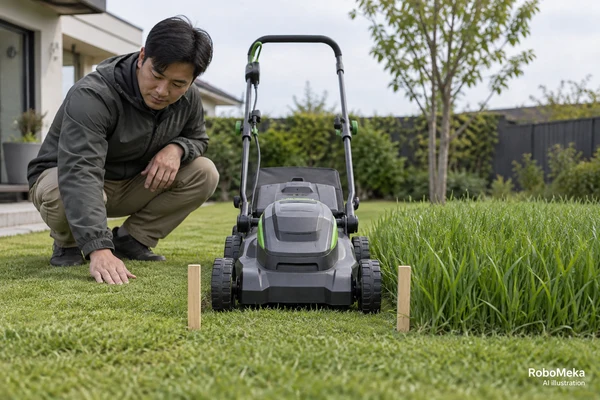
When sourcing an electric lawn mower, verify cutting width, overall machine dimensions and cutting-height behavior separately. The advertised deck width does not tell you whether the machine fits through a gate, and a height-adjustment label does not guarantee the same finished grass height on every surface. Evaluate those dimensions with the exact blade, wheel and drive configuration offered for production.
Introduction
When sourcing an electric lawn mower, verify cutting width, overall machine dimensions and cutting-height behavior separately. The advertised deck width does not tell you whether the machine fits through a gate, and a height-adjustment label does not guarantee the same finished grass height on every surface. Evaluate those dimensions with the exact blade, wheel and drive configuration offered for production.
Electric drive adds another consideration: the cutting system must deliver the intended result within the motor, controller and energy system’s approved operating range. A wider deck can increase potential coverage, but its practical value depends on grass conditions, overlap, maneuvering and load. Buyers should not assume that increasing width automatically increases useful productivity.
This article focuses on electric walk-behind equipment and supplier evaluation. It provides a measurement and application framework, not universal cutting settings or verified specifications for a RoboMeka model. Confirm the available product format and current technical information before making a purchase decision.
Define what the width specification measures
Ask whether a quoted width describes the nominal cutting swath, the deck enclosure or the overall machine. These dimensions serve different purposes. Cutting width helps describe potential coverage; enclosure and overall widths help assess access, storage and clearance around obstacles. A specification sheet should label them clearly.
Check the configuration used for the measurement. A discharge attachment, collection arrangement or wheel position may affect the space required in operation. The machine’s narrowest storage arrangement may not represent its width while mowing. Do not use a folded or accessory-free measurement to promise operational access.
Request a drawing or a measurement procedure when the dimension is important to the buying decision. Define the units and rounding convention. Converting an inch-based nominal label into an exact-looking metric value can imply a precision that the original label did not establish.
For a gate or passage, allow for the actual handling conditions rather than matching the opening to the mower’s width with no practical margin. The supplier should confirm the intended use; the buyer should document the site. This is an application check, not an instruction to operate in an unsafe or unapproved confined space.
Distinguish nominal height settings from the mowing result
A cutting-height range describes the product’s adjustment capability under its stated measurement method. It is not a promise that every blade of grass will remain at exactly that height. Surface irregularity, wheel sink, mower attitude, grass behavior and measurement technique can influence the observed result.
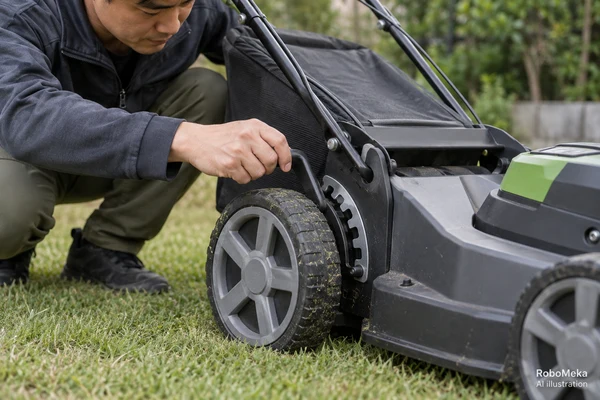
Ask how the manufacturer defines each setting. Some products use nominal height labels; others use numbered positions that require a table in the manual. Buyers need to know whether the setting applies to all wheels together or requires separate adjustments. The instructions should match the physical sample.
Inspect the mechanism for clear engagement and understandable operation while following the product’s isolation instructions. Do not adjust a machine during operation or improvise a procedure around moving parts. If measurement requires access to hazardous areas, it belongs with competent personnel using an approved method.
The objective is repeatability and usability, not cosmetic precision. A mechanism with many positions is not automatically better than one with fewer useful settings. Determine whether the available range supports the intended turf and whether users can reliably select and retain the required position.
Connect height selection to turf needs
The appropriate mowing height depends on grass species, season, local conditions and the maintenance objective. Buyers serving several regions should avoid promoting one universal lowest setting as a benefit. Very low mowing may be inappropriate for the customer’s turf or uneven ground even if the machine can mechanically achieve it.
University of Minnesota Extension’s mowing guidance discusses mowing height and avoiding excessive removal in one cut. Its regional recommendations should be interpreted in context. Ask local turf specialists when developing instructions or sales guidance for different climates and grass types.
The University of Maryland’s lawn-problem guidance also identifies issues associated with mowing practices and site conditions. This supports a useful purchasing distinction: a machine’s adjustment range and an appropriate application setting are related, but they are not the same claim.
Build a range around useful settings rather than the largest advertised span. For example, a buyer may prioritize easy adjustment within the customer’s normal maintenance range over an extreme low position that is rarely appropriate. Record that reasoning in the selection brief so that the supplier understands the actual requirement.
Evaluate width and electric drive as one system
Increasing cutting width changes the amount of grass encountered across a pass, but load also depends on grass density, moisture, height reduction and travel speed. Blade and deck design influence how material is cut and moved. Electrical input alone does not capture the complete interaction.
A controller may manage motor behavior under changing load. Buyers should ask how the product is intended to respond and what limitations apply, without attempting to bypass protection functions. A temporary change in sound or speed requires interpretation within the manufacturer’s design and instructions, not an immediate assumption of superior or inferior quality.
For battery equipment, evaluate width using the specified pack configuration. Comparing a wide-deck mower with a larger energy package against a compact model with a smaller package can be commercially valid, but it is not a controlled comparison of deck efficiency alone. Label what the comparison actually demonstrates.
For corded equipment, use the approved supply setup and observe the product’s operating limits. Do not treat mains connection as proof that the widest deck is always preferable. The customer still needs manageable handling, appropriate access and a satisfactory finish in the intended application.
Create a dimensions-and-results worksheet
The following worksheet separates physical measurements from application observations. Agree the procedure, responsible reviewer and acceptance criteria before the sample evaluation. Any dimensional tolerance should come from the product specification and intended use, not an arbitrary number introduced by the buyer after testing.
| Item | Record | Why it matters |
|---|---|---|
| Nominal cutting width | Supplier definition and units | Establishes the claimed swath |
| Overall operating width | Required accessories installed | Checks access and clearance |
| Storage envelope | Approved folded or stored arrangement | Supports warehouse and customer planning |
| Height positions | Labels and manufacturer measurement method | Prevents setting ambiguity |
| Adjustment operation | Isolation method and engagement observations | Evaluates usability safely |
| Finished grass | Sampling method and site conditions | Connects settings to actual results |
| Energy configuration | Supply setup or pack identity | Makes performance comparison interpretable |
| Clipping mode | Collection, mulch or approved discharge setup | Identifies the cutting-system configuration |
Add photographs that show the setup without presenting them as precision measurements. A tape placed at an angle or a camera perspective can make a dimension misleading. Retain the written method and results as the controlling record, with images used to explain context.
Where a dimension is borderline for the target application, request clarification or another sample rather than rounding in the favorable direction. A small discrepancy can matter at a narrow access point or in packaging, while being irrelevant to another customer. Tie the decision to the actual requirement.
Design a practical comparison session
Choose representative, permitted mowing conditions and document them. Compare products at settings appropriate to the turf and the question being studied. If one mower is tested at a materially different height reduction, the results may reflect different workloads rather than a meaningful width advantage.
Record effective pass width, including the overlap needed to avoid missed strips. Note turning, obstacles, emptying and any interruptions separately from straightforward mowing. This helps distinguish the theoretical coverage associated with deck width from the time needed to finish the property.
A hypothetical calculation illustrates the distinction. A 0.40-meter effective swath moving at 0.75 meters per second covers 0.30 square meters per second before turns, stops and other losses. That arithmetic is not a product capacity claim; it simply shows why swath and movement must be interpreted alongside the actual work pattern.
Observe the finished lawn using a consistent approach. Record missed areas, uneven appearance or clipping issues without immediately attributing them to one component. Repeat relevant observations when conditions or operator technique may have influenced the outcome. A single short pass is not a complete comparison study.
Send your electric mower deck requirements with the intended lawn conditions, access dimensions and clipping mode. The downloadable brief can help clarify which measurements and sample checks matter for your project, subject to confirmation of available product scope.
Check collection and mulching configurations separately
Collection and mulching may use different approved parts or operating recommendations. The airflow and clipping path form part of the system. A height and width combination that gives an acceptable result in one mode should not automatically be advertised as equivalent in another without supporting evaluation.
Confirm that the quoted package includes every required insert, bag or attachment. Ask how users identify the correct arrangement in the instructions. An accessory that appears to fit physically is not necessarily approved for the mower or the intended mode.
Blade identity is equally important. Replacement parts should be matched through the supplier’s model-based system. Toro’s parts lookup resources illustrate why model identification matters; they do not validate interchangeability for other products. Use the actual supplier’s part numbers and approved alternatives.
For deeper procurement questions about the assembly, see the electric mower blade-system guide. Keep width, height and blade decisions connected so that a later accessory change does not undermine the sample evidence used to approve the range.
Review production consistency and change control
The approved sample should have a recorded configuration and revision. Ask how production controls preserve the relevant dimensions, adjustment behavior and component identities. Buyers do not need every proprietary manufacturing detail, but they do need a credible method for checking the characteristics on which the purchasing decision depends.
Shipment inspection can include agreed dimensional and functional observations, using safe procedures. Its purpose and limits should be explicit. NIST’s acceptance-sampling introduction explains sampling as a tool for lot decisions, not a guarantee of every unit’s behavior throughout its service life.
Changes to wheels, height linkages, blades or the deck may affect more than appearance. Require the supplier to assess their impact on dimensions, performance, documents and service parts. A nominal cutting-width label that remains unchanged does not prove that the complete product is equivalent to the approved version.
Preserve the link between the catalog specification and the release record. If marketing rounds a dimension or simplifies a height description, have a responsible reviewer check that the wording remains accurate. Technical review should happen before the listing creates customer expectations that the physical product cannot support.
Prepare customer-facing guidance without overpromising
Explain the difference between cutting width and overall width where access is a common concern. Show which accessories are included in the stated dimensions. If storage measurements refer to a folded arrangement, say so and direct users to the approved folding instructions.
For height, present the adjustment range and encourage settings appropriate to local turf guidance and the manual. Avoid claiming that the lowest setting produces a better lawn or that all setting positions correspond to an exact final grass height under every condition.
Any productivity or runtime statement should identify the relevant test conditions and configuration. EGO’s mower information provides a manufacturer example of explaining factors that affect endurance. Buyers should obtain equivalent clarity for their own selected products rather than borrowing another brand’s results.
Finally, make safe adjustment and maintenance instructions easy to find. HSE’s machinery-maintenance guidance reinforces the role of planned, competent work, but it does not replace the mower manual. Customer convenience should be supported by clear instructions, not by omitting the precautions needed to use the adjustment system properly.
Keep measurement records accessible to sales staff
Provide a concise approved dimension sheet alongside the detailed evaluation. Sales staff should be able to distinguish cutting width, operating width and storage dimensions without reconstructing the test file. Include the measurement configuration and revision so that a later accessory change is not accidentally described using an earlier envelope. This makes everyday access questions easier to answer accurately.
Frequently asked questions
Is cutting width the same as the mower’s overall width?
No. Cutting width describes the nominal swath, while overall width includes the physical machine and may depend on installed accessories. Ask for both dimensions and their measurement conditions. For access planning, use the operating configuration and consider the real handling space rather than relying on the cutting-width label.
Does a wider electric mower always finish faster?
Not necessarily. Wider cutting can increase potential coverage, but turns, obstacles, overlap, handling and workload influence completed area. The energy and drive configuration also matter. Evaluate a representative mowing session and the finished result instead of converting deck width directly into a guaranteed time saving.
Why can the finished grass height differ from the setting?
The setting follows the manufacturer’s defined geometry, while the actual lawn includes surface variation, wheel movement and grass behavior. Measurement methods also differ. Record the selected position and site conditions, then evaluate the result consistently. Do not assume that a numbered setting is an exact universal grass-height measurement.
Should buyers specify the greatest possible height range?
Only if the intended application needs it. A useful, repeatable range for the customer’s turf can be more valuable than extreme positions that are rarely appropriate. Consult local lawn-care guidance and the product manual, and evaluate adjustment usability as well as the numbers on the specification sheet.
What changes require a new width-and-height review?
Changes to the deck, blade, wheels, adjustment mechanism or relevant accessories can affect the result. The responsible technical reviewer should determine the necessary evaluation. Keep the revised configuration traceable and update the published specifications where needed. An unchanged model name alone does not establish equivalence to the approved sample.
Conclusion
Electric mower width and height should be purchased as verified application characteristics, not isolated headline numbers. Clarify the measurement definitions, evaluate turf results with the approved drive configuration and preserve the specification through production. This gives buyers a stronger basis for assortment decisions and customer guidance.
Request a deck and application review, check the downloaded project brief and email it to info@RoboMeka.com. The contact form saves the brief locally; it does not automatically transmit it or establish product specifications or availability.