The short answer
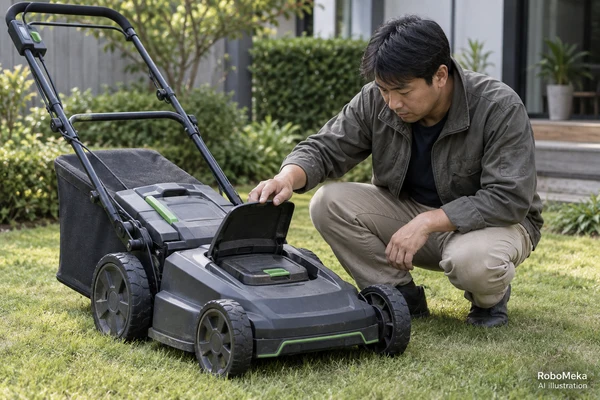
Source an electric mower’s blade and cutting system as one approved assembly: blade, mounting arrangement, deck, airflow path, motor control and clipping accessories must work together. A blade that looks similar or has the same nominal length is not automatically a suitable replacement. Buyers need model-specific identities and evidence for the configuration they intend to sell.
Introduction
Source an electric mower’s blade and cutting system as one approved assembly: blade, mounting arrangement, deck, airflow path, motor control and clipping accessories must work together. A blade that looks similar or has the same nominal length is not automatically a suitable replacement. Buyers need model-specific identities and evidence for the configuration they intend to sell.
This system view matters when comparing mulching, collection and discharge claims. The mower must cut the grass and manage the material under the intended conditions. A change that improves one characteristic may affect load, sound, finish or service requirements elsewhere. Procurement should assess the complete result rather than rank an isolated blade feature.
The article provides an evaluation framework for electric walk-behind equipment, not instructions for modifying blades or repairing a cutting assembly. All inspection and service activities must follow the actual product manual and use competent personnel where required. RoboMeka product availability and specifications need direct confirmation.
Identify the approved cutting configuration
Ask the supplier to list the mower model and revision, blade part number, mounting components and approved clipping modes. Include collection bags, inserts and discharge accessories that form part of the offer. The list should distinguish standard contents from optional equipment and from unsupported combinations.
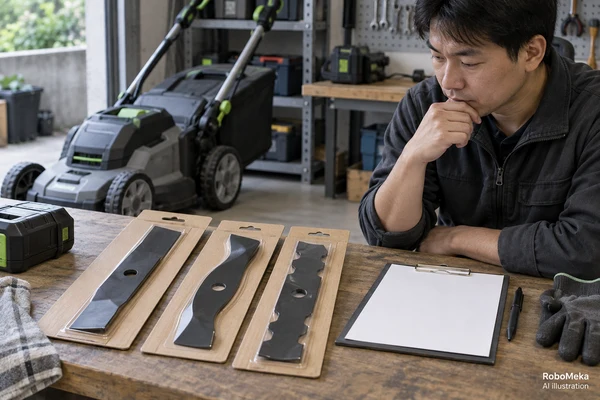
Do not infer compatibility from a shared deck size or a similar mounting hole. Geometry, mass, balance, clearance and the intended drive arrangement can matter. A buyer who needs an alternative blade should request a documented engineering review rather than ask a workshop to adapt an available part.
The manual and parts information should identify the same configuration. A generic diagram can be useful background, but it must not leave users guessing which blade or fastener belongs to their model. Service staff should have a reliable way to resolve revisions and approved replacements.
Toro’s parts resources demonstrate the importance of model-based identification in a service system. They do not establish interchangeability for other brands. Require the actual supplier to provide an equivalent route to the correct information for the mower being sourced.
Understand blade, deck and airflow interaction
The blade performs cutting work and can also influence the movement of clippings within the deck. Deck geometry and the path to a collection bag or discharge opening affect how material is handled. These interactions help explain why a blade description alone cannot establish collection or mulching performance.
An electric motor and controller must operate the approved assembly within its intended conditions. Changing the cutting component can alter the load seen by the system. Buyers should not assume that a blade marketed as more aggressive produces a free performance improvement without other consequences.
Ask the supplier what the chosen blade is designed to do in each supported mode. Request evidence for the whole assembly, including the relevant accessories and energy configuration. If the explanation relies only on a material adjective or a shape name, ask how that feature translates into an observed customer benefit.
Separate engineering rationale from verified results. A design explanation can make a proposed benefit plausible, but it is not the same as application evidence. The NIST conformity-assessment overview supports matching the type and scope of evidence to the claim being made.
Evaluate mulching and collection as different tasks
Mulching aims to manage cut material within the intended mowing process, while collection moves it into a receptacle. The appropriate configuration and operating recommendations can differ. Do not assume that removing the bag creates an approved mulching setup or that adding a bag makes any deck an effective collector.
Confirm the required insert or accessory and how the user identifies the correct arrangement. Instructions should explain permitted mode changes and any isolation steps without ambiguity. The carton contents and product listing should make it clear which modes are available with the supplied package.
Application conditions matter. Grass moisture, density, height reduction and maintenance frequency affect the workload and clipping behavior. University of Minnesota Extension’s mowing guidance discusses mowing practices that influence the result. Use locally appropriate turf guidance rather than expecting a cutting accessory to overcome every unsuitable condition.
When comparing modes, document the actual setup and acceptable outcome. A long runtime with poor clipping management does not establish a successful configuration. Equally, a favorable short demonstration does not prove that the same result will occur across all intended lawns and mowing intervals.
Review materials and manufacturing claims carefully
Blade material and manufacturing processes can be relevant, but buyers need more than a generic claim of premium steel or heavy-duty construction. Ask for the applicable specification, traceability and quality controls where those details are necessary to evaluate the product. Avoid demanding irrelevant proprietary information simply to make the inquiry appear technical.
The correct question is whether the finished component is suitable for the approved assembly and intended service conditions. Thickness, hardness or weight alone should not become a universal quality ranking. A change in one characteristic can have implications that require engineering evaluation rather than a simple better-or-worse label.
Request the supplier’s criteria for acceptance and replacement, along with the authorized maintenance instructions. Buyers should not invent sharpening angles, balancing methods or fastening values for a product they have not technically approved. Those details belong in model-specific documentation and competent service procedures.
If a sales claim refers to durability testing, ask what was evaluated and under which conditions. Identify the sample, method and limitations. Do not turn a component-level result into a complete mower reliability guarantee without evidence that supports that broader conclusion.
Build a cutting-system approval worksheet
The worksheet below organizes evidence for a purchase decision. It is not a repair guide or a complete safety assessment. Use it to ensure that the commercial offer and the technical configuration describe the same system.
| Review area | Information to record | Decision supported |
|---|---|---|
| Blade identity | Part number, revision and approved model | Prevents unsupported substitution |
| Mounting system | Applicable parts and service documentation | Establishes the correct assembly record |
| Deck configuration | Model and relevant accessories | Defines the evaluated clipping path |
| Supported modes | Required insert, bag or discharge component | Clarifies customer package capability |
| Electric drive | Approved motor-control and energy setup | Makes load-related results interpretable |
| Application evidence | Grass condition, setting and finished result | Supports mode-specific claims |
| Maintenance | User tasks and authorized service boundary | Defines support requirements |
| Production control | Traceability and change notification | Preserves approved configuration |
Attach the relevant documents rather than relying on a completed checkbox alone. A statement that a blade is compatible should be traceable to the responsible supplier’s approval. An unresolved field should remain visible until the appropriate reviewer closes it.
Use the worksheet when comparing suppliers with different terminology. One may describe a multi-function blade, another may offer separate approved blades for specific tasks. Compare the supported outcomes and package requirements rather than assuming that similar marketing names mean identical engineering.
Design an application evaluation around the finished lawn
Choose a permitted, representative area and document the condition before mowing. Record the blade identity and condition, selected height, clipping mode and energy setup. Use a consistent route and observation method where the comparison requires it. All preparation and inspection should follow the product’s isolation and operating instructions.
Observe the finish, missed strips, clipping distribution or collection behavior as relevant. Record interruptions and the need for corrective passes without assuming their cause. Differences can arise from the site, setup, operator or machine, so interpretation should follow evidence rather than a preferred supplier narrative.
The University of Maryland’s lawn-problem guidance is useful context for separating mowing-related turf issues from simple product defects. It does not diagnose a particular sample. Where the result is uncertain, repeat the relevant evaluation or seek suitable technical and turf expertise.
Keep component comparisons and customer-package comparisons distinct. If two mowers use different decks, batteries and blades, the session can compare complete offers for an application. It cannot establish which individual blade is more efficient unless the evaluation design isolates that question appropriately.
Send your cutting-system sourcing requirements with the desired clipping modes, customer application and package expectations. The downloaded brief can support a configuration discussion with RoboMeka; it does not approve substitutions or confirm availability of every electric mower format.
Connect blade choice with power and endurance claims
A blade or clipping-mode change can alter the work demanded of the electric system. Buyers should therefore review runtime and performance statements against the exact cutting configuration used in the supporting evaluation. Do not retain a favorable runtime headline after changing a relevant component without assessing applicability.
The electric mower power-and-runtime guide explains why input ratings, load and useful mowing time are separate concepts. Apply that distinction when a supplier proposes an energy-saving blade or an alternative cutting mode. Ask what result was measured and what trade-offs were observed.
Manufacturer examples such as EGO’s mower information show why runtime conditions need disclosure. Those results remain specific to the manufacturer’s own products and methods. They cannot be borrowed as proof that another cutting assembly will deliver the same benefit.
Treat noise claims similarly. A changed blade or operating behavior may affect the acoustic result, but the direction and magnitude require suitable evidence. Do not advertise a quieter cutting system solely because a component is lighter, smaller or described as optimized.
Define maintenance boundaries before launch
The customer manual should explain permitted routine care and identify work that requires authorized or competent service. Buyers need to know how the cutting component is inspected, when it should no longer be used and how the correct replacement is selected, according to the actual manufacturer’s instructions.
Do not provide generic blade removal, sharpening or fastening procedures across unrelated models. Isolation arrangements and assembly details vary. HSE’s machinery-maintenance guidance reinforces the importance of planning, safe isolation and competence, while the product manual supplies the specific procedure.
Service training should include identification and escalation, not only mechanical activity. Staff must recognize when the model or part revision is uncertain and obtain the correct information before proceeding. A repair network that improvises substitutions can undermine the configuration control established during procurement.
Ask how replacement parts will be stocked and how changes will be communicated. A low purchase price is less useful if the approved blade cannot be identified or obtained when needed. Confirm the actual support commitment without inventing an indefinite parts-availability promise.
Preserve the approved system through production and shipping
Factory controls should maintain the specified component identities and relevant assembly requirements. Ask how the supplier prevents mixed blade or accessory variants from entering the wrong package. The necessary evidence depends on the product and agreement, but the configuration should remain traceable from release to shipment.
Shipment inspection can verify agreed contents, identities and safe functional observations. It should not involve unapproved disassembly or improvised hazardous testing. Provide inspectors with the current release documents and a clear process for handling discrepancies before goods are released.
NIST’s acceptance-sampling overview explains the role of sampling in lot decisions. A successful shipment inspection does not replace engineering qualification or establish lifetime durability. Keep those limits explicit in both the purchasing record and marketing language.
If a supplier proposes a blade, deck or accessory change, assess the affected performance, instructions, evidence and spare-parts records. An unchanged nominal cutting width does not prove equivalence. Update the approved configuration and any claims only after the responsible reviewers have accepted the change.
Use a realistic package-review example
Imagine a retailer requesting collection and mulching capability in one electric mower kit. The supplier’s initial quotation includes the mower and bag but lists the mulching insert as an option. The buyer should resolve that package difference before comparing price or claiming both modes are ready to use out of the carton.
The evaluation then uses each approved arrangement with documented conditions. If the supplier later proposes a different blade, the team reviews whether the earlier results and instructions still apply. This is a hypothetical purchasing workflow, not a completed RoboMeka project or evidence of a particular product’s capabilities.
The lesson is that the cutting system has both engineering and commercial identities. Correct hardware can still create customer confusion when the package or instructions are unclear. A successful release aligns the assembly, contents, claims and support information rather than approving each in isolation.
Frequently asked questions
Can electric mower blades be selected by length alone?
No. Length is only one characteristic. The approved model, mounting arrangement, geometry and complete cutting system matter. Use the manufacturer’s part identification and documented alternatives. Do not modify a blade or mounting component to make a similar-looking part fit an otherwise unsupported application.
Does removing the collection bag enable mulching?
Only if the manufacturer approves that configuration and all required parts are present. Some systems need a specific insert or other arrangement. Check the actual manual and package contents before making a claim. Physical removal of an accessory does not by itself establish a supported operating mode.
Is a thicker blade always more durable or better?
Not necessarily. Suitability depends on the complete design, materials, manufacturing controls and intended assembly. A single dimension should not replace relevant evidence. Ask how the component meets the approved requirements and what testing or service guidance supports the claim for the exact mower configuration.
Should runtime be checked after a blade change?
The responsible technical reviewer should assess whether the change affects the existing evidence and determine the necessary evaluation. Blade and clipping-system changes can alter load and results. Do not automatically reuse an earlier runtime claim when the production configuration differs from the one originally evaluated.
What should importers require for replacement support?
Obtain model-specific part identities, applicable instructions, revision information and a clear ordering and escalation route. Confirm who performs authorized service and how substitutions are approved. This makes support traceable and reduces the risk that staff choose replacements based only on appearance or a broad product-family description.
Conclusion
Electric mower cutting-system procurement works best when the blade, deck, drive and clipping accessories are evaluated together. Define the approved assembly, check the finished result and preserve the configuration through production and service. Buyers can then make useful claims without implying that every blade or accessory is interchangeable.
Prepare a cutting-system project brief, review the downloaded document and email it to info@RoboMeka.com. The form does not transmit the inquiry automatically or establish technical approval, product availability or a supply commitment.