The short answer
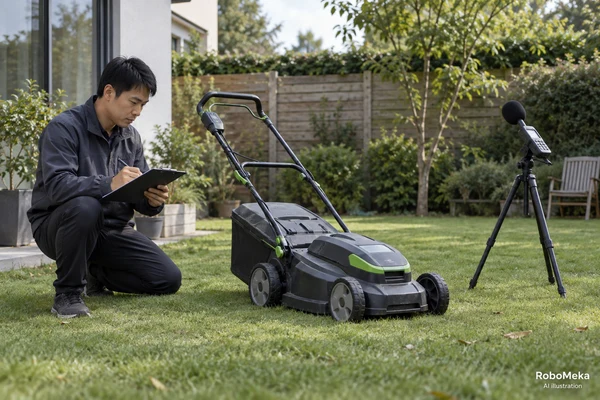
When sourcing an electric lawn mower, verify noise claims using comparable acoustic measurements and describe emissions within a clear boundary. A mower without an onboard combustion engine does not produce local engine exhaust during mowing, but that does not make its manufacture, electricity use or battery system impact-free. Buyers should separate these claims rather than compress them into silent or zero-impact marketing.
Introduction
When sourcing an electric lawn mower, verify noise claims using comparable acoustic measurements and describe emissions within a clear boundary. A mower without an onboard combustion engine does not produce local engine exhaust during mowing, but that does not make its manufacture, electricity use or battery system impact-free. Buyers should separate these claims rather than compress them into silent or zero-impact marketing.
Electric equipment can be relevant to customers concerned about neighborhood disturbance and local exhaust, but suitability depends on the actual model and operating conditions. The blade, airflow, grass interaction and drive system still generate sound. A quieter claim needs an identified comparison, not merely a different power source.
This guide helps importers, distributors and private-label brands review technical evidence and wording. It does not provide acoustic results, lifecycle calculations or environmental certification for RoboMeka products. Confirm the actual available configuration and obtain appropriate specialist review for regulated claims and destination-market requirements.
Define the customer’s noise question
Different buyers ask different questions when they say a mower should be quiet. A homeowner may be concerned about neighbors; a professional purchaser may need workplace exposure information; a tender may specify a particular declared acoustic value. These are related concerns, but they do not all use the same measurement.
Ask what decision the information must support. Is the buyer comparing products, planning a work schedule or checking a stated procurement requirement? Record the required metric and method before requesting data. Otherwise, suppliers may provide numbers that look comparable but describe different quantities.
The site also matters. Distance, nearby surfaces and the duration of use influence the experienced sound. A product value cannot by itself guarantee that mowing will be unobtrusive at every boundary or acceptable under every local rule. Use qualified assessment where a specific site decision requires it.
For professional contexts, OSHA’s landscaping hazard resources identify noise among relevant workplace concerns. They provide context rather than a product-specific exposure determination. Do not convert a general product specification into a complete workplace safety conclusion.
Distinguish sound power from sound pressure
Sound power describes acoustic emission from a source under a defined method, while sound pressure describes the level at a particular measurement position under specified conditions. The values answer different questions. Buyers should not compare a sound-power number from one supplier with a sound-pressure number from another as though they were the same rating.
Ask for the measurement method, operating condition, configuration and any declared uncertainty or related information needed to interpret the result. Identify whether the value concerns a particular operating mode and whether the mower was cutting representative grass or evaluated under another defined procedure.
Decibel values should not be treated as ordinary linear quantities. Avoid casual arithmetic that turns a difference into an unsupported percentage of perceived quietness. If a marketing comparison depends on a numerical interpretation, have an acoustic specialist review both the data and wording.
The European Commission’s outdoor equipment noise information explains the regulatory context for relevant outdoor equipment in the EU. Applicability and required declarations depend on the product. The page is a reference point, not evidence that a proposed model has satisfied every applicable requirement.
Compare complete operating configurations
Blade and deck design, clipping mode, motor behavior and the material being cut can affect the acoustic result. Buyers should identify the complete configuration behind a supplier’s claim. A change in the cutting assembly or control behavior may require review before the same noise statement is reused.
For battery equipment, record the approved energy arrangement where relevant to the method. For corded equipment, use the specified supply setup. Do not create an artificially favorable comparison by testing one machine under a lighter task or in a different mode without disclosing the difference.
Ask whether the claimed advantage applies to a defined competitor, a previous model or a general category. A comparison against one identified engine-powered mower does not establish that the electric model is quieter than every mower in the market. The scope of the wording should match the evidence.
The electric mower blade-system guide explains why the cutting assembly should be treated as a system. Apply the same thinking to acoustic claims: a component description alone does not prove the sound level of the assembled mower in use.
Separate local exhaust from wider environmental impacts
A mains- or battery-powered mower without an onboard combustion engine has no combustion-engine exhaust at the point of mowing. That is a defined operational characteristic. It should not be stretched into a claim that the product has no emissions anywhere in its lifecycle.
Electricity generation, manufacturing, transport, maintenance and end-of-life treatment fall outside that narrow local-exhaust boundary. Battery manufacture and replacement may also matter for battery products. Any broader comparison needs an explicit method, assumptions and relevant data rather than a general statement that electric always means impact-free.
The US EPA’s small-equipment emissions resources address emissions from relevant engine-powered equipment. They help explain the distinction between engine-emission questions and broader environmental evaluation. They do not supply a lifecycle result for an unidentified electric mower.
Use careful wording when discussing user experience. The absence of local engine exhaust may be relevant to a customer, but it does not remove other operating risks or guarantee suitability for enclosed spaces. The actual mower’s intended-use restrictions and safety instructions remain controlling.
Establish a claim-review matrix
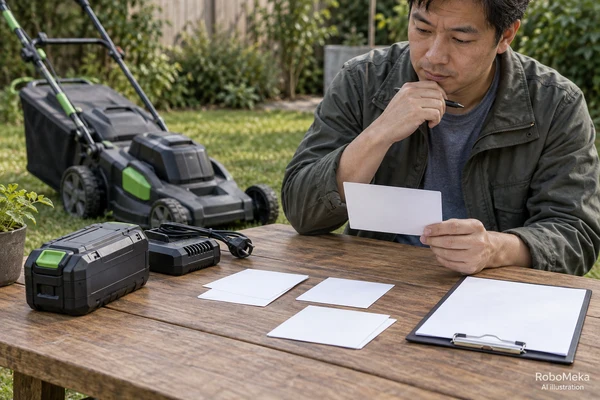
The following matrix helps marketing and purchasing teams connect proposed language to evidence. It is a drafting tool rather than legal advice. Have qualified reviewers assess claims where market-specific advertising or product rules apply.
| Proposed claim | Evidence or boundary needed | Safer review question |
|---|---|---|
| Quieter operation | Comparable metric, method and identified comparison | Quieter than which product, under what conditions? |
| Low noise | Defined value and relevant context | What does the phrase mean for this buyer? |
| No local engine exhaust | Confirmed power architecture and operating boundary | Is the claim limited to mowing operation? |
| Lower environmental impact | Defined lifecycle scope and applicable data | Which impacts and assumptions were evaluated? |
| Longer battery life | Relevant method and identified configuration | What life measure is actually supported? |
| Reduced energy use | Comparable work output and measurement | Was the same useful task completed? |
| Suitable for sensitive sites | Product evidence plus site requirements | What additional local assessment is needed? |
Mark unsupported claims as unresolved, not approved with softer punctuation. Replacing a precise unsupported number with a vague superlative does not necessarily improve accuracy. Sometimes the correct action is to describe the product’s verified architecture and leave a broader benefit unclaimed.
Keep the approved wording with the evidence file. If a distributor translates or shortens the statement, review the new version for meaning. A careful technical explanation can become misleading when a condition is dropped from a headline or an image caption.
Request evidence without commissioning the wrong test
Begin by asking what data the supplier already has for the proposed configuration and intended claim. Check the method, model identity and limitations. The NIST conformity-assessment overview helps distinguish testing and other assessment activities; a document should be used for the question it actually addresses.
If the available data does not answer the buyer’s question, define the missing decision before requesting further work. A regulatory declaration, an engineering comparison and a site assessment can require different approaches. Commissioning a generic sound measurement may not resolve the actual purchasing or marketing issue.
Do not present a phone recording or an informal demonstration as a standardized acoustic result. Such material may communicate context, but recording settings and playback conditions limit what the audience can infer. Label demonstrations honestly and avoid precise comparative claims unsupported by the method.
For environmental analysis, identify the functional basis of comparison. Comparing energy use per minute can answer a different question from comparing energy required to complete an acceptable mowing task. The method should align with the customer benefit being discussed rather than favor whichever denominator looks best.
Send your noise and environmental-claim requirements with the market, customer application and wording you need to support. The downloaded brief can organize a scope discussion with RoboMeka; it does not establish an acoustic rating or environmental approval.
Account for maintenance and changing conditions
The condition of the cutting system can affect operation and the user’s experience. Maintenance should follow the manufacturer’s instructions, including the response to abnormal sound or vibration. Do not advise customers to continue operating a suspect machine merely because a product is generally marketed as quiet.
HSE’s machinery-maintenance guidance supports planned maintenance and appropriate competence. Model-specific instructions should determine inspection, isolation and service procedures. A marketing team should not invent a maintenance shortcut to preserve an advertised acoustic benefit.
Grass management also affects the task being performed. University of Minnesota Extension’s mowing guidance discusses frequency, height and blade condition. Use local turf advice and the product manual to define reasonable operation rather than treating difficult, neglected grass as equivalent to every other application.
When a customer reports a change in sound, support should collect the model and circumstances and follow the approved escalation process. A change can have several causes; the response should neither dismiss it automatically nor diagnose a specific fault from a short message without sufficient evidence.
Compare corded and battery electric offers honestly
Both formats avoid an onboard combustion engine when designed as fully electric products, but their ownership systems differ. A corded offer depends on an approved mains arrangement during use. A battery offer includes pack and charger decisions, replacement planning and relevant transport considerations.
Do not infer that one format has a universally lower lifecycle impact without a suitable comparison. Results depend on the defined product, use pattern and analytical boundary. A buyer can still discuss concrete differences such as package contents and operating arrangements without making an unsupported environmental ranking.
For battery logistics, IATA’s battery transport resources provide air-transport context. Shipping compliance and environmental impact are different subjects: satisfying transport requirements does not establish that a battery has a particular lifecycle footprint.
Similarly, a battery warranty or capacity claim should not be converted into a guaranteed environmental benefit. The commercial promise, measured performance and lifecycle assessment each need their own evidence. Keeping these categories separate makes the buyer’s evaluation more precise.
Prepare a tender or product-page response
For a tender, identify each requested value and the required evidence format. Ask for clarification where terms such as low noise or environmentally friendly are undefined. A transparent response can state what is documented, what assumptions apply and which requirements need additional assessment.
For a product page, place important conditions close to the claim. Do not rely on a distant downloadable file to correct an absolute headline. A concise, accurate statement of the power architecture may be more useful than a broad green label that customers interpret in several incompatible ways.
Consider a hypothetical request for a mower suitable for a noise-sensitive residential service. The buyer would need the model’s acoustic information, the intended work pattern and relevant local site requirements. Selecting an electric architecture is only one part of that review, not the complete answer.
Retain the approved wording when the product is revised. A new blade, controller or energy package can require evidence review even if the commercial name remains unchanged. Ask the responsible technical team which claims continue to apply before issuing revised catalogs or distributor copy.
Review images and comparison graphics too
Environmental and noise claims often appear in visual content before they appear in a technical specification. Check icons, badges and captions for implied promises. A crossed-out sound symbol can suggest silence even when the accompanying text only claims a measured reduction against one model.
Have the same reviewer examine the complete customer presentation, including translations and distributor graphics. Use accurately bounded wording near the visual rather than relying on a remote disclaimer to correct it. An illustration can explain the operating context, but it is not a measurement record or proof of environmental performance.
Frequently asked questions
Are electric lawn mowers silent?
No. The cutting system, airflow, drive and interaction with grass produce sound. The level depends on the actual product and conditions. Use applicable acoustic data and a defined comparison rather than describing the entire category as silent or assuming that the absence of an engine removes all noise.
Can sound power and sound pressure be compared directly?
No. They describe different acoustic quantities and depend on their specified methods and conditions. Ask suppliers to identify the metric before comparing values. Where a purchasing or marketing decision depends on the interpretation, obtain qualified acoustic review instead of treating all decibel figures as interchangeable ratings.
Is zero emissions an accurate electric mower claim?
An unqualified statement can obscure important boundaries. A fully electric mower without a combustion engine does not create local engine exhaust during mowing, but manufacturing, electricity supply and other lifecycle stages can have impacts. State the intended boundary and use suitable evidence for any broader environmental comparison.
Does a battery transport document prove environmental performance?
No. Transport documentation serves a different purpose from lifecycle or environmental assessment. It should be reviewed for the actual shipment, while environmental claims need their own method, scope and data. Do not use a shipping-related document as a general sustainability certificate for the mower or battery.
What should buyers request for a quieter-than claim?
Ask for the identified comparison product, matching acoustic metric, method, operating configuration and relevant conditions. Review whether the proposed wording stays within that evidence. A result against one model or in one mode should not become a claim of superiority over every product or every mowing situation.
Conclusion
Electric mower noise and emissions claims are strongest when they answer a defined question within a visible boundary. Compare acoustic evidence correctly, distinguish local exhaust from lifecycle impacts and keep wording tied to the actual configuration. Buyers can then communicate useful benefits without promising silence or impact-free operation.
Prepare a claim-review inquiry, check the downloaded requirements document and email it to info@RoboMeka.com. The form does not send email automatically or establish noise performance, environmental certification or product availability.