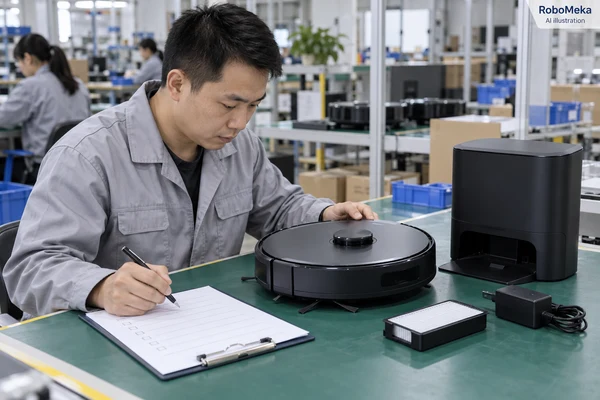
The short answer
Buyers should decide whether the complete packaged-product system can be evaluated against a route-appropriate procedure and pre-agreed product and packaging acceptance criteria. Define the exact configuration, application, evidence and operating responsibilities before approval; then preserve that identity through factory testing, shipment inspection, installation preparation and after-sales support.
Introduction
The short answer is to decide whether the complete packaged-product system can be evaluated against a route-appropriate procedure and pre-agreed product and packaging acceptance criteria. A useful sourcing decision connects the customer application, the exact proposed configuration, controlled evidence and a support plan. It does not turn a feature name, supplier presentation or short demonstration into a universal performance, safety or compliance claim.
This guide is written for importers shipping vacuums, robots, chargers, docks and accessories through parcel, ocean and regional distribution networks. It describes a proposed procurement method, not a report of completed RoboMeka factory testing, shipment inspection or customer installation. Any worked example is hypothetical. The exact product manual, qualified specialists and applicable rules remain authoritative for the supplied model and destination market.
What should buyers decide first?
Buyers should first write the decision in operational terms: whether the complete packaged-product system can be evaluated against a route-appropriate procedure and pre-agreed product and packaging acceptance criteria. That statement is more useful than asking whether the product or supplier is simply “good.” It identifies the customer result, the evidence needed and the people responsible when conditions change.
Start with freeze the product configuration, retail carton, inserts, accessory positions, master carton, pallet pattern and distribution assumptions before selecting a procedure with a qualified laboratory. Separate mandatory gates from preferences. A mandatory gate is a condition that prevents approval if it is not supported; a preference can influence the shortlist but does not silently become a safety, legal or performance requirement. This distinction keeps the evaluation proportional and makes supplier replies easier to compare.
Use the RoboMeka manufacturing overview, OEM and ODM process and sample evaluation guide to connect the article to the wider sourcing process. Here, the practical control points are packaged-product identity and pre-test condition.
Define the application boundary before comparing offers
The application boundary should state who uses the product, where it operates, what it must accomplish, which conditions are outside scope and what intervention is acceptable. For this topic, the practical focus is importers shipping vacuums, robots, chargers, docks and accessories through parcel, ocean and regional distribution networks. Record destination market, environment, expected frequency, skill level, accessories, connected services and after-sales route where relevant.
Avoid combining unlike scenarios into one acceptance statement. A sample that works in a controlled demonstration may not answer questions about another surface, property, network, climate, route or maintenance routine. Apply that boundary while reviewing distribution route assumptions alongside damage criteria.
The main foreseeable mistake is that a dramatic single drop video can be mistaken for formal transit qualification, while a valid report for another weight, pack or route is reused without justification. Make that risk visible in the RFQ, sample plan, instructions and sales review. A limitation stated before ordering is manageable; the same limitation discovered through returns is expensive and can undermine customer trust.
Turn the requirement into a traceable specification
A traceable specification links each promise to an exact model, revision, accessory set, document and verification route. At minimum, control packaged-product identity, distribution route assumptions, pre-test condition, damage criteria, complete report and photos and production packaging controls. Add an owner, evidence status and review date to every important line.
| Decision field | Buyer record | Approval question |
|---|---|---|
| Application | User, environment and intended task | Does the quoted configuration address this exact case? |
| Configuration | Model, revision, accessories and software | Can every sample, report and carton be tied to the same identity? |
| Evidence | Method, conditions, sample and result | What does the evidence establish, and what remains unknown? |
| Operations | Installation, maintenance and support | Can the distributor deliver the complete ownership routine? |
| Change control | Trigger, authority and retest scope | What happens when a part, supplier, document or release changes? |
Do not copy a competitor specification as a universal minimum. Competitor information can reveal useful comparison headings, but the buyer still needs a customer requirement and evidence for the proposed product. The record should connect this step to pre-test condition and complete report and photos.
Use official sources without transferring their claims
The ISTA test procedure overview distinguishes integrity, partial-simulation and general-simulation procedures. The ISTA design and testing guidance explains test selection, acceptance criteria and separate investigative versus certification work. These references help buyers frame questions; they do not certify RoboMeka, another supplier or an unverified model.
Read the source date, region, model scope and document status. A manufacturer support page describes that manufacturer’s covered products. A government page explains a jurisdictional framework but cannot select rules for a buyer’s exact product. A standard catalogue page identifies scope but is not a test report. In this context, resolve damage criteria before accepting production packaging controls.
Ask the supplier to provide its own current evidence. Record issuer, report or document number, model and component identity, dates, conditions, deviations and conclusion. Use complete report and photos and packaged-product identity to make this point operational.
Separate proof, observation and commercial judgment
Strong procurement records distinguish three layers. First, formal evidence addresses a defined question under a stated method and scope. Second, a buyer observation records what identified samples did under disclosed conditions. Third, commercial judgment weighs that evidence together with cost, timing, customer fit and remaining uncertainty. For the buyer, production packaging controls and distribution route assumptions are the relevant decision anchors.
For cleaning appliance packaging transit testing, build an evidence register with one row per important requirement. Add the requested source, received source, configuration match, reviewer, finding and next action. A laboratory report can be technically credible yet irrelevant to the quoted revision. A successful application trial can be commercially useful yet too small for a broad reliability claim. A certificate can show a management system or assessed scope without proving every product characteristic.
Use experience signals honestly. Notes from factory testing, shipment inspection, product application and installation preparation are valuable when they identify who observed what, when, where and on which unit. Do not invent customer projects or imply that a proposed exercise has already happened. Here, the practical control points are packaged-product identity and pre-test condition.
The decision record should end with one of four clear states: supported for the stated scope, conditionally supported subject to named actions, not supported, or not yet determined. Apply that boundary while reviewing distribution route assumptions alongside damage criteria.
Review usability as part of the evidence
Technical capability does not automatically create a workable customer experience. Ask a person who did not write the instructions to follow the permitted setup, ordinary use, maintenance and recovery steps. Record hesitation, missing information, unsafe interpretation and the assistance required. The record should connect this step to pre-test condition and complete report and photos.
Include packaging, labels, app screens, accessory identity and service contact points in the review where they affect the task. A product may complete its core function while still generating avoidable returns because the charger, zone control, storage routine or installation boundary is unclear. In this context, resolve damage criteria before accepting production packaging controls.
Design a buyer evaluation that another reviewer can understand
A practical proposed evaluation is to use an investigative round when needed, then a separate complete test on fresh packaged products if formal certification or an uninterrupted procedure is required. Before starting, define the decision, samples, starting condition, permitted operating instructions, observation method, stop rules and treatment of assisted or failed runs. Keep unsuccessful observations; they often reveal more about support requirements than a polished success video.
Use representative conditions without creating unnecessary hazards. Testing should stay within the product’s intended use and be planned by competent personnel when electrical, battery, machinery, water, chemical, regulatory or statistical questions are involved. Use complete report and photos and packaged-product identity to make this point operational.
Repeat only what the decision justifies and report the actual count. A small sample can expose a mismatch, clarify usability or support a conditional purchase. For the buyer, production packaging controls and distribution route assumptions are the relevant decision anchors.
Send your requirements with the target market, application, expected quantity and unresolved evidence questions. Here, the practical control points are packaged-product identity and pre-test condition.
Connect factory testing to production identity
Factory testing should support production control, not serve as a vague substitute for every design, compliance or field question. For this topic, require the supplier to control material specifications, supplier changes, moisture conditions, sealing, packing sequence and final carton identity after the design passes. Identify which checks occur at incoming inspection, assembly, end of line, audit sampling and final release.
Retain records by lot or serial range where practical. The record should identify the method, equipment status, limits, result, operator or system, date and treatment of failure. Apply that boundary while reviewing distribution route assumptions alongside damage criteria.
Change control is essential. Materials, electronics, batteries, motors, sensors, apps, firmware, labels, manuals, packaging and subcontractors can affect different requirements. The record should connect this step to pre-test condition and complete report and photos.
Plan shipment inspection and installation preparation
Shipment inspection confirms whether the order presented for release matches the approved commercial and technical bundle. It should verify identity, quantity, appearance, accessories, regional power arrangement, documents, packaging and selected functional observations. In this context, resolve damage criteria before accepting production packaging controls.
Installation preparation begins before the carton reaches the customer. Define site information, tools or competent trades, account setup, surfaces, clearances, network or pool conditions, charging and first-use checks as applicable. Use complete report and photos and packaged-product identity to make this point operational.
When a finding appears, preserve evidence and apply the agreed classification and escalation route. Do not rework, update software, swap accessories or relabel goods informally and then present them as the originally approved configuration. For the buyer, production packaging controls and distribution route assumptions are the relevant decision anchors.
Build the commercial and after-sales plan
The supplier and buyer should compare warehouse and customer damage evidence by route and failure mode, then trigger a documented review instead of quietly adding packing material. Assign ownership for customer instructions, dealer training, spare parts, software or document updates, warranty triage and escalation. Confirm how long essential parts and services are expected to remain available, while avoiding promises not supported by contract and capacity.
Total sourcing cost includes more than the unit price. Add sample work, compliance review, installation, consumables, training, expected support handling, stock of controlled parts, return logistics and the cost of unresolved dependencies. Here, the practical control points are packaged-product identity and pre-test condition.
Write claims after the evidence is reviewed. Apply that boundary while reviewing distribution route assumptions alongside damage criteria.
Worked buyer scenario
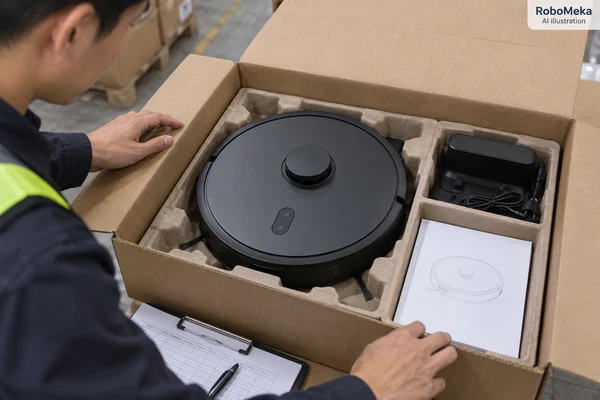
A robot and docking station pass a development screen in one shared carton, but the production order changes insert density and accessory placement. The buyer treats the pack as changed and requests technical review before release.
The team records what was observed, what decision it supports and what remains open. Installation preparation and customer requirements stay attached to the same record. If a supplier proposes a change, the reviewer checks whether the earlier evidence still applies. The record should connect this step to pre-test condition and complete report and photos.
Final buyer checklist
| Buyer check | Decision rule |
|---|---|
| Confirm packaged-product identity | State the exact identity and decision gate, then reject documents or samples that cannot be traced to it. |
| Review distribution route assumptions | Record the method, conditions and owner instead of relying on an informal verbal assurance. |
| Evaluate pre-test condition | Use representative permitted conditions and keep failures, assistance and exclusions in the report. |
| Control damage criteria | Connect the approved state to factory testing, shipment inspection and installation preparation. |
| Plan complete report and photos | Assign after-sales responsibility, information, parts and escalation before the first order ships. |
| Recheck production packaging controls | Trigger review when configuration, market, use case, supplier evidence or service dependency changes. |
The checklist is intentionally decision-focused. It does not prescribe a universal sample size, pass limit, legal route or service life. In this context, resolve damage criteria before accepting production packaging controls.
Frequently asked questions
What evidence should a buyer request for cleaning appliance packaging transit testing?
Request evidence tied to the exact model, revision, accessories, software and intended market. It should identify the method, conditions, sample, result, date and issuer. Ask what the evidence does not cover. Use complete report and photos and packaged-product identity to make this point operational.
Can one successful sample approve the whole order?
No. A successful sample can support a limited configuration or application decision, but it does not prove future production consistency or every unit in a lot. Connect sample approval to controlled specifications, factory testing, change notification and shipment inspection. For the buyer, production packaging controls and distribution route assumptions are the relevant decision anchors.
How should buyers compare two supplier offers?
Normalize the application, configuration, accessories, documents, support period and evidence scope before comparing price. List every deviation. A lower quotation that excludes installation, controlled spares, connected services or required verification is not directly comparable with a complete offer. Here, the practical control points are packaged-product identity and pre-test condition.
When should the evaluation be repeated?
Repeat affected work when the product, component, supplier, factory process, firmware, app, packaging, instructions, target market or intended use changes materially. Also review the plan when shipment findings or field evidence challenge an earlier assumption. Apply that boundary while reviewing distribution route assumptions alongside damage criteria.
What should be included in the supplier agreement?
Include product identity, approved documents and samples, responsibilities, evidence and record access, change-control triggers, nonconformity handling, warranty and service boundaries, confidentiality where needed, support periods and escalation. The record should connect this step to pre-test condition and complete report and photos.
Conclusion
The best cleaning appliance packaging transit testing decision connects a defined customer application with an exact configuration, transparent evidence and an executable operating plan. Focus on packaged-product identity, distribution route assumptions, pre-test condition, damage criteria, complete report and photos and production packaging controls. Keep source limits and proposed-test limits visible, then carry the approved identity through factory testing, shipment inspection, installation preparation and after-sales support.
Ask for the RoboMeka product catalog and include the destination market, application, quantity range and evidence priorities so the next discussion starts with a usable buyer brief.