The short answer
Evaluate RTK mower operation by separating satellite reception, correction delivery, reference infrastructure and service connectivity. Survey the mower route and reference location independently. Verify model-specific fallback limits and recovery rather than assuming strong Wi-Fi or a clear reference station solves every tree-covered location.
Introduction
An RTK mower stops beside a tree, and the customer reports that the Wi-Fi is strong. Both observations can be true. Satellite reception at the mower, correction-data delivery, reference infrastructure, and access to an account service are different parts of the operating arrangement. A successful phone connection does not prove that the mower has the positioning information it needs.
For importers and dealers, the purchasing task is to establish where the proposed system can work, how it behaves when a prerequisite is unavailable, and what customer intervention follows. The answer requires a site-specific evidence record. A broad claim that a mower works under trees cannot describe every canopy, building, passage, and season.
This article presents an original procurement framework for evaluating RTK mowers near trees and structures. It does not report completed RoboMeka testing or claim that a particular fallback system is available on a RoboMeka model. Confirm features, regional services, installation rules, and supported recovery behavior for the exact configuration under consideration.
Separate the navigation dependencies in the RFQ
Ask the supplier to draw a simple system diagram. It should identify the mower's positioning inputs, how corrections reach it, any local reference equipment, and services used for setup or remote operation. Request a plain-language description of what stops working when each component becomes unavailable.
This is a purchasing document, not a request for proprietary algorithms. A buyer needs enough information to distinguish a site problem from a network problem and to quote the necessary equipment. If every issue receives the same label of weak signal, dealers cannot tell which prerequisite to investigate.
Husqvarna's EPOS overview provides one manufacturer example of different correction arrangements: its described cloud option delivers correction data over an internet connection, while its reference-station option has installation requirements for that station. Treat these as examples of dependencies to document, not interchangeable specifications for other brands.
Write a function-by-function availability table
Distinguish local mowing, mapping, map editing, remote commands, notifications, updates, and correction delivery. Ask which functions require an internet connection continuously, which require it only at particular stages, and which can continue locally. A single yes beside offline operation is too broad to support a product promise.
Record the applicable country, app version, subscription assumptions, accessories, and software configuration. A service available to a demonstration unit in one market may not be part of the intended export package. The RFQ should make these differences visible before sample approval, packaging design, or dealer training.
Survey both the mower route and the reference location
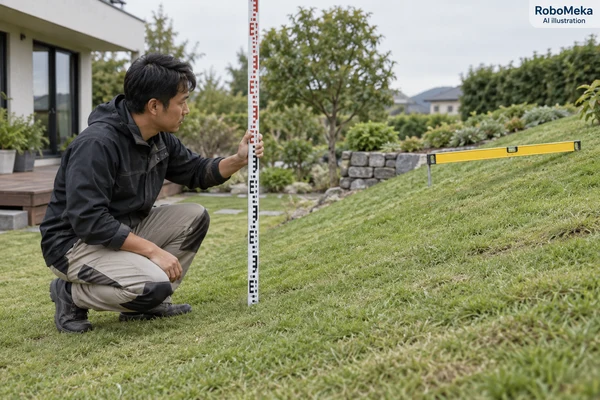
Review the lawn from the mower's operating height. Identify tree groups, building walls, covered sections, narrow gaps, and proposed docking approaches. A property can look open from an upstairs window while containing several constrained positions at ground level. Mark each location on the plan so later observations refer to the same place.
Assess any required reference station separately. Moving that station to a better position does not automatically resolve every obstruction experienced by the mower elsewhere on the property. Equally, a clear lawn does not establish that a proposed reference position satisfies its manual. Both parts of the arrangement need the appropriate installation review.
Document permissions and practical constraints. A customer may reject visible mounting hardware, may lack a suitable approved power arrangement, or may be unable to authorize work on a shared building. Those conditions affect installation feasibility even if an ideal technical position exists on paper.
Include the return and docking approach
A mower's working area is not the only important location. The approach to the station can determine whether an otherwise productive session finishes without assistance. Photograph and label the approach, waiting area if applicable, and nearby structures. Keep its assessment separate from performance in the open lawn.
Our installation planning guide explains how to connect these observations with site preparation and commissioning. The RTK-specific addition is a record of the positioning and communication prerequisites at each critical part of the route, with unresolved conditions clearly marked.
Treat trees as changing site conditions
Describe the canopy rather than recording only the number of trees. Note dense clusters, branches extending over a passage, seasonal foliage, and areas that remain shaded. Include contextual photographs with a date. The purpose is not to infer a universal signal threshold from appearance; it is to establish the conditions represented by the assessment.
A winter survey may not represent the same conditions as a summer evaluation beneath a leafy canopy. Similarly, a newly planted garden can change substantially over the ownership period. A supplier should not use one favorable visit to remove seasonal conditions from the installation record.
Do not propose tree removal as an automatic solution to a mower selection problem. First review approved system alternatives, adjusted work areas, different installation positions, or a different maintenance method. Any landscaping decision belongs to the property owner and appropriately qualified advisers, with the mower proposal reflecting their decision.
Buildings create more than a reception question
A narrow space beside a building may also restrict turning, contain slippery surfaces, or lack an acceptable return route. Separate these physical conditions from navigation observations. Otherwise, repeated stops near a wall may be attributed to satellite reception without evidence that reception was the cause.
Use the RTK versus boundary-wire comparison to frame architecture choices. A wireless system should be selected for an accepted site and service arrangement, not solely because avoiding perimeter installation sounds more convenient in an advertisement.
Ask what fallback actually means
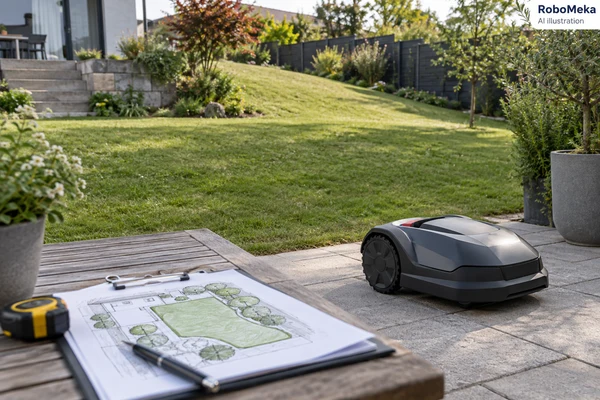
Fallback can describe very different behaviors: stopping safely, waiting for positioning recovery, using another supported sensor, or relying on a manufacturer-approved supplementary installation. Request the exact behavior, entry conditions, limits, and return-to-normal process. Do not allow the word fallback to stand in for those details.
Husqvarna's Support by Wire guidance describes a supplementary wire feature for specified EPOS models in weak-signal areas. It also states that the feature does not compensate for poor satellite reception at the docking point. This is a useful example of a fallback having both compatibility restrictions and locations it does not solve.
For a proposed camera-based or other sensor-assisted mode, ask what environmental conditions and maintenance requirements apply. Request documentation covering any speed, route, duration, or coverage restrictions if the manufacturer specifies them. Do not invent a standard fallback distance or assume a feature named similarly across brands behaves identically.
A controlled stop can be the correct outcome
Procurement teams sometimes classify every pause as poor performance. That can encourage misleading demonstrations. Evaluate the observed behavior against the approved specification first: a system that deliberately waits when a required input is unavailable may be behaving correctly, even if the resulting customer workflow is unsuitable.
The commercial decision then becomes whether the frequency and recovery burden are acceptable for the property. Buyers can reject a configuration for insufficient usability without describing a protective response as a defect. This distinction produces clearer supplier discussions and avoids pressure to weaken operating protections.
Build a site evidence matrix before the sample visit
Use an original worksheet such as the following. It links location, dependency, observation, and business decision without pretending that visual inspection proves navigation performance.
| Site item | Evidence to collect | Question for supplier | Purchasing implication |
|---|---|---|---|
| Open lawn reference area | Dated plan and baseline operation record | Is the approved system setup functioning here? | Establish a comparison point |
| Dense tree section | Canopy photographs and messages during permitted operation | Which prerequisite was unavailable, if identifiable? | Accept, revise, or exclude the area |
| Building-side connection | Geometry plus navigation observations | Is both physical access and navigation supported? | Decide whether areas remain connected |
| Docking approach | Complete return-cycle record | Does the approved return process finish reliably enough for the use case? | Approve station placement |
| Correction-data arrangement | Market, connection, accessory, and service details | What happens if delivery is interrupted? | Define connectivity and service scope |
| Supported fallback | Model documentation and observed recovery | Which limits and interventions remain? | Define a defensible customer promise |
Send your site and connectivity requirements with the lawn sketch, tree and building photographs, target market, and expected dealer support arrangement. The contact form prepares a brief for download or your email application; send it to info@RoboMeka.com to discuss evaluation requirements.
Evaluate normal operation before investigating interruptions
Start with a correctly installed system and an accepted operating area. Follow the manufacturer's commissioning process with competent personnel, keeping people and animals outside the work area as required. Establish baseline operation before attributing a later interruption to the surroundings.
Retain the sample identifier, software revision, installation layout, relevant settings, and support messages. Record the time, location, activity, and any intervention for each event. A short video can supplement the record where appropriate, but protect account information and avoid recording unrelated people or neighboring property unnecessarily.
Observe entry into constrained sections, work within accepted areas, exit, and station return. A mower that passes beneath a tree once has not demonstrated a complete maintenance routine. The evaluation should reflect the route and schedule the customer intends to use, within the conditions approved by the manufacturer.
Do not manufacture hazardous signal-loss demonstrations
Use supplier-supported diagnostics and documented evaluation methods. Do not cover safety sensors, interfere with radio services, dismantle antenna systems, or disable protections to force a dramatic failure. Those actions can change the product beyond the proposed installation and produce evidence that is neither safe nor representative.
Where controlled connectivity checks are appropriate, agree the procedure with the supplier and site owner. Record what was deliberately changed and restore the approved configuration afterward. Keep these checks distinct from naturally observed positioning interruptions; losing internet access and losing usable positioning are not the same event.
Measure recovery burden as well as completed mowing
Record how the user becomes aware of a pause, whether the explanation is understandable, and what approved action is needed. A message that simply says error may create a service call even when the solution is to wait for an acknowledged condition to clear. A useful support interface identifies the relevant prerequisite without overwhelming the homeowner.
Classify recovery as automatic, user-commanded, locally assisted, or installer-assisted. Track elapsed interruption time and hands-on time separately. Ten minutes of unattended waiting and ten minutes requiring someone to attend the garden have different consequences for a customer who is away at work.
These categories are proposed evaluation fields, not industry thresholds. Agree acceptance criteria before testing and relate them to the customer application. A managed estate with on-site staff may accept a workflow that would be unsuitable for a holiday property. Avoid turning one customer's preference into a universal product ranking.
Repeat only where the conditions justify it
If a configuration change resolves an identified issue, repeat the relevant route and return checks. If the unresolved concern is seasonal canopy, schedule an assessment that actually represents that condition. Repeating the same favorable demonstration many times cannot answer a question about a different environment.
Record remaining uncertainty in the recommendation. A proposal can be conditional on later seasonal confirmation or can exclude an unverified section. That is more useful than assigning a precise reliability percentage to a small, unrepresentative set of observations.
Convert findings into a dealer support package
Give the dealer a diagram of the approved system, a site acceptance record, and a simple troubleshooting classification. Staff should distinguish installation geometry, positioning status, correction delivery, general app connectivity, and account access. They do not need to diagnose internal algorithms to collect useful escalation evidence.
Specify which changes require another installation review. Relocating a station, adding a substantial structure, or altering a mapped route can invalidate assumptions used during commissioning. Customer requirements should include notification of such changes rather than an expectation that every future garden layout remains supported.
Our dealer service planning guide covers escalation and handover responsibilities. For connected positioning systems, add a named owner for regional service questions and a way to confirm that the supplied hardware and documentation match the supported configuration.
Keep product testing and site validation separate
Factory testing can verify defined functions under specified conditions. Shipment inspection can confirm the ordered model, accessories, identifiers, and documentation. Site validation evaluates the actual combination of lawn, installation, services, and user routine. Ask for all relevant evidence without treating one record as a substitute for the others.
Marketing approval should follow the same boundaries. Use a qualified phrase tied to the selected model's documentation rather than promising unrestricted operation beneath trees. If a supplementary accessory or service is required, include it in the offer and ownership explanation, not only in an installer note.
Frequently asked questions
Can an RTK mower work under trees?
Some installations and supported configurations may work in partially obstructed areas, but tree cover is not a single condition. Assess the actual canopy, route, station arrangement, correction delivery, and model-specific fallback. A successful demonstration on a different lawn does not establish suitability for a heavily covered section on the customer's property.
Does strong Wi-Fi solve weak satellite reception?
No. Network connectivity and reception used for positioning are separate prerequisites. Wi-Fi may support correction delivery or connected functions on a particular system, but its presence does not prove adequate positioning at the mower. Ask the supplier to identify the unavailable input from supported diagnostics before recommending a network change.
Will moving the reference station solve every interruption?
No universal conclusion follows. The reference location must satisfy its instructions, while the mower's operating locations also need assessment. Use the manufacturer's diagnostic and installation guidance to establish what is limiting operation. Do not relocate equipment repeatedly without recording the approved position, observed issue, and reason for each change.
Is fallback the same as uninterrupted mowing?
No. A documented fallback may continue work within limits, use another supported arrangement, or stop until required information returns. Confirm the exact behavior and recovery process. Evaluate whether the resulting customer involvement is acceptable rather than assuming that the presence of a fallback feature guarantees continuous operation everywhere.
Should buyers approve a model after one demonstration?
A demonstration can establish useful observations for its recorded conditions, but it cannot cover every season or property type. Approve claims that the evidence supports and identify open questions. Repeat evaluation when a configuration change or an unrepresented condition creates a specific reason, using agreed acceptance criteria and the manufacturer's procedures.
Conclusion
An RTK mower purchase near trees should connect each site condition to a documented system requirement. Separate positioning from network access, assess critical return locations, define fallback precisely, and record recovery effort. The resulting recommendation should say where the proposed arrangement is accepted and what still requires evaluation.
Prepare an RTK mower sourcing brief with your market, quantities, representative sites, preferred installation method, and service expectations. Use the download or email-client option to send that information to info@RoboMeka.com. RoboMeka can then discuss candidate configurations and the evidence needed before a site-specific promise is made.