The short answer
Keep the mower parked until the in-hand product label, applicable law, responsible applicator and mower instructions all permit release. Record treated zones, watering, access conditions and restart authority, and never replace product-specific directions with one waiting period for fertilizer, herbicide or pesticide use.
Introduction
There is no universal waiting period for robotic mowing after fertilizer, herbicide, insecticide, fungicide, or another lawn treatment. The product label, applicable law, licensed applicator instructions, local agronomic advice, treatment purpose, irrigation requirement, and mower manual determine when mowing may resume. When information conflicts or is incomplete, keep the mower parked and ask the responsible professional.
This answer protects both treatment effectiveness and people, animals, turf, and equipment. Mowing too soon may remove treated foliage, redistribute granules, interfere with watering instructions, expose the mower to residues, or bring it into an area that the label says must remain restricted. Waiting longer by guesswork can also disrupt the robotic cutting plan without resolving the underlying question.
The buyer needs a handoff system between lawn-care provider and mower operator. This guide explains that coordination for procurement and property planning. It does not recommend any pesticide, fertilizer, rate, application method, or off-label use, and it does not claim RoboMeka chemical compatibility or treatment testing.
Let the in-hand label and local requirements control
The current label is the first operating document. In the United States, the EPA introduction to pesticide labels explains that pesticide labels are enforceable and define where, how, how much, and how often a product may be used. Other countries have their own rules.
Use the label attached to the actual container and any properly accompanying approved material, not a generic internet summary or an old label for a similar product. Confirm the product identity, registration or authorization where applicable, treatment site, application date, instructions about people and pets, watering, mowing, clipping management, re-entry, and any other relevant restriction.
| Information source | What it controls | What it does not establish alone |
|---|---|---|
| Current treatment label | Legal and safe directions for that product and approved use | Mower model compatibility beyond stated directions |
| Licensed or authorized applicator | Applied product, timing, site, and professional handoff | Permission to contradict the label or local law |
| Local turf adviser | Grass, soil, weather, and treatment effectiveness context | Authority to invent a shorter restricted interval |
| Mower manual | Machine shutdown, cleaning, operation, and maintenance | Pesticide authorization or treatment efficacy |
| Property manager | Access control and schedule coordination | Technical power to waive another party’s requirements |
If no one can produce the necessary treatment record and label directions, do not guess. Keep the mower and other people or animals out as required and contact the applicator, product manufacturer, regulator, or appropriate local adviser.
Distinguish fertilizers from pesticides and combination products
“Lawn treatment” is too broad for a restart decision. A straight fertilizer may need watering according to its label and local advice. A foliar herbicide may need leaf contact. A granular insecticide can have different watering and access instructions. A combination weed-and-feed product joins two purposes that may have different ideal timing.
The University of Minnesota Extension fertilizing lawns guide explains that many fertilizers are watered after application unless the label says otherwise, while some herbicides need to remain on foliage. It specifically advises checking the product label for post-application requirements. This illustrates why one rule such as “wait until dry” cannot cover every treatment.
Record the full product name and formulation rather than only the active ingredient or service name. Different formulations can have different directions. If several products are applied together or in sequence, the responsible applicator should identify every applicable condition and the controlling, most restrictive requirement under local rules.
Create a formal mower-treatment handoff
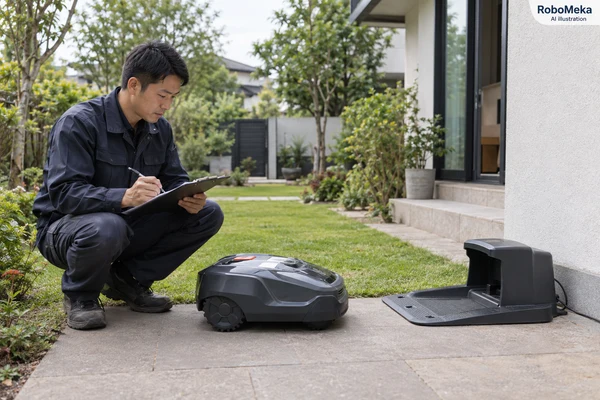
Before application, the mower should be parked through its supported controls and secured as required by its manual. The applicator and mower operator should agree which work areas are affected, whether the dock or transit route is inside them, and who holds authority to restart.
After application, the applicator should provide a dated record with product identity, treated zones, application time, relevant label instructions, watering steps, mowing constraints, re-entry conditions, contact details, and any local professional directions. The mower operator should acknowledge the restriction and prevent an automatic schedule from resuming.
The handoff remains open until all controlling conditions have been satisfied and the responsible person explicitly releases the area. A calendar entry alone is weak because a required watering event, drying condition, inspection, or weather window may not occur as planned.
Include contractors, residents, and app users
A landscape company may apply the product while a property manager controls the mower and a resident can start it remotely. Identify everyone with operating access, use supported roles rather than shared passwords, and communicate restrictions clearly.
If the mower returns to a dock across treated turf, parking only the treated work zone may be insufficient. Map the complete route. The irrigation and sprinkler planning guide is useful when label-directed watering must be coordinated with charging and mowing access.

Determine restart from conditions, not a borrowed number
The release decision should answer several questions. Has the label-defined restriction ended? Has required watering occurred? Is any required drying or settling complete? Has the applicator approved mowing under the stated treatment objective? Does the mower manual allow the current lawn and environmental condition? Are all transit routes available?
The EPA’s pesticide safety tips advise keeping children, toys, and pets away until a pesticide has dried or as recommended by the label, and asking a commercial applicator about precautions. That does not create a universal “dry equals mow” rule. A label can require a longer or different condition, and mowing efficacy considerations are separate from human and animal access.
Avoid translating advice for one broadleaf herbicide into a universal interval for all products. Extension publications may provide typical regional practices, but the in-hand label and licensed local advice remain controlling. State the source and scope whenever an example interval is discussed in a customer conversation.
Protect treatment effectiveness
Mowing can remove treated leaf tissue, collect granules, alter clipping distribution, or change the surface before a treatment has worked as intended. The exact effect depends on product, target, formulation, application method, grass, and timing. The mower supplier should not make agronomic promises outside documented competence.
Ask the applicator whether mowing must pause before as well as after treatment. An automatically maintained lawn may have less leaf area at the planned application time, and the treatment provider may need to adjust their approved approach or timing. Only that responsible professional should make the decision under the label and local requirements.
Where clippings require special handling, remember that robotic mowers normally return fine clippings to the turf rather than collecting them. Confirm whether that operating method is compatible with the treatment instructions. If not, the property may need a different approved mowing method or revised treatment plan.
Protect people, pets, wildlife, and operators
The mower must not enter an area that people or pets are required to avoid. Its movement can attract a child or pet, while service personnel may need to retrieve it. Keep the machine parked until access restrictions and the mowing release are both satisfied.
Do not ask an operator to inspect or clean residues without the product and mower instructions, suitable training, and required protective measures. Suspected exposure, spills, or misapplication belong with the label’s emergency information and the appropriate local authority or professional.
Plan the treatment before the automatic schedule
Routine lawn-care visits should appear in the mower operating calendar. The property manager can preserve a buffer around the appointment, park the machine, provide site access, and prevent remote restart. However, the final duration must stay open until the actual product and conditions are confirmed.
The lawn plan should identify separate work areas, dock, transport paths, irrigation zones, slopes, and any untreated route. If only part of the lawn is treated, confirm that supported zoning truly prevents transit through it. Do not assume an inactive cutting zone is also unavailable as a return path.
Use the robotic mower area-capacity guide to assess the lost mowing window. Treatment downtime can be predictable yet still leave too little capacity under local grass growth. A larger nominal rating does not automatically solve access or treatment constraints.
Send your lawn-care coordination requirements with destination market, treatment-provider workflow, work-area map, mower schedule, grass type, and required records. A product discussion can then address supported parking and zoning without inventing a chemical waiting period.
Decide what happens to the mower and dock during application
The mower may need to remain at the station, be switched off, or be moved and stored according to its manual. The treatment label or applicator may require equipment to be outside the area. Confirm the chosen arrangement before the crew arrives so no one improvises by carrying an active mower or disconnecting electrical equipment.
Protect the dock, contacts, reference equipment, power supply, and exposed accessories as directed by their manufacturers and the applicator. Do not wrap electrical equipment, cover ventilation, or construct a temporary shelter without authorization. If the treatment cannot be applied around installed equipment under the approved method, revise the work scope with the responsible parties.
Physical boundary wire, virtual boundaries, and reference stations may also be affected by aeration, injection, scarification, or other associated lawn work. Preserve the as-built record and schedule boundary inspection if ground work could disturb the installation.
Handle fertilizer granules and visible residues cautiously
Visible granules do not tell the mower operator whether a product is active, watered in, safe to cross, or correctly applied. Colour, dryness, and apparent dissolution are not substitutes for the label and applicator release. Keep the area controlled until the stated conditions are met.
If granules or residue are found on the mower, stop and isolate it under the manual and contact the applicator and authorized mower service for instructions. Do not blow, brush, wash, vacuum, or redistribute unknown material without competent direction. Runoff into drains or water features can create additional concerns.
For ordinary machine cleaning after authorized release, follow the exact mower manual. Some models permit specified water cleaning while others restrict it. Pressure washing, solvents, and access near blades or electrical parts may be prohibited. The treatment product instructions remain relevant to any contaminated wash material.
Coordinate with newly seeded or repaired turf
Some treatment schedules interact with seeding, sod, aeration, or renovation. These activities can also require the mower to remain off while grass establishes. The label and local turf adviser determine treatment timing; the new sod and overseeding guide addresses the separate mechanical readiness of young turf.
Ending the chemical restriction does not override unsuitable seedlings, soft soil, raised irrigation hardware, or repair materials. Conversely, a turf establishment date does not waive the label. Apply every relevant gate and use only supported exclusions.
Use a hypothetical multi-contractor property
Imagine a hypothetical office lawn managed by a property company. A treatment contractor applies a granular combination product to the front lawn, an irrigation contractor schedules watering, and a mower dealer manages the robotic schedule. The dock is behind the building, so the return route crosses the treated front area.
No contractor can safely decide in isolation. The applicator provides the product and label conditions, irrigation follows that approved plan, and the mower remains parked until the release is communicated. The operator then checks the route, site condition, and mower instructions before restarting. If one record is missing, the restriction stays open.
This proposed example is not a RoboMeka customer project or completed treatment test. It illustrates the coordination needed when responsibilities are distributed.
Specify documentation in commercial contracts
The mower service agreement should require advance treatment notice, a handoff record, a named restart authority, and a process for missing information. The lawn-care agreement should notify the mower operator and protect installed boundary or navigation equipment.
Avoid contracts that promise restart after a fixed number of hours for every product. A better target is prompt review after controlling conditions are documented as complete. The log can record treated zone, product identifier, applicator, instructions, watering, access release, mowing release, and restart approval.
Evaluate mower features without chemical claims
Useful functions can include supported parking, zone scheduling, event history, role-based access, and clear status messages. Verify each function on the proposed model and destination region. An app that can pause a mower does not understand a pesticide label or know when a product has dried.
Ask suppliers how schedules behave after a manual park, software update, connectivity loss, power interruption, or missed session. Determine whether operation resumes automatically and how to prevent it. This behavior matters more than a generic “smart lawn” description.
Do not request a factory to spray agricultural chemicals on a mower as an informal compatibility demonstration. Material compatibility and ingress claims require defined standards, substances, methods, and safe facilities. A random exposure test would neither establish legal use nor represent the destination treatment.
Separate factory, shipment, and site acceptance
Factory testing can verify the supported parking control, schedule behavior, account function, warning history, and other agreed features for a submitted configuration. It cannot determine the waiting period for an unknown future treatment or authorize chemical exposure.
Shipment inspection can confirm exact mower, charger, accessories, manuals, labels, packaging, and visible condition. It may verify that required documentation is included, but it cannot prove that a property manager will receive an applicator handoff or follow local pesticide rules.
Site acceptance should test the normal pause and release workflow without applying chemicals for the test. Use a hypothetical treatment event, park the mower, document a fictional restriction clearly as a drill, and verify that authorized users understand the handoff. Do not confuse that administrative exercise with treatment safety certification.
Audit the process after a near miss
If the mower enters a restricted area or restarts too early, park it, prevent access, preserve logs, and contact the applicator and appropriate service or authority. Do not minimize the event because no visible residue is present. Follow product-specific directions for exposure, cleaning, and reporting.
Review who applied the product, who knew, how the schedule resumed, whether routes crossed treated turf, and why the release state failed. Correct permissions, notifications, contracts, or supported settings before the next appointment.
Keep the review factual and confidential as appropriate. Do not publish an unsupported claim that the machine neutralized, spread, resisted, or was damaged by a treatment. Technical diagnosis needs evidence.
Frequently asked questions
How long after fertilizing can a robotic mower run?
There is no universal interval. Read the in-hand fertilizer label and obtain local professional advice about watering, turf, and mowing. Resume only after all stated conditions are complete and the mower manual permits the current site condition. Combination fertilizer-pesticide products may add stricter requirements.
Can a robotic mower run after herbicide has dried?
Drying may be one condition, but it is not automatically the complete release rule. The label may include mowing, watering, access, or efficacy instructions, and local law may add requirements. The licensed applicator should identify the controlling conditions before the mower is restarted.
Who should restart the mower after a lawn treatment?
A named authorized person should restart it only after receiving the applicator’s documented release and checking mower and site conditions. Contractors, residents, and remote app users should understand that responsibility. Avoid automatic timer-based restart while the handoff remains open.
Should the mower be washed after every treatment?
Not automatically. Unnecessary or incorrect washing may violate mower instructions or create contaminated runoff. Prevent the mower entering the treated area, then follow the exact treatment and machine guidance. If residue is suspected, isolate the equipment and ask the applicator and authorized service provider.
Can the mower supplier recommend a pesticide waiting period?
Only if it is repeating valid product-specific instructions within its competence and jurisdiction. It should not invent a general interval. The in-hand label, applicable regulation, licensed applicator, local turf advice, and exact mower documentation control the decision.
Conclusion
Lawn-treatment coordination succeeds when the mower stays parked until a documented, product-specific release is complete. Treat fertilizers, herbicides, pesticides, and combination products separately; map all transit routes; preserve label authority; and assign one clear restart owner. Automation should enforce the handoff, not replace professional judgment.
Prepare a treatment-coordination mower brief with your destination market, contractor roles, work-area plan, access controls, schedule behavior, and documentation needs. RoboMeka can discuss proposed parking and zoning functions while product labels, licensed local advice, and applicable law remain the authority for every treatment waiting period.