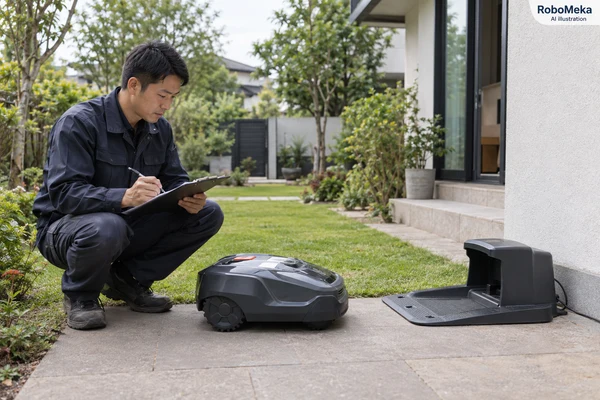
The short answer
A charging-station location must suit the exact mower's approach, navigation, power arrangement, and environmental instructions. Compare candidate positions for drainage, sun exposure, access, and recurring obstructions, then document the accepted layout and verify normal return and charging before finishing the installation.
Introduction
The most convenient outdoor socket may be beside the wettest corner of the lawn. The most discreet parking spot may leave an awkward return approach. A shaded recess may conflict with the navigation requirements of the selected mower. Charging-station siting is a comparison of these competing conditions, not simply a search for somewhere the dock fits.
A suitable position must satisfy the exact model's installation instructions while supporting routine return, charging, access, and maintenance. Assess the station, power equipment, route, and local environment together. Then document the accepted arrangement so future garden changes do not quietly invalidate it.
This guide helps buyers and dealers compare candidate positions before committing to a robotic mower installation. Its assessment tables and examples are proposed methods. They do not establish universal approach distances, charging temperatures, weather ratings, or performance specifications for RoboMeka products.
Define the charging arrangement before surveying positions
Identify the exact mower, charging station, power supply, cable arrangement, and navigation architecture. Confirm which components are included and which documents govern their installation. A location assessed for one platform may not qualify for another even when the mowers have similar external dimensions.
Ask how the mower reaches and leaves the station. The relevant approach may depend on physical wires, mapped paths, docking points, or other documented arrangements. Do not import a familiar distance or layout from a previous model unless the current instructions explicitly permit it.
The RTK and boundary-wire comparison helps identify the architecture questions. For station siting, translate those questions into a specific site requirement sheet. The installer should be able to point to the instruction behind each proposed clearance or preparation item.
Keep the power supply separate from the dock in the record
The station and its power unit may have different installation requirements. Record their intended positions individually, including cable routing and service access. A claim that the mower is intended for outdoor use does not establish that every associated electrical component can be placed anywhere outdoors.
Electrical installation and alterations should follow the manufacturer's instructions and applicable local requirements through an appropriately qualified professional. A dealer survey can identify a need for work without authorizing improvised extension leads, altered cables, or makeshift covers around power equipment.
Compare several candidate positions
Where the property permits it, evaluate more than one plausible location before fixing the station. Use the same criteria for each position. A simple comparison makes the tradeoffs visible and helps the customer understand why the installer recommends a less obvious location.
Record the route to every accepted mowing area, the environmental conditions, the available power arrangement, and the access needed by people. Include any preparation cost or unresolved question. A position that needs a qualified electrical change should not be scored as ready merely because the rest of the site looks attractive.
Husqvarna's official charging-station placement guide discusses level installation, sun protection, and different approach requirements for the Automower architectures it covers. It is a useful example of model-dependent siting. Its numerical distances and configuration details should be checked in the relevant instructions, not reused as universal dimensions.
Assess the ground through ordinary site conditions
Inspect the support surface and the surrounding ground. Look for settlement, recurring puddles, runoff routes, loose material, and changes in level near the approach. Ask the owner what happens during normal rain and watering because a dry visit may conceal a recurring problem.
The purpose is to identify whether the proposed position remains suitable under the product's installation requirements. Do not claim that a small raised platform or improvised drainage trench automatically resolves an unsuitable site. Any preparation should be designed and carried out by the relevant professional, then reassessed before acceptance.
Take photographs that show the station position in context. A close image of the baseplate may hide the downhill path of runoff or a sprinkler aimed toward the area. Include recognizable fixed features so the approved location can be understood by a future technician.
Check the approach as well as the parking surface
A dry, stable parking surface is not enough if the mower must repeatedly cross an unsuitable patch immediately in front of it. Review the entire documented approach and departure area. The most important part of the route may sit outside the small rectangle occupied by the station itself.
Record any proposed landscape correction separately from ordinary installation labor. The customer should know which work must be completed before commissioning and who will assess it. This prevents an installer from being pressured to accept an unfinished approach because the electrical connection is already available.

Review sun, shade, and enclosure proposals together
Describe when the candidate location receives direct sun and whether that pattern changes through the season. Consider nearby walls, hard surfaces, and overhead structures as part of the local setting. The actual equipment documentation determines the permitted operating and charging conditions; a pleasant-looking shaded spot is not a substitute for that check.
A proposed mower shelter also needs review against the manufacturer instructions. Confirm approved compatibility, ventilation, approach space, and access for service. Do not assume that enclosing a station more tightly improves protection. A cover can introduce new constraints even when it solves the owner's visual preference.
Keep claims about battery life and heat reduction evidence-based. A supplier may recommend sun protection without providing a quantified improvement in service life. The site proposal should follow the recommendation without inventing a percentage saving or guaranteed extension of battery life.
Treat normal return as a complete route
Trace how the mower returns from each accepted work area. Identify gates, narrow passages, crossings, exclusions, and places that are frequently occupied by garden furniture or equipment. The station location is only practical if those routes remain available under the agreed operating routine.
Husqvarna's charging and empty-battery support guidance includes guide-wire issues, search settings, obstacles, exclusions, and installation layout among the checks for the covered Automower products. That illustrates why a return complaint should not automatically be labeled battery failure. The exact diagnostic procedure remains product-specific.
Our narrow-passage and separated-lawn guide supports the route assessment. If a candidate station makes one part of the property difficult to reach or return from, show that consequence before selecting it on appearance alone.
| Candidate-location factor | Evidence to collect | Decision to record |
|---|---|---|
| Base and approach | Finished levels, support, and model requirements | Accept, prepare, or reject the position |
| Water exposure | Runoff history, irrigation coverage, and observed ground | Define necessary site correction |
| Sun and shelter | Seasonal exposure and approved enclosure guidance | Confirm a suitable arrangement |
| Return access | Routes from each work area and recurring obstructions | Establish normal access responsibility |
| Power equipment | Approved component placement and professional review | Release electrical preparation |
| Navigation conditions | Platform-specific survey and setup requirements | Confirm the configuration fits the site |
| Maintenance access | Safe access to identified service points | Agree usable working and inspection space |
Select a location using the unresolved constraints
Do not average away a disqualifying condition. A candidate that looks good on several convenience factors still cannot be accepted if it conflicts with a required installation condition. Use the comparison to identify mandatory corrections and to choose among positions that can actually meet the documented requirements.
The robotic mower installation checklist provides the broader handover structure. Add the chosen station position, rejected alternatives, and the reason for the decision. That record is particularly helpful when a customer later asks to move the station to a more discreet corner.
Send your charging-location requirements with photographs, a garden plan, candidate positions, and the intended mower architecture. Include known drainage, access, or electrical constraints so the proposed configuration can be reviewed before an installation date is promised.
Make the preparation scope concrete
Describe the agreed ground preparation, route clearance, electrical work, and any approved shelter installation in the quotation. Assign each item to a responsible party and identify the evidence needed before the mower installer arrives. “Customer to prepare site” is too vague when several different trades are involved.
Keep the proposal tied to the chosen model. If the supplied configuration changes, review the station requirements again before assuming the preparation remains valid. A late substitution should not inherit acceptance from a different mower's survey without checking the relevant differences.
Include the people who use the surrounding space
The station should coexist with the property's normal use. Ask whether a gate opens through the approach, whether bins are stored there on collection day, or whether a gardener parks equipment nearby. These ordinary habits can matter more than a carefully staged installation photograph.
Agree how the return route stays available. The owner should know which area must remain clear and how to recognize the relevant limits on the site plan. If the route crosses a shared space, review the permitted operating schedule and protective arrangements under the product instructions.
Provide a practical service-access plan. A technician should be able to inspect the relevant equipment safely without dismantling an unapproved enclosure or moving stored household items unpredictably. The installation should also account for the owner's ability to perform any documented user checks.
Plan a defined docking acceptance observation
Before testing normal operation, confirm that the required site preparation and authorized setup are complete. Use the manufacturer's commissioning procedure and identify the relevant return conditions to observe. Keep people and animals separated as required and avoid testing by deliberately blocking the mower or placing it near a hazard.
Record the initial state, accepted work area, return request or normal return event, observed approach, and charging indication defined by the actual product. Include any intervention. A manually positioned mower at the dock is not evidence that the autonomous return route has been accepted.
Do not invent a universal number of successful returns as proof of reliability. The required procedure and risk of the actual installation should guide the observation. State what was checked and what remains outside the evidence, such as conditions not present during a dry daytime commissioning visit.
Investigate a poor result before moving everything
If the mower does not return or dock as expected, preserve the observed behavior and follow authorized troubleshooting. The cause may concern setup, an obstruction, the route, or equipment condition. Moving the station immediately can introduce new variables before the original issue is understood.
Record any correction and repeat the relevant prescribed check. If the problem remains unresolved, keep the installation under review with a clear next step. The customer needs an explanation of the current status rather than repeated promises based on a single apparently successful attempt.
Compare an imagined patio corner and open lawn edge
Consider a hypothetical garden with two candidate locations. The patio corner is discreet and close to an existing outlet, but the approach is narrow and garden equipment is often stored there. The open lawn edge offers clearer access but requires professional review of the power arrangement and local exposure.
The installer would compare both against the selected model's requirements. The patio position might be rejected if its geometry cannot qualify, regardless of convenience. The lawn-edge position might remain provisional until the power and environmental questions are resolved. Neither position should be accepted solely because it appears better in one photograph.
This example illustrates a decision method, not a completed RoboMeka installation. It also shows why station siting belongs before final quotation. The cost and feasibility of preparation can change which product configuration and installation service make sense for the buyer.
Keep charging performance claims within their evidence
A correctly selected location supports the intended installation, but does not establish a universal charging time or battery lifetime. Those claims require the exact equipment specification and suitable test conditions. Avoid using a successful dock approach to imply that every aspect of the charging system has been independently validated.
The battery and charging buyer guide explains the broader equipment comparison. Station siting adds the property-level conditions under which that equipment will be used. Keep model documentation, factory testing, shipment inspection, and site acceptance distinct in the procurement record.
Shipment inspection can confirm the agreed station, power unit, cables, and instructions in the presented package. It cannot prove that a customer's chosen location has suitable drainage, access, or electrical preparation. Those facts require the separate site process described here.
Reassess the position after meaningful changes
Review the station arrangement when new paving changes runoff, a fence narrows the route, a sprinkler is redirected, or a shelter is added. Tree growth and garden use may also change the conditions that supported the original decision. Keep the change history with the installation record.
Do not move the station or related navigation equipment casually. The model may require configuration or map changes after relocation. Ask the authorized installer to identify those dependencies before a contractor changes the position to accommodate another garden project.
A periodic owner review can focus on visible changes and clear access within the documented user tasks. Technical inspection and electrical work remain within the appropriate professional scope. The handover should make that boundary understandable without asking customers to diagnose charging hardware themselves.
Frequently asked questions
Is the nearest outdoor outlet always the best charging location?
No. The location must also satisfy approach, ground, environmental, navigation, and access requirements for the exact model. Compare candidate positions and identify necessary professional site preparation. An existing outlet can be convenient, but it does not establish that the surrounding garden is suitable for the station or that the electrical arrangement is approved.
How much clear space does a robotic mower dock need?
Use the current installation instructions for the exact mower and architecture. Requirements differ across products and may distinguish the station, docking point, approach, and departure route. Avoid borrowing a number from another model or a generic internet diagram. Record the applicable requirement in the site assessment and verify the finished arrangement against it.
Should every charging station have a mower house?
Not necessarily. Follow the manufacturer's guidance for the supplied equipment and the actual site. Any shelter should be approved or assessed for compatibility, access, ventilation, and navigation requirements. A cover is not automatically beneficial if it creates an obstruction or conflicts with the documented installation conditions.
Does a docking failure mean the battery needs replacement?
Not by itself. Return access, installation, settings, obstacles, and equipment condition may need assessment under the actual troubleshooting procedure. Record the symptom and relevant conditions before recommending parts. A charging complaint should be routed through authorized diagnosis rather than converted immediately into a battery quotation.
What should the dealer retain after station installation?
Keep the chosen location, equipment identities, applicable instructions, preparation record, route plan, and commissioning observations. Include limitations and any unresolved conditions, plus the customer's responsibility for keeping access available. These records help future technicians understand the approved arrangement and assess later garden changes without relying only on memory.
Conclusion
Charging-station siting is a property decision with recurring operational consequences. Compare candidate locations against the exact mower requirements, resolve preparation needs, and verify the relevant return and charging behavior. Preserve the accepted layout so that ordinary garden changes can be reviewed before they disrupt the installation.
Prepare a robotic mower docking brief with your market, site photographs, candidate locations, and proposed service scope. Send the prepared information to info@RoboMeka.com to discuss configuration evidence, installation documentation, and the requirements for an accepted charging arrangement.