The short answer
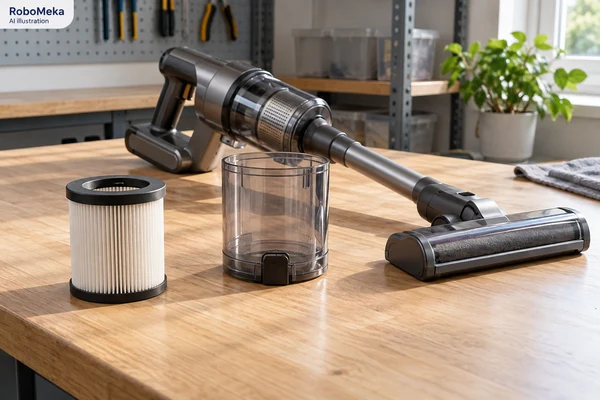
An automatic dock can wash and reduce moisture in a mop pad, but buyers must verify the exact cycle, water handling, drying conditions and required manual maintenance. Define the application, exact configuration, evidence boundary and operational owner before approval.
Introduction
The short procurement answer is: An automatic dock can wash and reduce moisture in a mop pad, but buyers must verify the exact cycle, water handling, drying conditions and required manual maintenance. That answer is useful only when it is connected to a named product revision, an intended application, a destination market and a responsible decision owner. Buyers should be cautious when a complex operational question is reduced to one feature, one photograph or one unqualified pass statement.
This guide is written for distributors sourcing robot-vacuum systems with clean-water and dirty-water dock tanks. It describes a proposed buyer workflow, not a claim that RoboMeka has completed the described factory testing, shipment inspection or customer project. The scenario below is hypothetical. Model instructions and current destination-market requirements control; involve qualified safety, engineering, quality, compliance, legal or logistics professionals when the decision falls within their discipline.
Direct answer for B2B buyers
For **robot vacuum mop pad washing drying dock**, start by defining what success and unacceptable failure mean in the real operating context. Indoor cleaning results depend on the full air, water, debris, software and maintenance system rather than one headline specification. The decision should show the configuration reviewed, the evidence available, the gaps still open and the action required before release.
The scope should include pad material, wash interval, clean and dirty tanks, basin, roller, filter, drain path, airflow, humidity, solution compatibility, sensors and errors. The buyer should then define wash triggers, water dose, tank capacity, dry method and time, residual dampness, odor criteria, noise, cleaning access, consumables and fault recovery. This turns a vague request into something that product, quality, factory and service teams can all interpret consistently.
A predictable mistake is that “automatic cleaning” is interpreted as maintenance-free even though pads, tanks, basins, filters and overflow areas retain soil and moisture. Record this failure mode before samples arrive. It can then become an RFQ question, an observation in a proposed evaluation and a trigger for corrective action rather than a surprise after shipment.
Who should use this guide?
The framework supports importers, private-label brands, distributors, product managers, installers, commercial operators and after-sales teams. Procurement needs comparable offers; engineering needs an identified technical baseline; quality needs inspection logic; marketing needs supported wording; and service needs a safe recovery boundary. Apply that boundary specifically to wash cycle and water path and drying method and conditions.
Related RoboMeka pages include the cordless vacuum range, wet and dry floor cleaner range and robot vacuum range. They provide navigation to products or sourcing information. For this article, document how clean and dirty tank capacity influences residual soil and odor.
Turn the application into a controlled requirement
A useful requirement states the object, condition, method and decision rule. For this topic, the buyer brief should cover wash cycle and water path, clean and dirty tank capacity, drying method and conditions, residual soil and odor, manual maintenance access and error and overflow response. Mark each line as mandatory, preferred, supplier-proposed or unresolved so a later quotation does not quietly convert preferences into promises.
| Requirement layer | Buyer record | Review question |
|---|---|---|
| Application | User, site, task, frequency, environment and exclusions | Is the offered use actually supported? |
| Configuration | Model, hardware, software, accessories and documents | Does the evidence match what will ship? |
| Evaluation | Starting condition, method, observations and stop rules | Can another reviewer understand the result? |
| Operations | Setup, cleaning, maintenance, storage and recovery | Can the market use and support the product? |
| Governance | owner, approval, change notice and escalation | Who decides and what causes re-review? |
Replace adjectives such as powerful, intelligent, commercial-grade or maintenance-free with an observable customer outcome. Not every topic needs a universal numeric threshold, but every material line needs a decision owner and an honest evidence boundary. The approval record should connect drying method and conditions with manual maintenance access.
Freeze the exact configuration being reviewed
Cleaning equipment combines mechanical parts, motors, batteries or power supplies, chargers, seals, filters, brushes, blades, sensors, firmware, apps, accessories, instructions and packaging. Here, reviewers should examine residual soil and odor alongside error and overflow response.
For this decision, the configuration record should include include pad material, wash interval, clean and dirty tanks, basin, roller, filter, drain path, airflow, humidity, solution compatibility, sensors and errors. Give samples and production lots durable identities. Record component or software revisions where they affect the question, and retain a controlled list of accessories and regional documents. Photographs help reviewers understand condition, but they should supplement rather than replace traceable records.
When an alternative part or process is proposed, ask what changed, why it changed, which requirements could be affected and which evidence will be reviewed again. A lower-cost alternative may be acceptable. Keep manual maintenance access and wash cycle and water path visible when the configuration changes.
Build an evidence pack that answers the question
Evidence can include controlled specifications, drawings, component declarations, laboratory reports, production records, inspection results, software release notes, manuals and documented application observations. Resolve uncertainty about error and overflow response before treating clean and dirty tank capacity as complete.
For this topic, record mission area, pad soil and moisture, wash count, water use, tank state, ambient humidity, dry duration, odor observation, residue, error and intervention. The register should also identify who created and reviewed each item, deviations, failures, corrective actions and open decisions. Do not transform component evidence into a whole-product claim, or evidence from one variant into a statement about an untested family.
Experience improves E-E-A-T when its limits are visible. A trustworthy note says what an identified person observed on an identified unit under recorded conditions. It does not invent customers, certifications, order volumes, failure rates or field history. Apply that boundary specifically to wash cycle and water path and drying method and conditions.
Interpret official external guidance carefully
The iRobot AutoWash Dock FAQ describes model-specific pad washing, ambient drying limits and odor guidance. The iRobot AutoWash Dock maintenance provides official basin, roller, filter and drainage-port maintenance steps. These references help a buyer ask better questions, but they do not certify RoboMeka or automatically apply another manufacturer’s procedures to a different product.
Before relying on a source, confirm the publisher, region, current status, named model and intended audience. A manufacturer support page controls only the covered products. Government guidance may establish a framework while leaving classification and local implementation to competent parties. For this article, document how clean and dirty tank capacity influences residual soil and odor.
Summarize the useful point in the buyer record and retain the URL and review date. Obtain current authoritative text and qualified advice when a binding compliance, public-health, dangerous-goods, electrical, machinery or statistical decision is required. The approval record should connect drying method and conditions with manual maintenance access.
Design a safe and repeatable evaluation
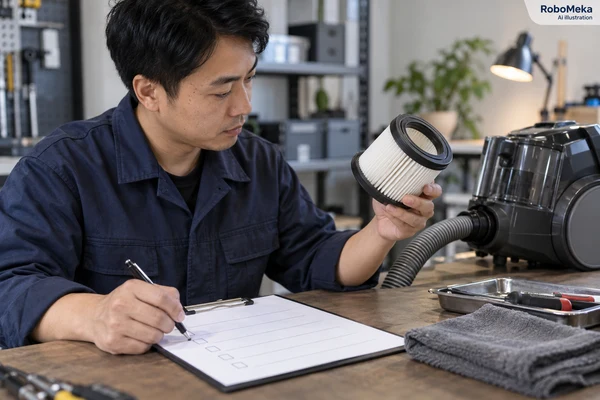
A proportionate proposed evaluation is to run representative mopping and dock-care cycles under disclosed ambient conditions, then inspect the pad and complete water path using the documented maintenance routine. Write the protocol and acceptance logic before observing the outcome. State purpose, identified samples, environment, preparation, operators, measurement or observation method, repetitions, stop conditions, allowed assistance and treatment of incomplete runs.
Remain within intended use and the exact safety instructions. Do not defeat guards or interlocks, touch moving blades, energize wet equipment, open battery cells, improvise charging or electrical connections, or operate pool equipment near swimmers. Here, reviewers should examine residual soil and odor alongside error and overflow response.
A small evaluation can reveal a mismatched use case, confusing instruction or process weakness. It cannot establish a universal lifetime or field failure rate. Report the real sample count and conditions, keep failed and assisted runs, and distinguish measurement uncertainty from product variation. Keep manual maintenance access and wash cycle and water path visible when the configuration changes.
Set acceptance and escalation before results arrive
For this topic, separate pad soil removal, moisture reduction, odor control and user labor instead of collapsing them into an automatic-wash claim. Separate essential conditions, preferences and observations. Use outcomes such as approve, approve with conditions, corrective action required, reject, or not yet determined. “Not yet determined” prevents missing evidence from silently becoming a pass.
| Decision question | Evidence expected | Possible output |
|---|---|---|
| Is identity correct? | Model, revision, software and accessory record | match, mismatch or unresolved |
| Is application supported? | intended-use documents and representative observations | supported, conditional or excluded |
| Is the method reproducible? | protocol, conditions, raw results and deviations | repeatable, limited or inconclusive |
| Can production preserve it? | process control, verification and change system | release, action or hold |
| Can the market support it? | setup, maintenance, spare and escalation plan | ready, conditional or not ready |
Phrase conclusions as narrowly as the evidence requires. Resolve uncertainty about error and overflow response before treating clean and dirty tank capacity as complete.
Verify usability, maintenance and recovery
Ask a representative operator who did not write the instructions to perform the permitted setup, routine use, cleaning, storage and first-line recovery. Observe hesitation, errors and requested help. Apply that boundary specifically to wash cycle and water path and drying method and conditions.
Define what a consumer or facility operator may do and what requires a dealer, authorized service center or qualified technician. Tools, protective equipment, drying time and controlled work areas should be stated in advance. For this article, document how clean and dirty tank capacity influences residual soil and odor.
Send your requirements with the destination market, use case, expected quantity and the questions you want the evidence pack to answer. The approval record should connect drying method and conditions with manual maintenance access.
Connect the approved result to factory controls
Factory testing should protect a released baseline and detect defined production failures. It does not replace design verification, legal review, application validation or every long-term reliability question. For this topic, the production plan should control pumps, valves, tanks, seals, sensors, roller, filters, basin, blower, firmware and solution-contact materials. Assign controls to incoming inspection, assembly, in-process checks, end-of-line verification or audit sampling according to risk.
Records should link lot or serial range, method, equipment status, limits, result, date and disposition. A generic pass label is weak if nobody can tell which function was checked. Here, reviewers should examine residual soil and odor alongside error and overflow response.
Use formal change notification for affected materials, components, suppliers, tooling, factory lines, firmware, apps, test methods, accessories, labels, packaging and instructions. Review the impact against wash cycle and water path and residual soil and odor, then document any repeat work or the reason no repeat is needed. Silent substitutions break traceability between approval and production.
Keep shipment inspection as a separate gate
Shipment inspection asks whether the presented lot matches the purchase order and release requirements. It commonly covers identity, quantity, workmanship, accessories, regional power arrangement, documentation, labeling, packaging and selected functional observations. Here, inspectors should check tank and basin fit, leaks, included pads and filters, software identity, status indications and permitted wash or dry function.
Agree sample selection, defect classification, acceptance logic and reinspection rules before the visit. Sampling supports a lot decision; it cannot prove every unit is perfect or predict useful life. Keep manual maintenance access and wash cycle and water path visible when the configuration changes.
First-article approval, line control, end-of-line checks and pre-shipment inspection answer different questions. A credible quality plan connects them and shows what remains outside each gate.
Prepare installation and customer handover
Installation preparation begins while the order is still configurable. Collect relevant site dimensions, surfaces, utilities, network conditions, grass, pool, debris, access and competent-trade needs. Resolve uncertainty about error and overflow response before treating clean and dirty tank capacity as complete.
For handover, show filling, emptying, pad removal, basin cleaning, air drying, solution limits and response to persistent dampness or error codes. Record installed settings, asset identity, accessories and any excluded areas or conditional uses. Drawings and photographs can remove ambiguity if they match the shipped model and protect personal information.
The service team should be able to reconstruct the starting condition without relying on one installer’s memory. Apply that boundary specifically to wash cycle and water path and drying method and conditions.
Evaluate lifecycle cost and after-sales consequences
The quoted unit price omits many costs that determine whether an offer is viable. For this topic, include dock size, replacement pads, filters, solution, water handling, energy, maintenance time and warranty parts. Add verification, sampling, packaging, installation, training, consumables, spare inventory, connected services, returns and unresolved dependencies to the comparison.
The service workflow should record ambient condition, tank and pad state, error code and maintenance history before diagnosing a pump, drain or drying fault. Define evidence requested from the user or dealer, remote-support limits, remove-from-service triggers, authorization for replacement and the parts or support period actually available. Avoid promises such as zero maintenance, safe in every environment, never blocks or guaranteed lifetime.
Write claims only after the final configuration and evidence are known. For this article, document how clean and dirty tank capacity influences residual soil and odor.
Hypothetical buyer scenario
A pad remains damp after the displayed drying cycle in a humid laundry area. The support plan checks placement, airflow and manual air-drying guidance instead of promising complete dryness in every environment.
The example demonstrates the decision process rather than an actual RoboMeka customer case. The record should preserve starting condition, configuration, actions, result, limitations and next owner. The approval record should connect drying method and conditions with manual maintenance access.
Final buyer checklist
| Buyer check | Practical release rule |
|---|---|
| wash cycle and water path | Attach it to an identified application and product revision. |
| clean and dirty tank capacity | Name the evidence, reviewer and unresolved boundary. |
| drying method and conditions | Evaluate it under safe, permitted and representative conditions. |
| residual soil and odor | Carry it into production control and change review. |
| manual maintenance access | Recheck it where relevant at shipment and handover. |
| error and overflow response | Assign maintenance, support and escalation ownership. |
This checklist intentionally avoids a universal sample size or legal route. Those choices depend on product risk, destination market, application and competent judgment. Here, reviewers should examine residual soil and odor alongside error and overflow response.
Frequently asked questions
What should a buyer include in the initial RFQ?
State the destination market, user, application, environment, quantity range, launch timing, mandatory features, exclusions, target configuration, service model and evidence expectations. Ask the supplier to identify assumptions and deviations. Keep manual maintenance access and wash cycle and water path visible when the configuration changes.
How can two supplier offers be compared fairly?
Normalize model scope, accessories, software, charger or power arrangement, documents, evidence, packaging, warranty and service responsibilities. Put omissions and open decisions beside price. Resolve uncertainty about error and overflow response before treating clean and dirty tank capacity as complete.
Does a successful sample prove mass-production quality?
No. It shows what an identified sample did under stated conditions. Production confidence also needs released specifications, controlled suppliers and processes, factory testing, failure handling, change notification and shipment inspection. Apply that boundary specifically to wash cycle and water path and drying method and conditions.
When should evidence be reviewed again?
Review impact after relevant changes to components, materials, suppliers, tooling, factory, firmware, app, accessories, packaging, instructions, market or intended use. Repeat the work needed for the changed risk. For this article, document how clean and dirty tank capacity influences residual soil and odor.
What should be included in the supplier agreement?
Identify the product and approved baseline, responsibilities, evidence access, specifications, change-control triggers, nonconformity and corrective-action process, warranty and service boundaries, records, software support and escalation. The approval record should connect drying method and conditions with manual maintenance access.
Conclusion
A defensible **robot vacuum mop pad washing drying dock** decision connects the real customer application to wash cycle and water path, clean and dirty tank capacity, drying method and conditions, residual soil and odor, manual maintenance access and error and overflow response. Preserve the exact configuration and evidence boundary through factory testing, shipment inspection, installation preparation and after-sales support. If an important answer is unknown, record it as an open decision rather than filling the gap with marketing language.
Ask for the RoboMeka product catalog and share your destination market, use case, order range and evidence priorities to start a structured sourcing discussion.