The short answer
When sourcing a lawn mower, check cutting width and height as application dimensions, not isolated brochure features. Verify the actual cutting path, overall machine envelope, adjustment range, repeatability and permitted operating conditions. Then evaluate the resulting finish on representative grass. A wide deck or a long adjustment range does not establish that the product suits the customer's lawn.
Introduction
When sourcing a lawn mower, check cutting width and height as application dimensions, not isolated brochure features. Verify the actual cutting path, overall machine envelope, adjustment range, repeatability and permitted operating conditions. Then evaluate the resulting finish on representative grass. A wide deck or a long adjustment range does not establish that the product suits the customer's lawn.
This guide helps importers and purchasing engineers turn dimensional claims into an inspection-ready specification. It covers different mower formats without assuming that they use the same measurement method or mowing schedule. All example dimensions are hypothetical buying exercises. They are not RoboMeka specifications, and discussion of conventional mowers does not confirm their availability from RoboMeka.
What does cutting width actually describe?
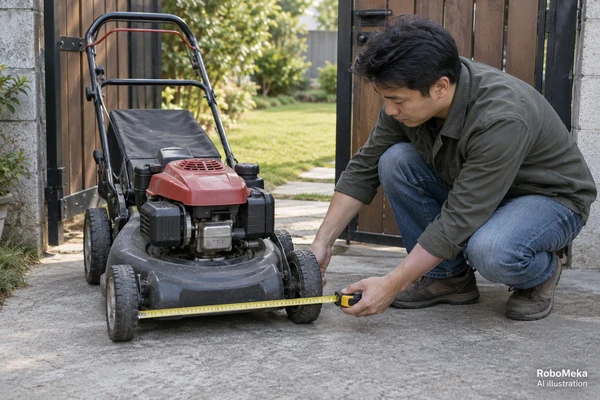
Cutting width describes the lateral span of the cutting action under the manufacturer's stated configuration. It should not be confused with the outside width of the deck, the wheel track or the space required to maneuver. Ask the supplier what its published number refers to and whether the measurement is nominal, rounded or tied to a defined method.
For an operator-led mower, the useful width of a pass is usually affected by overlap and steering accuracy. A buyer comparing two machines should therefore distinguish advertised width from effective coverage during the intended task. A difference on a specification sheet may be less important when the property contains tight turns, obstacles or narrow strips that cannot use the full deck.
Robotic mowing needs a separate interpretation. Cutting span is one input to recurring coverage, but route behavior, available mowing time, boundary arrangements and docking also matter. It is misleading to turn a robotic deck width directly into the same hourly capacity expected from a walk-behind machine moving in deliberate parallel passes. Use the robotic mower area-capacity guide for that workflow.
Request four dimensions, not one
Ask for cutting width, overall operating width, overall transport width where a different configuration is permitted, and storage footprint. Obtain drawings or clear measurement references. Include the relevant accessories and handle positions. If a supplier quotes an unusually compact storage arrangement, confirm that the arrangement is specifically allowed rather than inferred from a photograph of the sample.
These distinctions improve sales copy as well as buying decisions. A customer should not order a machine because its cutting-width label appears smaller than a gate, only to discover that the wheels or discharge attachment prevent access. Publishing the correct overall dimensions can prevent an avoidable mismatch that has nothing to do with cutting quality.
Translate width into coverage without promising productivity
A simple planning calculation can explain the effect of overlap. Suppose a hypothetical mower has a 0.46 m cutting span and the planned pass overlap is 0.04 m. Its assumed effective swath is 0.42 m. At an assumed forward speed of 0.8 m/s, straight-line geometric coverage would be 0.336 m²/s, or about 1,210 m²/h before interruptions.
That calculation is not a tested capacity. It excludes turning, preparation, collection emptying, obstacles, rest, cable management, battery changes and any reduction in speed required by the grass condition. The numerical example is useful because it reveals assumptions, not because it supplies a publishable performance claim. Record each loss of time separately during a proposed evaluation.
Consider two hypothetical decks: 0.42 m and 0.50 m. The wider option has a geometric advantage on an open rectangle, but that advantage can be offset by more difficult access or maneuvering. If the route includes narrow sections, the buyer may be unable to use a clean multiple of either width. Compare the complete route rather than extrapolating from a single straight pass.
Do not add a universal “efficiency factor” copied from another type of equipment. Measure or explicitly estimate the actual session components for the customer segment. If the estimate is uncertain, show a range and identify the missing evidence. A transparent worksheet gives the supplier a question to answer; a precise-looking unsupported capacity number conceals it.
Which cutting-height range does the customer need?
The required range depends on grass type, climate, season, intended finish and mowing frequency. The lowest setting is not automatically the most desirable specification. A product can offer an impressive minimum height that is inappropriate for the target turf or difficult to use consistently on uneven ground. Define the customer outcome before selecting the adjustment range.
Agronomic guidance is context-specific. University of Minnesota Extension links mowing height and leaf removal to lawn health in its regional context. A buyer importing to a different climate should obtain locally appropriate advice rather than treating one region's recommended height as a worldwide mower requirement.
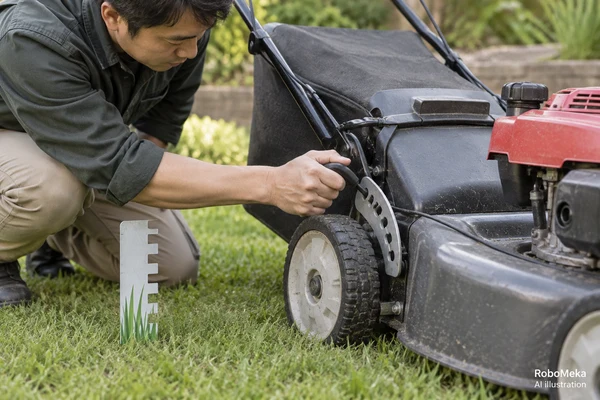
Ask suppliers to state the minimum and maximum nominal settings, the number of positions and whether the intervals are equal. A label with seven positions does not tell the customer how those positions map to millimeters. Obtain the mapping and its measurement conditions. If front and rear adjustments are separate, clarify the instructions for achieving the intended deck attitude.
Setting labels and finished grass height are different
A height setting is a machine configuration; the observed grass height is an outcome. Ground irregularity, wheel support, grass orientation and the measurement approach can affect that outcome. Buyers should avoid specifying a finished-height tolerance without also specifying where, when and how it is measured. Otherwise, supplier and inspector can reach different conclusions from the same lawn.
For example, an illustrative setting labeled 50 mm should not be interpreted as proof that every cut leaf across a rough property will measure exactly 50 mm. Define a suitable representative test area and an agreed observation method. Keep instrument resolution, setup variation and turf variation separate when interpreting the results.
Examine adjustment usability and retention
The adjustment mechanism must be understandable and usable by the intended owner. Compare access to the lever, required effort, visibility of position labels and the likelihood of incomplete engagement. Evaluate the procedure with the machine safely stopped and isolated according to its instructions. Do not assume a demonstration by an experienced technician represents a first-time customer's experience.
Central adjustment can simplify setting changes, but the procurement question remains whether the mechanism holds the selected position and is supported by clear instructions. Individual wheel adjustments introduce a different user task: the operator must follow the manufacturer's specified relationship between positions. Neither arrangement is inherently sufficient evidence of quality.
Inspect the identifiers as well as the mechanism. Labels should remain associated with the correct adjustment positions and agree with the manual. Ask how factory testing checks assembly and retention, and what shipment inspection can verify without performing an unsafe or destructive procedure. A cosmetic inspection of the lever alone cannot establish its behavior over a season.
Model-specific documents are important here. Toro's manual and parts lookup demonstrates a documentation route organized around product identity. Request the actual instructions for the offered mower and its revision. A manual from a visually similar product is not an acceptable basis for teaching customers how to adjust it.
Write a dimensional acceptance worksheet
Create a worksheet that allows the supplier, sample reviewer and shipment inspector to use the same definitions. Separate nominal design values from agreed manufacturing tolerances and from application observations. Do not fill an unknown tolerance with a convenient number simply to make the form look complete.
| Item | Define before approval | Record during review |
|---|---|---|
| Cutting span | Configuration, reference points and stated method | Observed value and measurement conditions |
| Overall envelope | Accessories, handle position and allowed transport state | Clearance against the customer's route |
| Height settings | Nominal range and position mapping | Label agreement and adjustment operation |
| Retention | Permitted non-destructive check and acceptance rule | Any movement, ambiguity or incomplete engagement |
| Turf result | Grass condition, permitted setting and observation method | Finish, missed strips and scalping concerns |
| Documentation | Manual, drawing and label revision | Agreement with the delivered configuration |
Keep photographs with the sample identity and measurement reference. A close-up that omits the reference points may be difficult to interpret later. Likewise, an image showing a ruler beside the deck does not necessarily measure the cutting span. Ask the person recording evidence to explain what each photograph establishes and what it does not.
If your planned range already has target widths and turf requirements, send the dimensional sourcing brief. Include access restrictions and the intended mowing height, rather than requesting only the widest available model. Project fit and available formats need confirmation before any commercial commitment.
Compare finish on representative, permitted terrain
The sample evaluation should include the customer conditions the product is intended to handle, while remaining within its instructions. Identify level turf, modest undulations or narrow passages as separate observations rather than combining them into an unexplained “good cutting” result. Do not use a difficult or hazardous site to test beyond the manufacturer's limits.
Scalping risk is one reason width and height cannot be evaluated independently. A wider deck may span changes in ground level differently from a narrower machine. University of Maryland Extension's discussion of lawn problems identifies low mowing and uneven ground as relevant factors. The purchasing implication is to check the intended surface, not to infer suitability from deck size alone.
Evaluate the clipping method in the approved configuration. Collection, discharge and mulching can involve different components or operating instructions. Keep those identities in the record when comparing finish. A result obtained with one blade and accessory set does not automatically transfer to another package carrying the same model-family name.
Use repeated observations to distinguish a consistent issue from an isolated condition. Record whether a missed strip appears in the same place, whether the operator changed overlap, and whether the ground or grass differed. This creates a useful engineering question without inventing a statistical conclusion from a small demonstration.
Control dimensional changes between sample and shipment
Once a configuration is approved, require review of changes affecting the deck, wheels, adjustment linkage, blade geometry or relevant labels. A supplier may regard a substituted wheel as minor, but its dimensions or compliance can affect the relationship between a setting and the cutting plane. The buyer needs a change description and a reasoned assessment of what must be rechecked.
Keep the approved dimensional drawing and manual version with the purchase specification. Specify whether packaging must display cutting width, overall dimensions or both. Review translations and unit conversions carefully: a rounded inch description should not silently become an exact millimeter acceptance criterion. Retain the original reference value and explain the displayed rounding.
For an illustrative conversion, 18 inches equals 457.2 mm mathematically. A product marketed in that nominal class may use a different declared metric value or measurement convention. The conversion does not establish the physical dimension of the offered mower. Obtain the supplier's specification and agree which value governs acceptance.
Shipment sampling must also have a defined purpose. NIST's acceptance-sampling introduction describes a decision based on a lot sample. A passing sample does not prove every machine has identical dimensions, nor does it replace design validation. Agree the inspection plan with competent quality personnel and preserve the resulting records.
Review what the customer will actually read
The final listing should help a buyer answer practical questions: will it pass through the gate, can it maintain the desired lawn height, and how are settings changed? Provide model-specific dimensions and explain relevant qualifications in readable language. Avoid packing the page with nominal numbers while omitting the measurements needed for ownership.
Instructions should not encourage low cutting simply because the product permits a low setting. Present the available adjustment range separately from turf recommendations. Where grass guidance is offered, identify its context and encourage customers to follow appropriate local advice. This protects the distinction between machine capability and good mowing practice.
Review photography for the same reason. A product shown on a golf-like surface can imply a finish or application that the offered configuration has not established. Use accurate descriptions and clearly label illustrative imagery. The visual should support the intended-use explanation, not broaden it through implication.
Frequently asked questions
Is cutting width the same as mower width?
No. Cutting width concerns the cutting action, while overall width includes the machine's physical envelope in a specified configuration. Wheels, deck edges or attachments may determine gate clearance. Request both dimensions and confirm the permitted configuration for passing through access routes or placing the mower in storage.
Do more height positions guarantee better cutting?
No. The useful question is whether the available range and increments suit the turf and whether the settings are clear, repeatable and retained. Extra positions do not compensate for poor instructions or an unsuitable deck. Compare the intended finish using the exact configuration and an agreed observation method.
Can buyers calculate lawn capacity from deck width?
They can calculate a geometric planning estimate if speed and overlap are stated, but that is not measured capacity. Real sessions include turning, obstacles, collection handling and power-related interruptions. Use the calculation to structure a test or expose assumptions, then validate the practical customer task separately.
Should the minimum cutting height be a purchasing priority?
Only if the intended turf and use case require it. A lower setting is not a universal quality indicator, and inappropriate low mowing can create poor results. Define the local grass requirement first, then verify that the offered range and operating instructions support it without exceeding the machine's permitted use.
What should shipment inspection check?
It should check the agreed configuration, dimensions, adjustment operation, labels and documentation using approved methods. Inspectors need clear reference points and acceptance criteria. Shipment inspection is not a substitute for application trials or long-term mechanism evaluation; it verifies specified aspects of the production lot presented for release.
Conclusion
Lawn mower cutting width and height become useful purchasing criteria when they are connected to access, turf requirements, complete-machine geometry and a repeatable review method. Define the terms, test the intended application and preserve those definitions through production. The strongest specification explains what each number means, not just how large or small it is.
Prepare your cutting-width and height requirements with the target property, desired finish and measurements that need confirmation. Review the downloaded brief before emailing info@RoboMeka.com; the form does not automatically send an inquiry or confirm product availability.