
The short answer
Electric mower customization should separate brand presentation from changes to the electrical and cutting system. A new carton or color scheme has a different review path from a changed plug, charger, controller, harness or enclosure. Buyers should define the requested changes, assign technical responsibility and preserve a traceable configuration before discussing a production launch.
Introduction
Electric mower customization should separate brand presentation from changes to the electrical and cutting system. A new carton or color scheme has a different review path from a changed plug, charger, controller, harness or enclosure. Buyers should define the requested changes, assign technical responsibility and preserve a traceable configuration before discussing a production launch.
The term OEM can describe very different projects. One supplier may offer an existing platform with approved private-label options, while another proposal may require engineering work and additional evaluation. A useful inquiry states the actual changes and customer requirements instead of relying on a broad service label.
This guide addresses private-label and regional electric mower programs. It does not confirm that RoboMeka offers every customization or every electric mower format. Availability, engineering scope, ownership, MOQ and schedule must be agreed for the specific project, and technical or legal questions require appropriately qualified review.
Write a change-based project brief
Start with the intended user, destination market and base product if known. List each requested change separately and explain why it matters. This helps the supplier distinguish a required customer benefit from a visual preference or an optional idea that can be evaluated later.
Classify requests as appearance, documentation, package contents, regional electrical version or engineering change. The classification is a planning aid, not a declaration that an item has no technical consequences. Even a label or manual change can affect the information customers rely on.
Identify what must remain unchanged. The brand may want the approved blade, energy package and controls retained while changing presentation. Make that baseline explicit so that the supplier does not propose an unreviewed substitution as part of the same quotation.
The electric mower buyer-selection guide can help establish the application before customization begins. A distinctive brand appearance is not a substitute for choosing a platform that fits the customer’s actual lawn, power arrangement and service expectations.
Distinguish cosmetic changes from functional consequences
Color, graphics and branding can appear straightforward, but the project still needs approved artwork, placement and production references. Check that labels remain readable and that branding does not obscure required information or interfere with controls, ventilation or maintenance access.
Ask whether a proposed finish or material change affects the existing evaluation or manufacturing process. The responsible technical team should determine the necessary review. Do not assume that every visible change is harmless, or that every change requires the same level of engineering work.
For documentation, control language versions, model names and accessory descriptions. A localized manual must describe the actual product and retain its technical meaning. Translation review should involve someone able to identify mismatches in controls, electrical versions and maintenance instructions.
Keep packaging claims within the approved evidence. A new brand should not inherit unverified phrases from a supplier’s generic catalog. Review performance, compatibility and environmental wording against the exact configuration that will be supplied under the private label.
Treat regional electrical versions as controlled products
A destination-market request may involve a different charger, plug, cord, label or other electrical configuration. Do not reduce the review to whether a connector physically fits a local socket. Ask the supplier to identify the complete proposed version and the evidence that applies to it.
Have competent specialists determine applicable requirements for the market. The NIST conformity-assessment overview explains why different documents and assessment activities have specific purposes. A report for one version should not be described as universal approval for all regional variants.
Document which parts can vary and which remain fixed. If a charger is changed, compatibility with the battery system must be confirmed. If a corded mower version changes, the responsible engineering review should consider the actual electrical configuration rather than a plug-only description.
Use a distinct identity or controlled variant code that remains understandable through production, inspection and service. Regional packages that look identical on the outside can create receiving and replacement errors unless their records and labels make the differences clear.
Review controller, harness and enclosure changes explicitly
Changes to controls, wiring assemblies or electronic behavior can affect more than a feature list. Ask for a description of the proposed function, affected components and verification plan. Purchasing should not approve these changes solely because they improve the quotation or shorten the schedule.
The supplier should identify who owns the engineering decision and how the revised configuration will be documented. Where firmware or software is relevant, record the applicable release identity and how updates are controlled. An unchanged model name does not guarantee unchanged behavior.
Enclosure changes may influence fit, access, protection, cooling or other design characteristics. The actual implications require qualified assessment. Avoid making technical claims from a rendering or assuming that an attractive industrial design can be transferred directly into production without validation.
Do not ask a workshop to bypass controls or modify protective features to satisfy a customization request. The objective is an approved, supportable product. If the desired function falls outside the platform’s supported scope, treat it as a separate development question or select a more suitable platform.
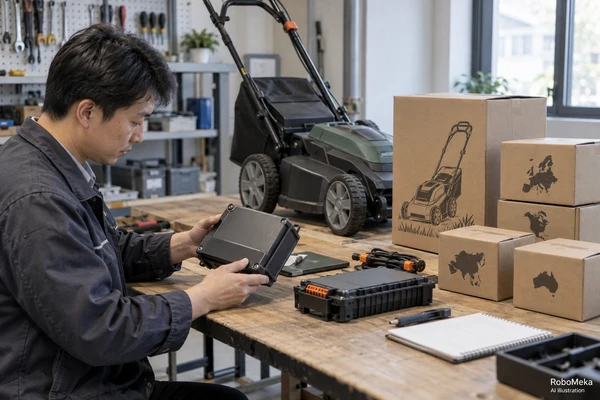
Build a customization responsibility matrix
The matrix below separates decisions that often become mixed in a private-label email chain. Adapt it to the project and obtain appropriate contractual advice where necessary. It is a coordination tool, not a complete development agreement.
| Change area | Record required | Responsible review |
|---|---|---|
| Brand appearance | Artwork, placement and finish reference | Brand and product reviewers |
| Instructions | Language, model and revision | Technical documentation reviewers |
| Kit contents | Exact mower, packs, charger and accessories | Purchasing and engineering |
| Regional version | Configuration and applicable evidence | Qualified market and technical specialists |
| Functional change | Requirements and verification plan | Responsible engineering team |
| Tooling or design assets | Ownership and permitted use terms | Commercial and legal reviewers |
| Production release | Approved sample and controlled records | Named release authority |
| Service support | Parts identities and escalation route | Local service and supplier teams |
Give every unresolved decision an owner and an expected resolution point. A project should not proceed on the assumption that the supplier handles everything when responsibilities have not been assigned. Equally, the supplier needs to know which buyer approvals are required before committing to production.
Maintain one current change list rather than several conflicting message threads. Record accepted, rejected and deferred requests. This prevents an optional future discussion from appearing on the production floor as an approved launch requirement.
Define sample stages and what each stage proves
An appearance sample can help assess color and branding without establishing electrical or performance approval. An engineering sample can support technical evaluation while still differing from the intended production process. A production-representative sample has another role. Name the stage and its limitations clearly.
For each stage, agree the configuration, questions to answer and evidence to retain. Do not ask reviewers to approve a sample without knowing what decision their approval will authorize. A signature on a color sample should not become blanket approval of an unreviewed charger or controller change.
Application evaluation should reflect the intended use and remain within the product’s instructions. University of Minnesota Extension’s mowing guidance provides relevant context on mowing practices; local turf conditions should inform the actual application. Do not create an unrealistic demonstration simply to make a customized feature look successful.
Retain the relationship between the evaluated sample and the final bill of materials. If a component changes afterward, the responsible reviewer should determine which evidence remains applicable. Prototype approval is not permission for unrestricted production substitutions.
Send your electric mower customization brief with the destination, base configuration and separate change requests. The downloadable document can support a scope review with RoboMeka; it does not confirm engineering capability, project acceptance or availability of an electric walk-behind platform.
Recheck performance and marketing claims after changes
A battery, blade, controller or accessory change can affect the basis of a runtime or cutting claim. Review the original evidence before reusing it in the new brand’s catalog. The electric mower power-and-runtime guide explains why the complete configuration and conditions must remain visible.
Manufacturer examples such as EGO’s mower information show the importance of conditional runtime communication. They do not provide evidence for a customized product from another supplier. Obtain relevant results for the actual version or qualify the claim until that evidence exists.
Noise statements also need review when changes affect the acoustic configuration. The European Commission’s outdoor equipment noise information provides an EU regulatory reference point, but qualified specialists must determine the applicable obligations for the product. Do not infer compliance from a similar base model.
Review claims embedded in images, packaging and distributor copy as well as the main specification sheet. A careful technical statement can be undermined by an absolute phrase on a carton or a promotional graphic. Use one approved claim set and control changes to it.
Agree ownership and commercial boundaries
Discuss ownership and permitted use of artwork, drawings, tooling, software-related assets and other project materials where relevant. The answer depends on the agreement; a development payment does not automatically resolve every ownership question. Obtain suitable professional advice rather than relying on assumptions.
Separate one-time charges from recurring unit costs and define what each payment covers. Clarify sample quantities, revision rounds and the treatment of changes introduced after approval. This makes the quotation more understandable and reduces disputes about whether a request belongs to the original scope.
MOQ and schedule should be tied to the actual customization. A standard product order, custom carton run and engineered regional variant may have different constraints. Ask the supplier to explain those dependencies rather than treating one headline MOQ or lead time as valid for every option.
Define the release authority and the consequences of late changes. A fair process identifies whether a delay comes from supplier execution, a buyer approval or new requirements. The aim is not to assign blame in advance, but to make the project manageable when the scope evolves.
Prepare production, packaging and logistics records
The production release should connect the approved sample, component identities, artwork, instructions and inspection criteria. Staff should not have to assemble the final specification from several emails or infer which rendering is current. Clear records are especially important when regional variants run through the same facility.
For battery kits, involve logistics before finalizing the package. IATA’s battery transport resources provide air-transport guidance, but qualified personnel must assess the actual shipment. Adding a spare battery can change the logistics review even when the mower itself is unchanged.
Shipment inspection should use the released variant list and package contents. NIST’s acceptance-sampling introduction explains sampling’s role in lot decisions. It does not replace engineering approval of the customization or guarantee the future performance of every unit.
Set a process for discrepancies before the shipping deadline. If the wrong manual, label or charger is found, identify who assesses the issue and authorizes corrective action. Do not let a familiar exterior appearance become the reason an incorrectly configured package is released.
Make the customized product serviceable
Private labeling should not erase the information needed to support the underlying model. Maintain a controlled cross-reference between the brand’s SKU and the supplier’s technical identity. Service teams need to identify the correct parts and revision even when the customer sees only the private-label name.
Ask for applicable parts information and approved maintenance boundaries. HSE’s machinery-maintenance guidance supports planned, competent work, while the actual product manual defines procedures. Do not create a branded support promise that the available documentation and network cannot fulfill.
Use a hypothetical service scenario before launch: a customer in one region needs help identifying a charger for a particular kit. Can the local team trace the package to the approved combination without guessing? A successful rehearsal checks information usability, not long-term product reliability.
Finally, define how later revisions will be communicated to distributors and service partners. A customized product remains a controlled system after the first shipment. New packaging, replacement components or software behavior should follow an agreed review path rather than gradually drifting away from the original approval.
Frequently asked questions
Is changing a plug a cosmetic customization?
No. Treat regional electrical changes as technical configuration questions, even when the visible difference seems small. The responsible reviewers should assess the complete version and applicable evidence. Physical fit with a socket does not establish that the mower or charger is suitable for the intended market.
Can a private-label model use the base model’s reports?
Only where the scope, identity and effect of the changes support that use, as determined by responsible reviewers. A shared housing or product family is not enough. Document which evidence remains applicable and what additional evaluation is required before reusing claims or releasing the changed configuration.
What should buyers include in an OEM inquiry?
Provide the intended market and application, the proposed base product, required changes and items that must remain unchanged. Separate launch requirements from optional future ideas. Include package and service expectations. This helps the supplier assess scope and dependencies without treating every request as a simple branding exercise.
Who owns custom tooling and design files?
Ownership and usage rights depend on the agreement. Define access, permitted use, modification and transfer with appropriate professional advice where necessary. Do not assume that a tooling or development payment settles every issue. Keep the commercial terms connected to the technical assets and project deliverables they concern.
Why does customization affect after-sales support?
Changes can create new parts, documents, regional packages or control behavior that staff must identify correctly. Maintain a cross-reference between branded SKUs and technical configurations, and update service information when revisions occur. A customized exterior should not make the underlying product harder to diagnose or support.
Conclusion
Electric mower customization is most manageable when every requested change has a defined scope, reviewer and release record. Separate branding from electrical and functional changes, preserve applicable evidence and prepare service information before launch. This supports a distinctive private-label offer without relying on undocumented assumptions about compatibility or approval.
Prepare a private-label electric mower inquiry, review the downloaded brief and email it to info@RoboMeka.com. The form does not automatically send the document or establish development acceptance, ownership terms, MOQ or delivery commitments.