The short answer
Plan a robotic mower installation around the full footprint of trampolines and play equipment, including low supports, anchors, and access space. Use approved exclusions where clearance is uncertain, keep mowing separate from play, and require a new boundary review whenever equipment moves or the garden layout changes.
Introduction
A trampoline can look like an open area to a mower buyer because the grass beneath it is visible. The installation problem is closer to the ground: horizontal supports, anchors, ladders, hanging material, and narrow spaces can interrupt a robot's path. The area also changes whenever equipment moves or toys are left outside.
Plan a robotic mower installation around the full footprint of trampolines and play equipment, including low supports, anchors, and access space. Use approved exclusions where clearance is uncertain, keep mowing separate from play, and require a new boundary review whenever equipment moves or the garden layout changes.
For a dealer, this is a concrete product-fit decision. The objective is an installation that the household or property manager can operate consistently, with clear remaining lawn-care tasks. This guide explains what to inspect and what to request from suppliers without treating a hypothetical assessment as a completed safety test.
Survey the whole structure, including the ground
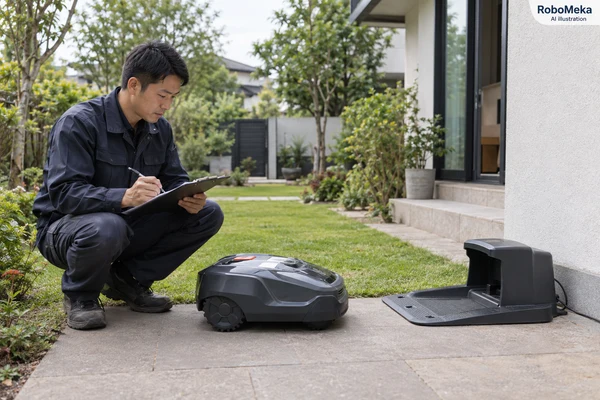
Start with the mower off and the play area empty. Record the equipment's complete footprint rather than drawing a circle around the most visible posts. Include ground-level supports, projecting feet, anchors, tie-down arrangements, access ladders, and any material that can hang below the main structure.
Ask whether the equipment is fixed, seasonally moved, or moved frequently for lawn care. The installation proposal must match that behavior. A carefully mapped location becomes outdated if someone drags the trampoline to a different part of the garden without reviewing the mower arrangement.
Photograph the ground and underside from safe accessible positions. Do not crawl under equipment that is in use or alter its supports for inspection. The purpose is to give the qualified installer useful information, not to diagnose or modify the play structure. Equipment safety and anchoring should remain governed by its manufacturer's instructions.
Add the proposed exclusion to the property's robotic mower installation checklist. The special requirement here is to describe a low, three-dimensional structure whose usable clearance may be different from what a simple overhead lawn plan suggests.
Understand why visible clearance is not enough
Clear space beneath the main trampoline bed does not prove that the mower can enter, turn, and leave safely under all supported conditions. Low crossbars may sit within the travel path, and grass growth can conceal parts that were visible during installation. Assess the entire route, not only the highest open space.
Husqvarna's Trapped error guidance specifically uses a children's trampoline as an example of a location that can require an island or stay-out zone when a mower repeatedly becomes trapped. That supports deliberate exclusion planning; it does not justify repeated collision trials at the customer's property.
Ask for model-specific clearance and obstacle requirements before deciding whether any space beneath a structure is suitable. Do not infer them from the mower's external height alone. The body, turning movement, supported obstacle behavior, and installation margins all matter to the approved arrangement.
Where suitability is uncertain, exclude the complete affected area using the supported installation method and assign its grass to another maintenance process. That is an honest service boundary. Describing inaccessible grass clearly is preferable to promising complete coverage and leaving the customer to recover a trapped machine.
Separate obstacle recognition from play-area management
Obstacle recognition does not make it appropriate to mow while children or other people use the area. Establish separate periods for mowing and play and follow the product instructions for keeping people, pets, and wildlife clear. The purchasing decision should include whether the household can maintain that separation reliably.
Husqvarna's AI vision object-detection guidance recommends stay-out zones around permanent objects such as trampolines and explains that raised structures or supports hidden by grass can create difficulties. This is a model-specific description of limits, not evidence that a different camera system will behave identically.
Ask the supplier what the exact detection feature does and which operating conditions it requires. Treat the answer as one part of an approved installation, alongside boundaries, site checks, and scheduling. A marketing photograph with a mower near play equipment cannot establish suitability or safe shared use.
The pets, wildlife, and scheduling guide provides related operating considerations. For a family garden, add the people who supervise outdoor access and the process they use to ensure the mower is stopped and secured before play begins.
Compare fixed and changing play-area arrangements
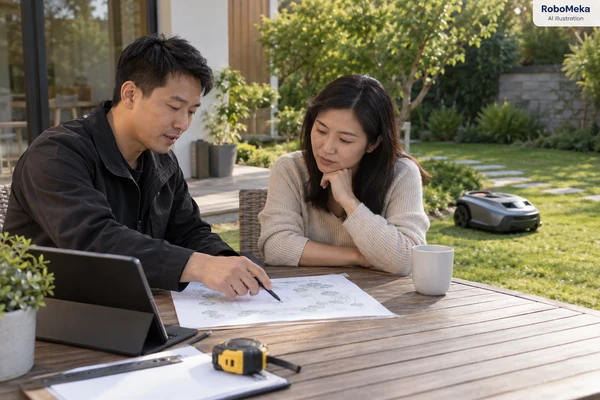
A fixed trampoline, a movable football goal, and a temporary play tent should not receive the same installation assumption. Classify equipment by how it changes the site and who controls those changes. The following table is a proposed planning worksheet, not a record of tested products.
| Equipment situation | Main installation question | Proposed management decision | Evidence to obtain |
|---|---|---|---|
| Trampoline kept in one position | Does the full structure need exclusion? | Establish an approved protected footprint | Ground-level survey and installer review |
| Trampoline moved for lawn maintenance | How will the new position affect mowing? | Pause affected operation until boundaries are reviewed | Named person and change procedure |
| Movable goal or play tent | Can its position be kept outside active mowing? | Include removal or exclusion in the pre-mowing check | Practical storage and inspection arrangement |
| Low supports hidden by long grass | Is the obstacle still adequately managed? | Keep the affected area excluded and maintained separately | Accepted finish and clearance responsibility |
| Play area beside a narrow connecting route | Will exclusion disconnect another lawn? | Review the route before approving the layout | Supported dimensions and dock-access observation |
The table helps the customer see the work remaining after purchase. If the household cannot consistently clear movable items or preserve approved equipment positions, that limitation belongs in the recommendation. A different lawn-care arrangement may be needed for that section.
Choose an approved exclusion method
The suitable method depends on the proposed mower and installation. Ask how its physical boundary, virtual boundary, or other approved exclusion mechanism is configured around this particular structure. Obtain the relevant documentation and record the complete protected footprint, including the space required by the instructions.
Check the remaining lawn geometry after applying that exclusion. A wide-open garden can acquire a narrow bottleneck between the trampoline and a hedge. The mower still needs a supported route to its work areas and charging location. Increasing the excluded area may solve a trapping concern while creating an access concern elsewhere.
Use the narrow passages and separated lawns guide to examine those consequences. Do not remove required margins or rely on repeated contact with the structure to squeeze through an unsuitable gap. The installer should decide whether another route or separate maintenance arrangement is appropriate.
Avoid structural modifications suggested solely to accommodate the mower. Changes to anchors, feet, frames, or protective arrangements must remain consistent with the play-equipment manufacturer's requirements and any relevant professional assessment. A mower installation should not quietly compromise a different product's intended setup.
For an application and configuration review, send your play-area and lawn requirements. Include photographs of low supports, the equipment's normal positions, lawn access routes, and intended mowing windows so the proposed scope can reflect the actual garden.
Make the daily routine understandable
The operating routine should fit the people who use the garden. Specify who checks for toys, sports equipment, ropes, hoses, and other loose objects before mowing. Give that person a clear way to keep the mower stopped when the area is not ready. An automatic start time should not defeat a known restriction.
Define how the household confirms that the mower is stopped and secured before outdoor play. Follow the model's controls and instructions, including any relevant access or restart restrictions. Do not treat a quiet mower or an apparently idle dock as proof that it cannot begin a scheduled operation.
Keep the routine short enough to use and specific enough to avoid ambiguity. “Check the lawn” is weaker than identifying the movable equipment and approved storage location. The customer's handover should show the excluded area and explain why the grass there is maintained separately.
Ask the buyer to consider visitors and contractors as well as regular household members. A person moving garden furniture may not know that the mower map assumes a fixed layout. The property manager needs a practical communication method for changes; the sales agreement should not assume that everyone automatically understands the installation.
Plan access for manual maintenance and retrieval
Excluded grass still grows and needs a suitable maintenance method. Agree how the groundskeeper can reach it without changing anchors or entering beneath equipment while it is in use. The lawn-care method should follow the instructions for the tools and the play structure involved.
When manual work is planned, stop and isolate the robotic mower as its instructions require and keep it out of the shared working area. Do not create an overlap in which someone trims around supports while the robot continues nearby. Scheduling is part of the practical service design, not a footnote.
Also explain the approved response if the machine stops or becomes trapped. The customer should use the prescribed stop and isolation procedure before approaching or retrieving it. Repeated trapping at the same location should trigger an installation review rather than a habit of restarting the machine unchanged.
Connect that support arrangement to the robotic mower dealer service plan. A clear reporting process should capture the location, current layout, and observed behavior so a technician can distinguish a moved obstacle from a configuration or product issue.
Design a safe acceptance observation
A proposed acceptance observation begins with an empty, inspected garden and the approved exclusion already configured. Use only a manufacturer-approved commissioning process. The observer remains in a safe position outside the operating area and does not introduce people, animals, or loose objects as detection targets.
Record whether the mower serves the intended lawn without entering the excluded footprint, whether the remaining route works, and whether it returns to the dock as specified. Do not attempt to prove collision resistance by steering it at trampoline legs or allowing it to become stuck under the frame.
Once the mower is stopped and isolated, inspect the remaining lawn and boundaries. Identify grass that requires separate cutting and agree whether the result matches the quotation. A clean outer lawn does not mean the customer has accepted unmentioned work around every support and corner.
Keep the conclusion narrow. “Approved exclusion and route observed under the recorded conditions” is a meaningful statement. “Safe around children” would imply a different and much broader claim. The latter should never be inferred from a commissioning session in an empty garden.
Work through a hypothetical family-garden change
Imagine a proposed installation where a fixed trampoline stands beside the only route to a rear lawn. The first plan excludes the complete structure and preserves a supported passage. This is a planning example, not a documented RoboMeka installation or a claim about a specific clearance dimension.
Later, the owner wants to move the trampoline closer to the fence to make room for a table. That apparently minor change may reduce the remaining passage or leave the new structure position outside the existing exclusion. The owner should pause affected operation and request the agreed review before resuming.
The review may approve a revised boundary, identify a different equipment position, or assign the rear lawn to separate maintenance. The appropriate result depends on the manufacturer's limits and site conditions. A flexible app does not eliminate the need to understand the changed layout.
Use this example during handover to explain the change rule. The customer does not need to memorize navigation technology, but they should understand that moving play equipment can change the mower installation. That knowledge is more useful than a broad promise that the robot will learn every new obstacle.
Request supplier evidence and preserve claim limits
For sample evaluation, request the exact model's obstacle-management documentation and supported exclusion controls. If factory testing is supplied, ask what the method demonstrates, which configuration was used, and what limitations remain. Do not present a generic obstacle video as proof of suitability beneath a trampoline.
For shipment inspection, confirm the mower revision, ordered installation accessories, regional supply components, and correct instructions. If the proposed layout depends on an optional feature or accessory, verify that it is included. A purchase-order description should identify it explicitly rather than relying on an informal conversation.
Private-label brands should review imagery as carefully as written claims. Show powered-off equipment during close inspection and empty areas during any approved operation. Avoid visual suggestions that children can play beside active cutting equipment, or that a household needs no pre-mowing checks because the model has a camera.
The final quotation should state the excluded footprint, remaining grass-care work, allowed operating arrangement, and responsibility for later layout changes. This connects customer requirements to a supportable product application without inventing experience, safety certification, or results that have not been documented.
Frequently asked questions
Can a robotic mower go under a trampoline?
Do not assume that it can from the apparent height of the trampoline bed. Low supports, anchors, hanging parts, and turning space can make the area unsuitable. Obtain a model-specific installation assessment and use an approved exclusion where required or uncertain. The grass beneath the equipment may need a separate maintenance method.
Will a camera prevent the mower from getting stuck on trampoline legs?
A camera feature does not establish a universal guarantee. Manufacturer guidance for some systems identifies difficulties with raised structures and supports hidden by grass. Confirm the proposed model's limits and use the recommended installation controls. Do not replace a defined exclusion plan with a belief that every low object will be recognized.
Can children use the trampoline while the mower runs elsewhere nearby?
Plan mowing and play as separate activities and follow the manufacturer's instructions for keeping people out of the operating area. A boundary line alone is not a substitute for the required operating precautions. The household should have a clear process for stopping and securing the mower before the garden is used for play.
What should happen when the trampoline is moved?
Pause affected mowing and review the installation before resuming. Check the new footprint, low supports, exclusion, remaining passages, and charging access. The original map may no longer match the garden. Assign one responsible person to approve the change through the dealer or supported process so other users do not restart an outdated arrangement.
Should I modify the trampoline feet to suit the mower?
Do not make improvised structural changes for mower clearance. Follow the play-equipment manufacturer's requirements for supports and anchoring and seek qualified advice when needed. The robotic installation should be designed around an approved equipment arrangement. Excluding the area and maintaining its grass separately may be the more suitable solution.
Conclusion
Trampolines and play equipment require a complete footprint assessment, a supported exclusion plan, and a practical separation between mowing and garden use. Define the remaining manual work and explain what happens when equipment moves. These decisions make the purchase easier to support because coverage and responsibility are clear from the beginning.
To review a model and installation proposal, contact RoboMeka with your play-area site brief. Share the lawn layout, equipment photographs, movement patterns, and dealer support requirements to discuss a configuration based on the garden's real conditions.